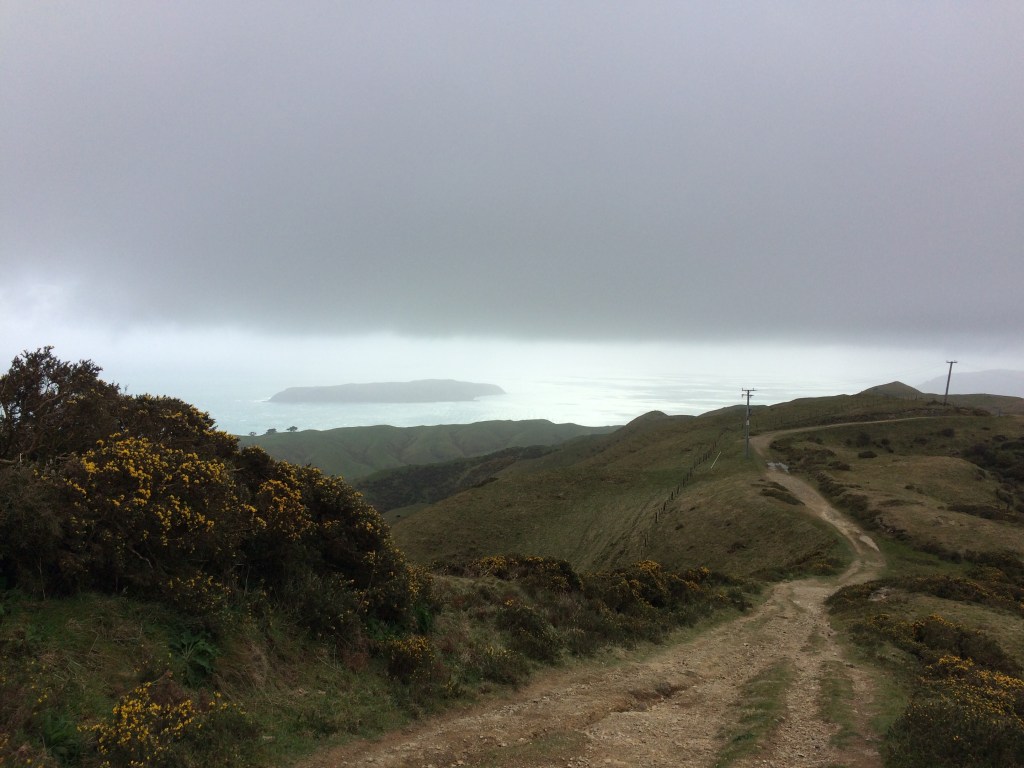
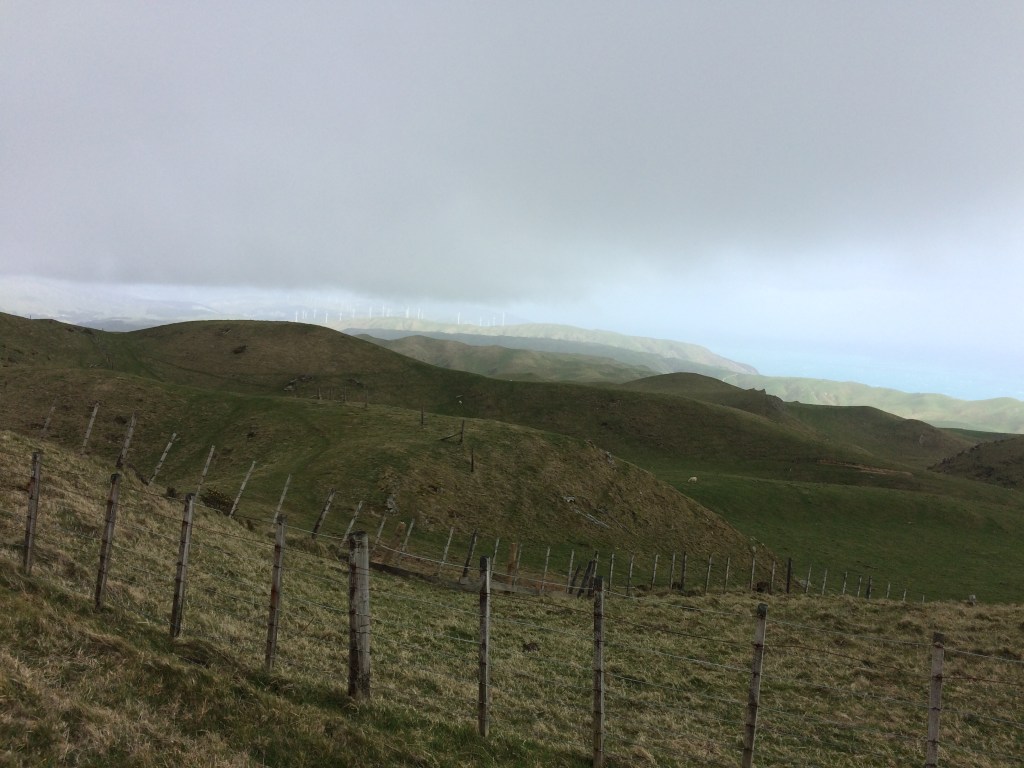
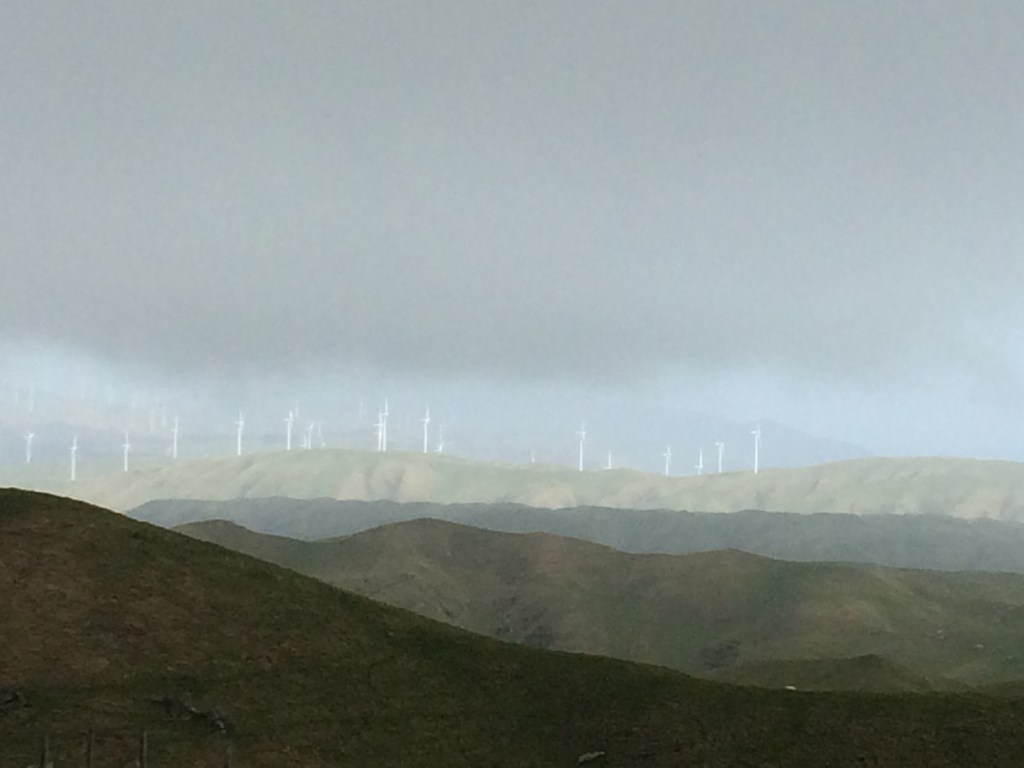
Along the lofty spine: Te Matawai Hut to Ōtaki Forks – Te Araroa Trail days 93-99, kms 1524-1583*

Day 93: Poads Road to bush campsite near road end – about 2km

*Note that the days on the trail are out of sequence between the title of this post and the titles of the previous and following posts. This is because I initially had to postpone this section due to bad weather (see posts on two previous attempts above this one). But the kilometres walked are in the correct order, to create the reading experience of a continuous north-to-south journey.

It was late December 2021, and summer was settling in. I had a week off and it looked like I’d finally be able to complete this tricky mountain section, which had eluded me twice before. It was one of the final North Island pieces remaining in my attempt to section-hike the Te Araroa Trail down the whole length of Aotearoa, north to south, as contiguously as weather and life allow. As before, I left my car at the Ōtaki Gorge road end got a lift with a transport provider, Waka, who I met via the Te Araroa trail notes.

He dropped me off at the range access point of Poads Road end, east of Levin, an hour or so’s drive north of Wellington.

He was a keen tramper too, and had asked me my plans as we drove. I’d explained how Te Araroa heads straight up to the tops from Poads Road, spends a day or so on the long ridge in the heart of the range before descending to Waitewaiwai Hut, then follows a river valley out to Ōtaki Gorge Road. He looked at me, surprised.

“In this weather? It’s going to be perfect for the tops. Do you know how rare that is in the Tararua? Instead of a day up there, you could have three or four. Why don’t you just stay on the main range the whole way?”

The main range: I’d heard of this legendary Tararua route. It describes simply walking along the tussocky tops of the longest, most central and straightest of the Tararua complex’s several long, ragged ridges. I told Waka I supposed the Te Araroa Trust prefers to send trampers out via the lower Waitewaewae route to lessen their exposure to sudden bad weather, which can be literally a killer if you get trapped on the tops. He shrugged, unconvinced. But the exchange did make me think.

There’s an info panel at the road end with a 3-D image of this whole southern part of the Tararua park; I ran my fingertip right along the long, sinewy, golden ridgeline, from the Dundas ridge in the north (near Eketāhuna) to the Southern Crossing in the south (near Upper Hutt). It looked like a sublime, secluded, wild highway, exclusively for those walking single file. It was definitely tempting.

So far though I’ve been totally faithful to the Te Araroa route that’s been carefully planned and built up over decades, hard-won by much negotiation with landowners and other stakeholders. It’s become a kind of pilgrimmage route, and not one I’d deviate from lightly. It feels like cheating. Like a short-cut.

Yet I wouldn’t be, really. If I took the alternate route along the main range, I’d actually be walking further than the official TA route – while still walking roughly parallel to it.

I decided to mull it over as I tramped.

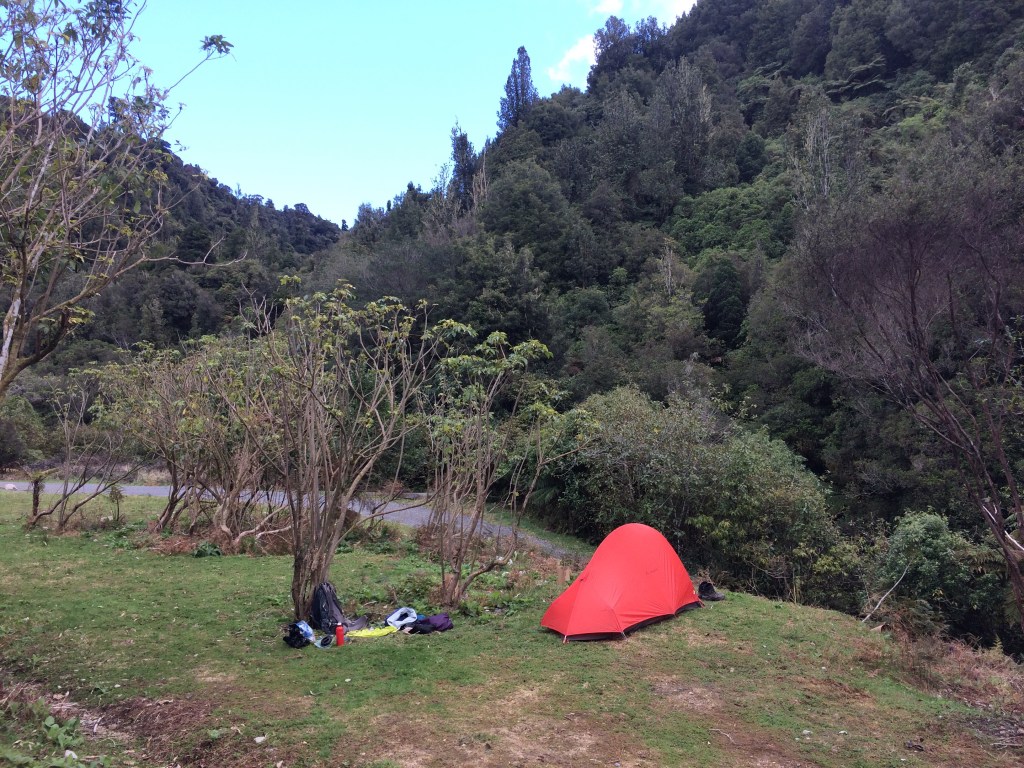
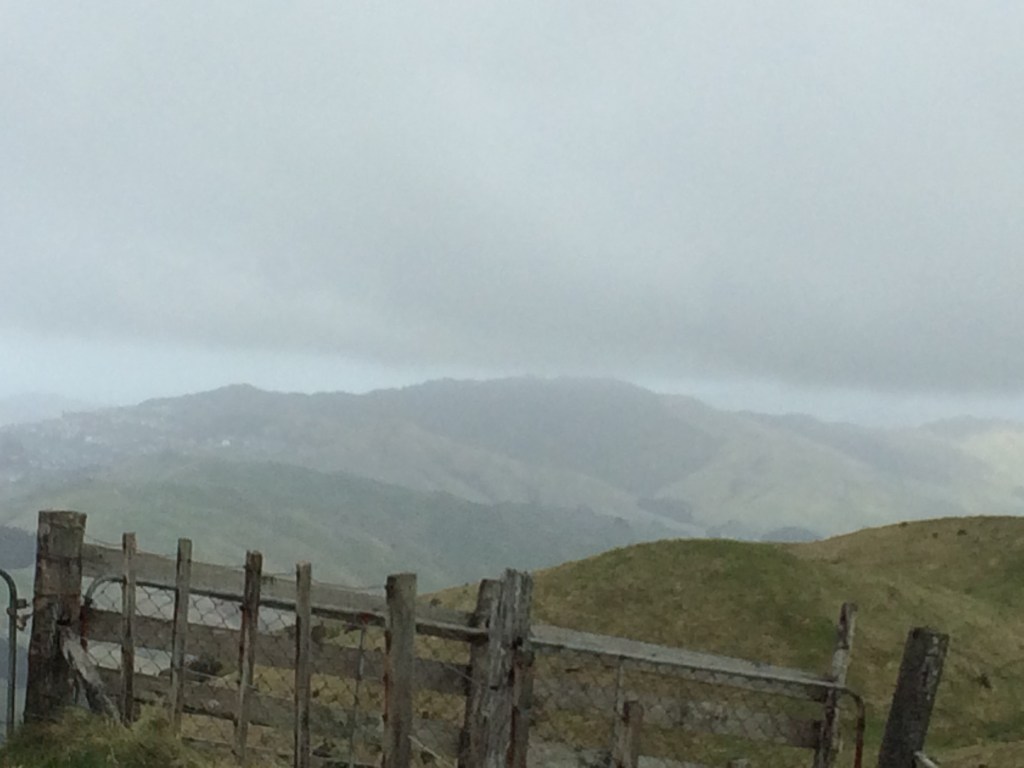
A quick skip across now-familiar paddocks and I was in the welcoming forest. Within a minute or so I passed the turn-off for the old Te Araroa route up to Waiopehu Hut. (Te Araroa no longer uses this route, preferring the shorter Gable End one, but I did it on an earlier attempt as Gable End was blocked by a slip.) The night wasn’t far off so I found a flat spot near a creek and settled in for the night, ready for an early start in the morning.
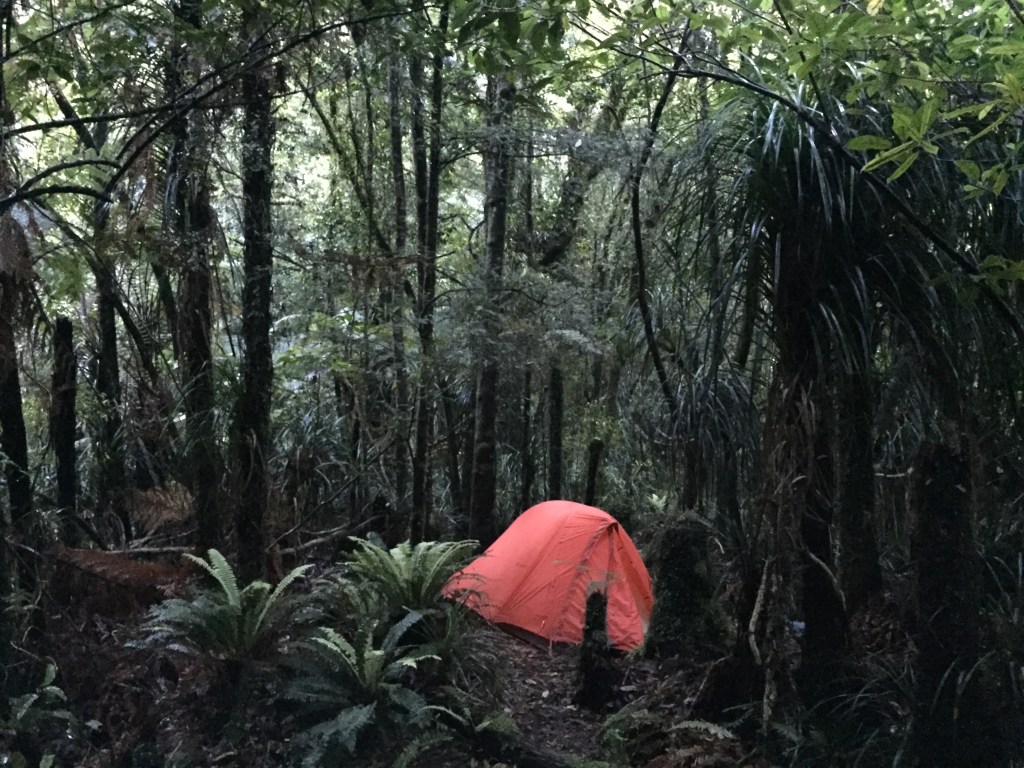
Day 94: Campsite near Poads Road end to Te Matawai Hut – about 10 km

I had a long day to get up to my next stop: Te Matawai hut, right up on the bushline, some 700 metres’ climb – through terrain I’d already crossed on my way down from that previous attempt. So I wasted no time breaking camp. It was still fairly early by the time I was swinging along the easy, mostly flat track, with views through sunlit bush down to the Ōhau River.
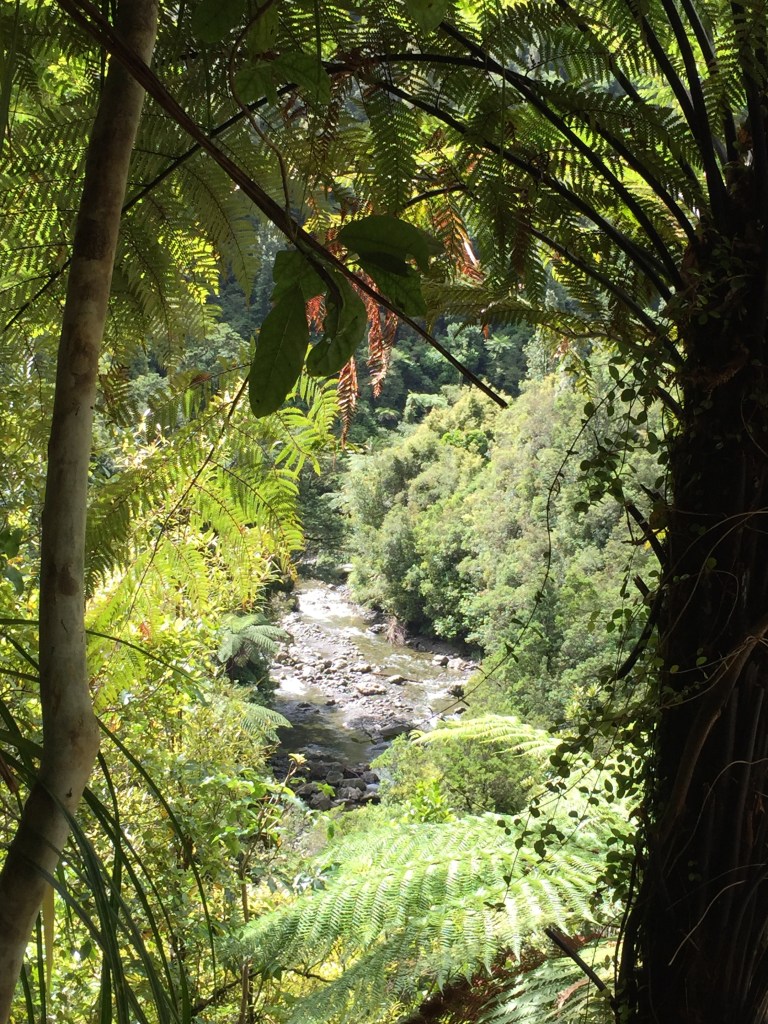
Soon I was at a the big slip that had impeded me on my last attempt at this section – I’d decided then against risking a scamble across the steep washout, from which a false step could easily send you tumbling into the Ōhau. It had added several hours to my trip after I had to double back and go up the alternative route, via Waipoehu. Being midsummer this time, the slip was dryer and had less loose, muddy material on it, but it still looked imposing.

This time, though, there were two supports to get across: first, a steep track has been cut up and around the slip. Secondly, someone has knotted a fairly sturdy line from an anchor point, letting you scramble across with relative safety. I took the latter option, since it looked quicker and easier. It was still a wee bit hairy, but not too bad.

In minutes I was past the turn-off to Six Discs Track (which also goes to Waiopehu) and over the swing bridge leading to the South Ōhau campsite. I scrambled down under the bridge into the Blackwater Creek to fill up my bottles. There’d be no more water until Te Matawai Hut, a good six or eight hours of climbing ahead. Here’s the bridge seen from the creek:

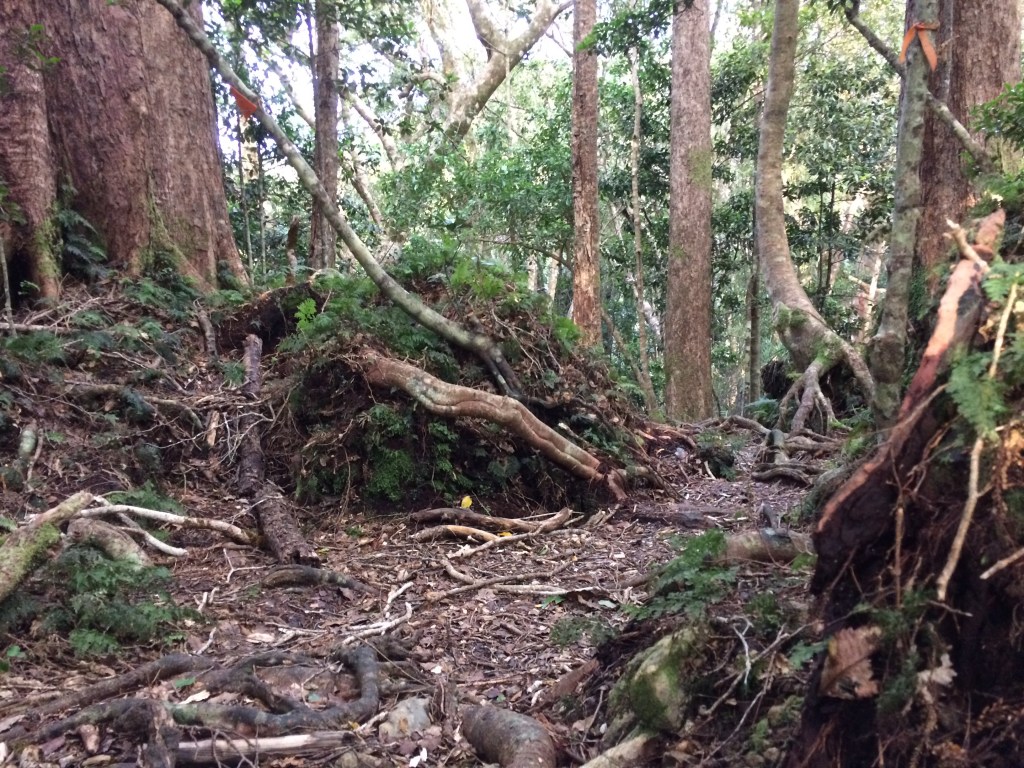
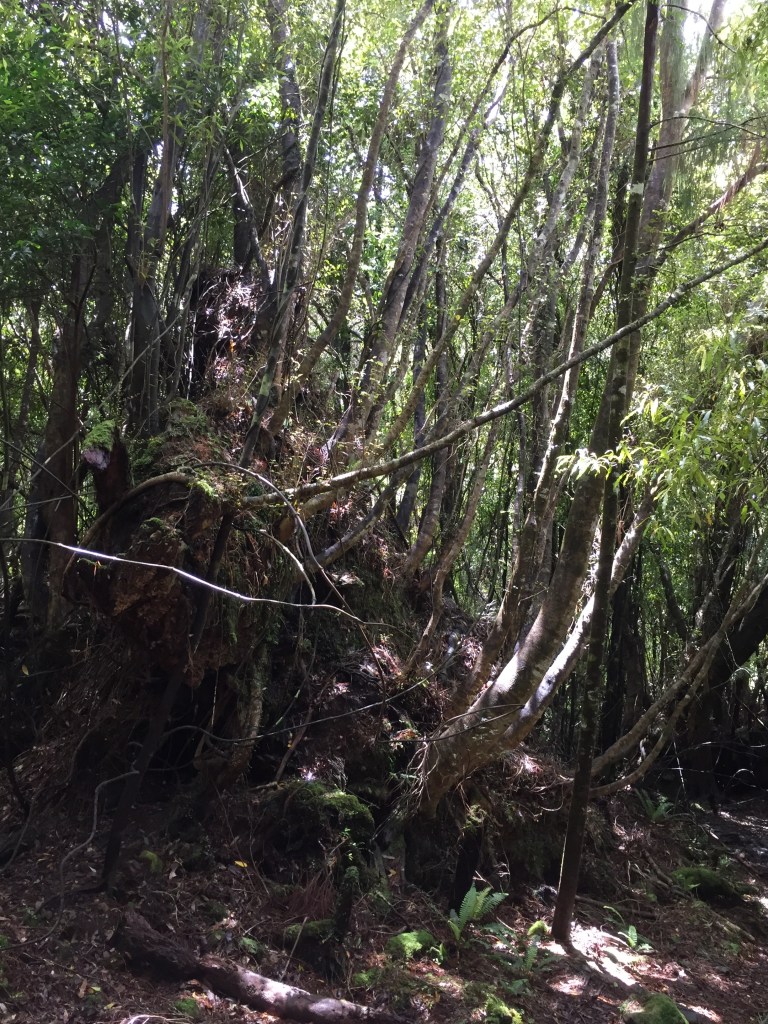
Then I was grinding up Gable End track, steep and tough. Last time I was here I was coming the other way, swinging down from the snowy tops in the near-dark. I was struck both times by the exuberance of this particular stretch of bush. How the trees crowd up out of the ground. How the body of a fallen behemoth seems to have barely hit the leaf litter before getting swamped by upstart saplings:
The epiphytes, too, are impressive – great vertical carpets of them:

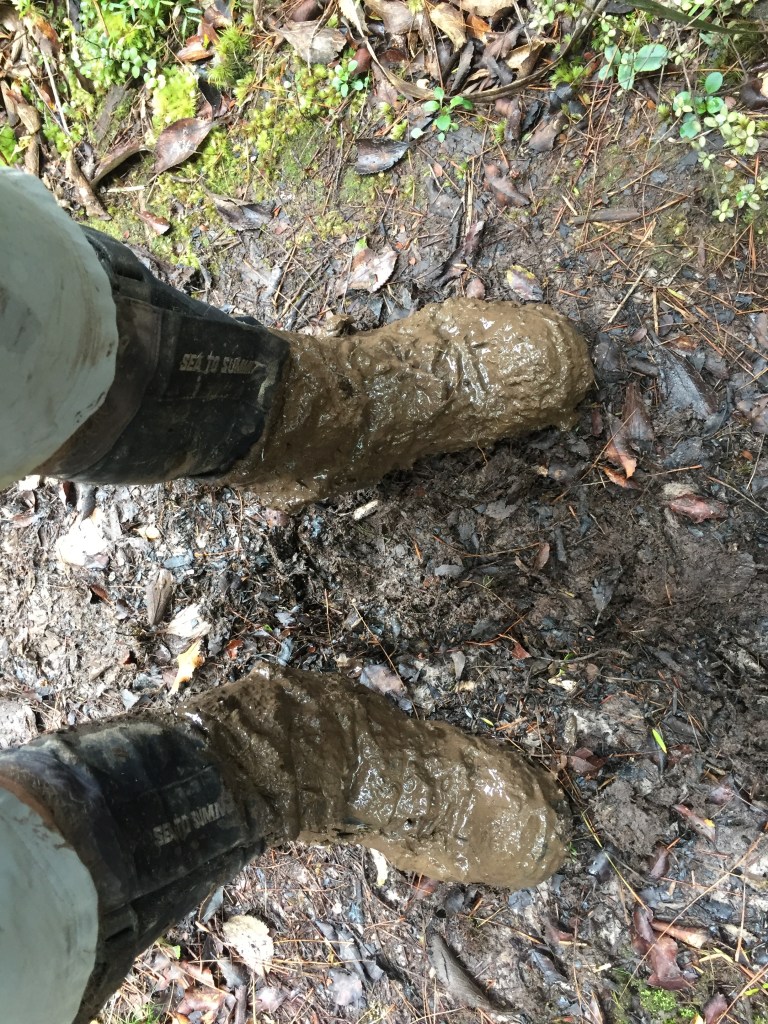
The mud is as relentless as the vegetation and the gradient:
But, on all sides, there are small and perfect consolations.

Mostly through low bush, with occasional open stretches, I made my way over Mayo Knob (666m), Gable End (903m) and Richards Knob (985m, named for a tramper killed nearby on an expedition.) Then it was the pain of losing quite a lot of that hard-won height heading down into Butcher Saddle (690m). Only to have to slog laboriously back up on the other side.

It was heavy going, lugging several litres of water and a week’s worth of food up the range. Especially over ground I’d already covered. But I kept grinding and right on nightfall made it to Te Matawai Hut (900m). The winter before I’d spent one of the coldest nights of my life in this cute little shelter, before bad weather forced me to pull the plug on that attempt.

I ate my noodles and perused the hut book to get an idea of what lay ahead. “Deep tussock plus deep mud = dead inside”, one tramper tersely noted.

I took a pensive sip of peppermint tea and turned to a tramping club’s annual mag. “Do you know why you tramp? You’ll say it’s for the views or the company. But in fact, neither can be counted on. I know why you really tramp. It’s because you like suffering.”

On that note I turned in early, ready for the painful delights ahead.

Day 95: Te Matawai Hut to Dracophyllum Hut, 8.5km

It was a damp, chilly morning, the last of a stretch of bad weather before a forecast long stint of golden days. As I climbed up the narrowing ridge from Te Matawai toward the main range, sunlight found its way more and more through low cloud.

It’s a steep pinch up to Pukematawai (1432m), and often razor-backed. I was glad I hadn’t tried to tackle it the year before, when it had been under thick snow.

There was an icy breeze at the top so I hunkered down for lunch on the lee side, with a view past wildflowers down into Park Valley.

A quick detour through clag to the top of Pukematawai yielded no clear view of nearby Arete, a well-known peak I’ve seen from afar but never up close. In fact, there was no clear view of anything. So I was soon heading south again along a very up-and-down ridgeline.
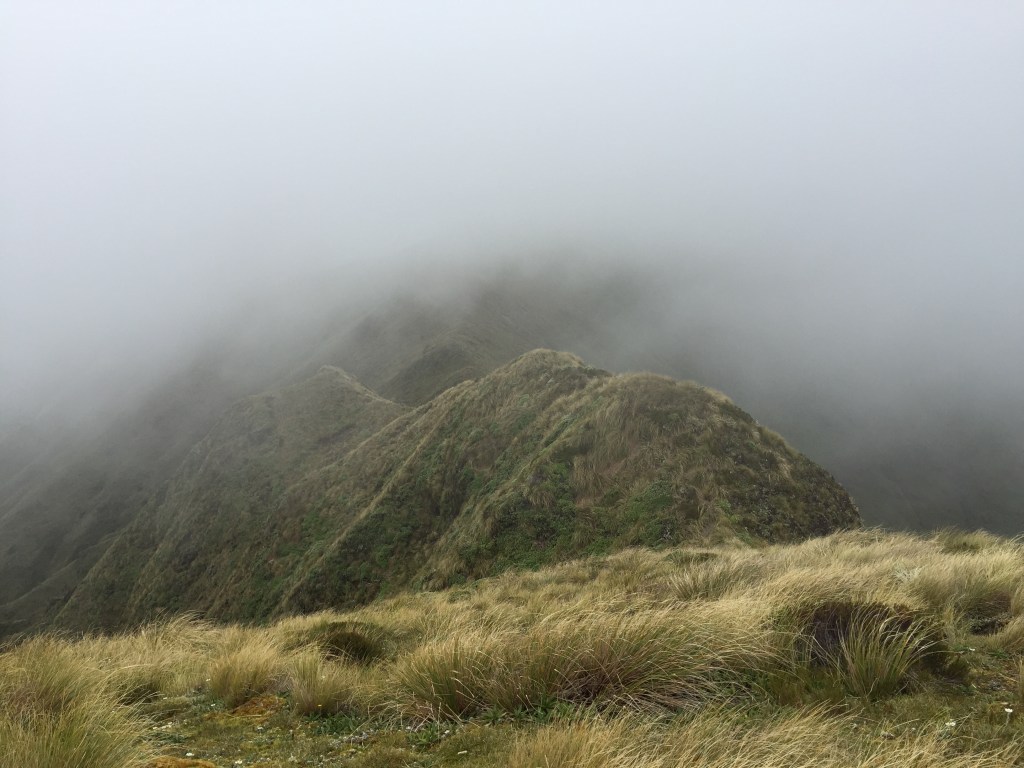
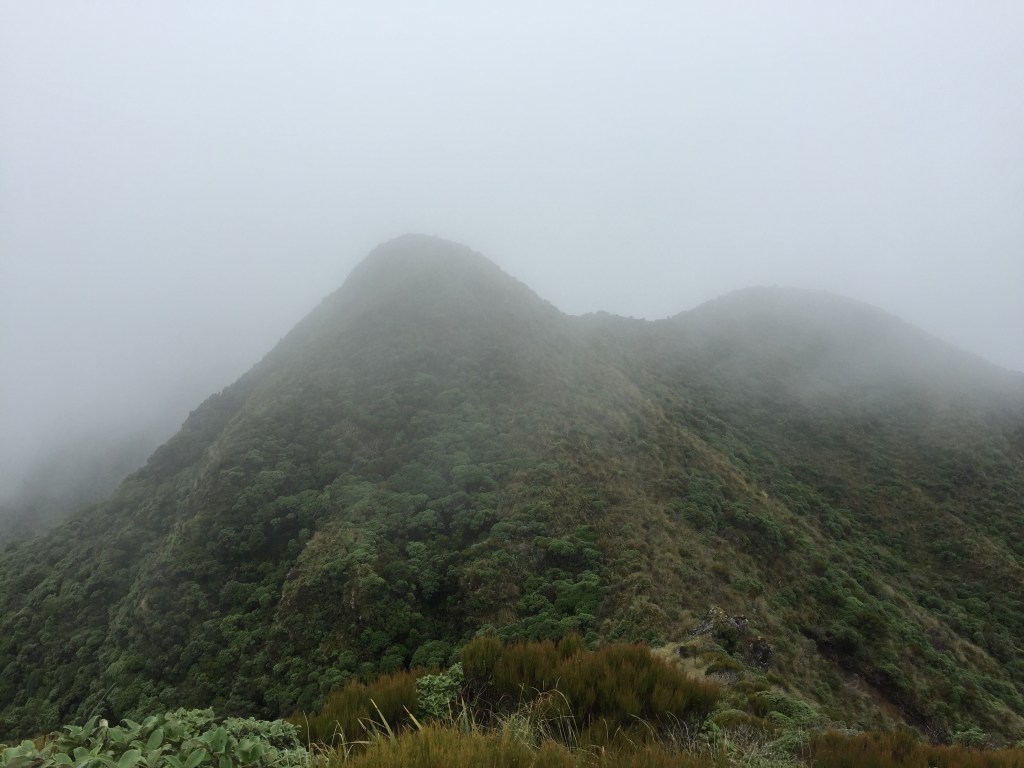
This sort of tramping is pretty brutal – you’re constantly going either steeply up or steeply down over slippery, uneven ground and it’s hard to find a ground-covering rhythm. Being a section-hiker, rather than doing the whole length of the country in one hit, means you have to start from scratch on your trail fitness each time. So I was soon feeling pretty battered. But Butcher Knob (1158m) loomed through the mist, making a good target:
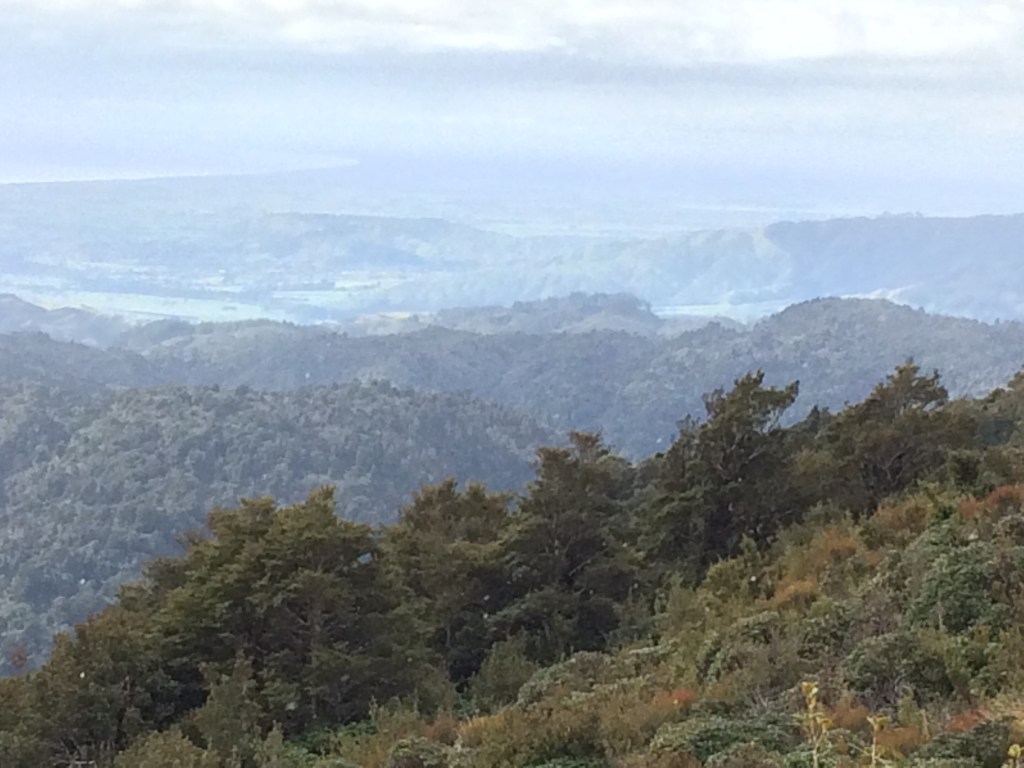
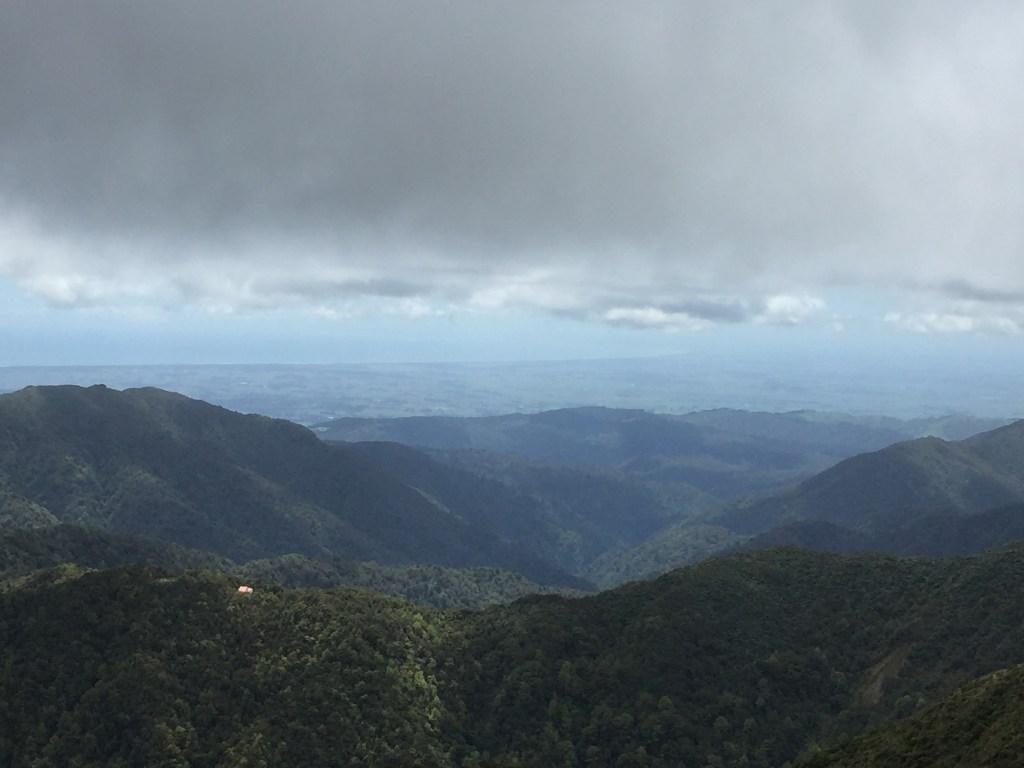
After that the track goes in and out of low alpine bush, with some great views as the cloud lifted, across the Horowhenua plains to the Tasman Sea in the east. That orange dot in the foreground is Te Matawai Hut:
The ups and downs just kept coming. It was a long afternoon:
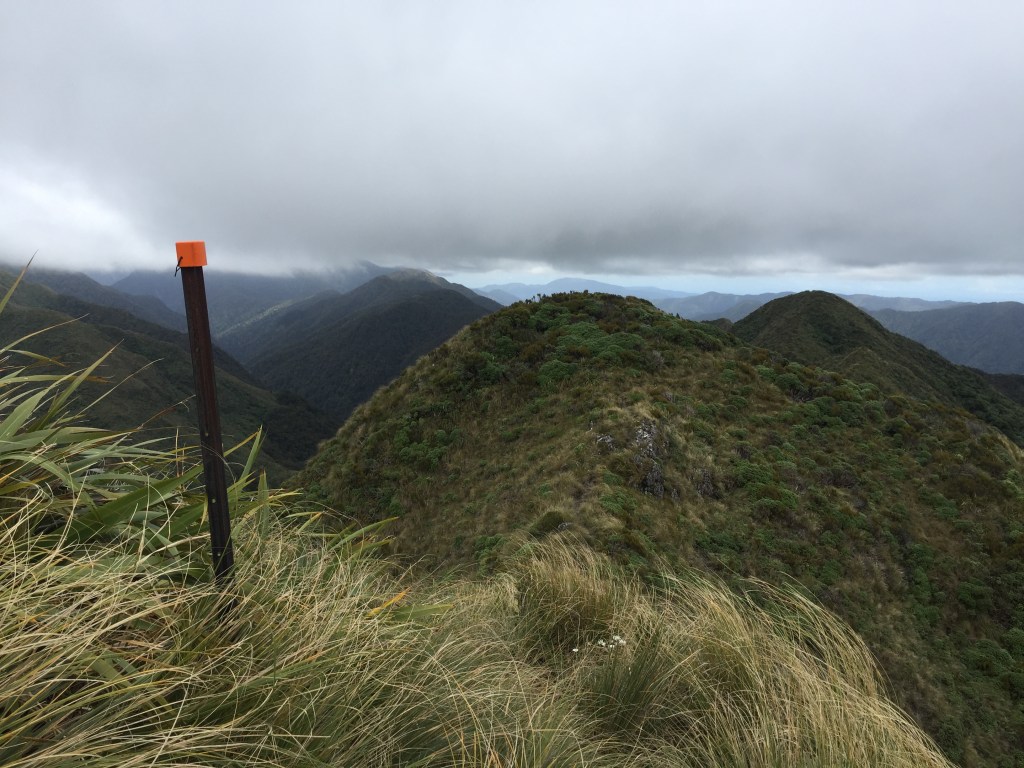
Some consolation was in the continuing, sweeping views down into Park Valley, a fabled landmark, route and playground I’ve often heard of but never, as far as I can remember, gazed upon:

Mounts Nicholls and Crawford, the next day’s destination, slowly emerged in the distance. I love this aspect of tramping – how by dint of constant, arduous effort, the land slowly unfurls in front of you.

Finally I reached Dracophyllum Hut, cosily nestled at about 1100m in goblin forest. I was delighted to find I had this sweet little two-bunker all to myself for New Year’s Eve.

Or so I thought, until a lean and steely looking figure came loping out of the twilight. But he was only stopping for water, it turned out – he was running a totally insane, long-distance route called the S-K Traverse. He told me about it while he rehydrated and I eyed his tiny pack, containing only an ultralight stove, wet-weather gear, thermals, a sleeping bag and some dehydrated food. S-K is about 80km, goes down the whole of the Tararua Main Range and stands for Schormann to Kaitoke. The starting point is named after a now-defunct track up from Putara Road near Eketāhuna in north Wairarapa, and it ends at Kaitoke, near Upper Hutt.

It’s become a legendary route that people complete in 24 hours: to me, a barely believable feat. But it’s a thing.

This guy had started running early that morning, would bunk down in Nicholls that night (he was aiming to be there by 10pm or so), then run out to Kaitoke on New Years Day. In two days, he was covering what would have taken me, at my usual stately pace, a solid week. He shrugged gently at my amazement, and with a flash of teeth and heels was gone into the evening.

Still shaking my head, I hung up my gear, wet from camping out the first night, in the last of the sun.

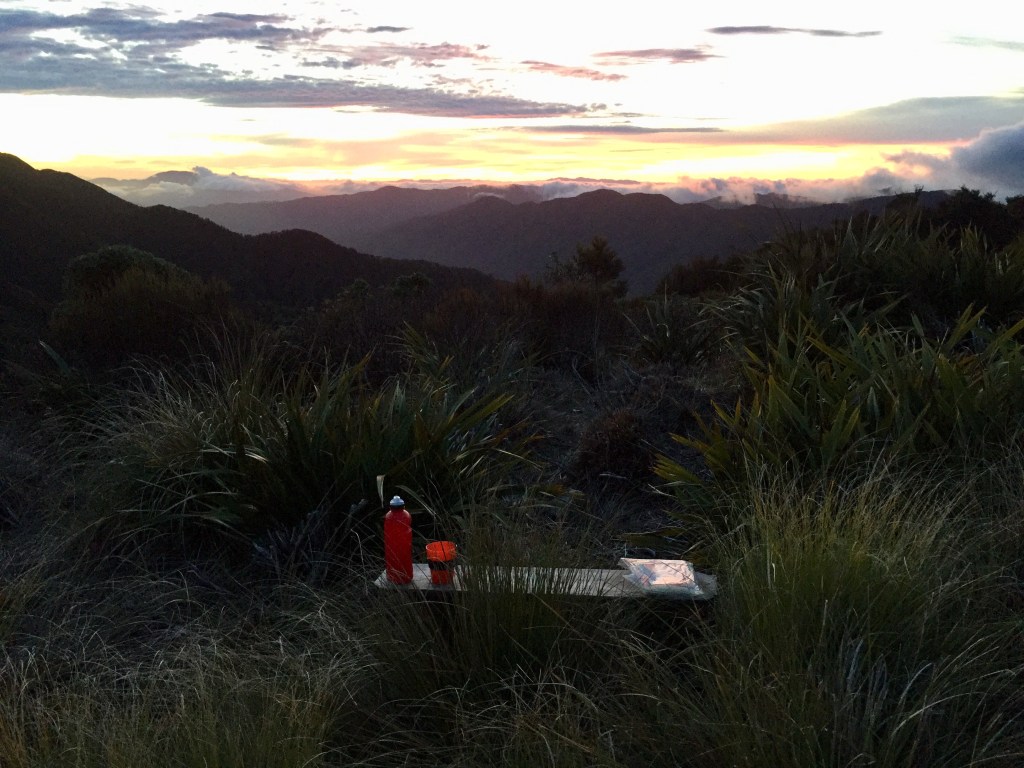
I got myself set up inside before heading up to the hilltop just above the hut to take in the last sunset of the year. It’s really a neat little whare.

From the top of Dracophyllum Knob (1117m) I took in the mountains all around, golden in the last rays of 2021. To the north were Pukematawai and Arete; to my east, Carkeek Ridge including the peaks of Thompson (1448m) and Lancaster (1504m).
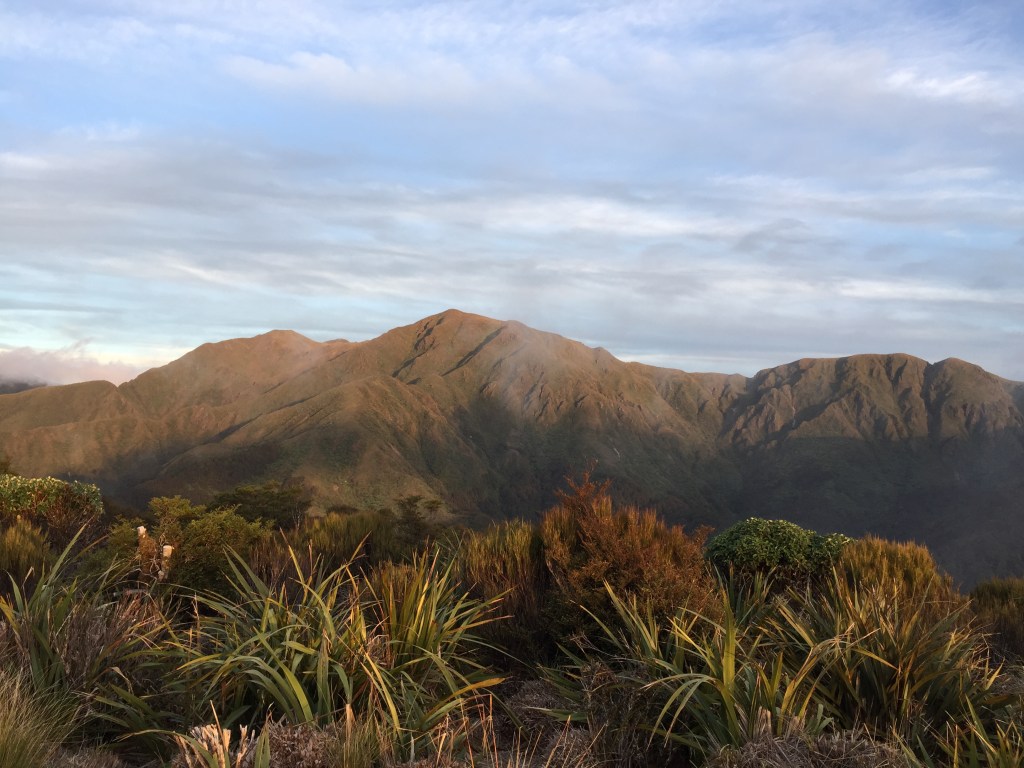
To the south-west, the sun went down in splendour above Cook Strait.
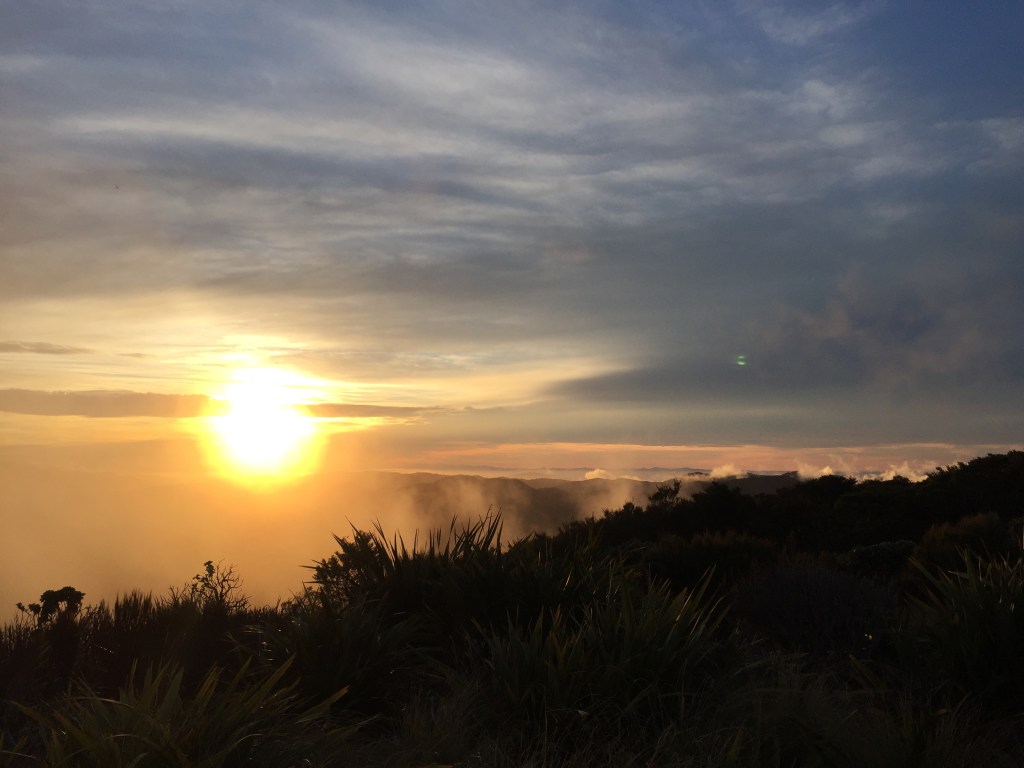
Thick cloud slowly filled the strait and the valleys and plains. Beyond on the horizon, back-lit in rosy hues, were the hills around the Marlborough Sounds. Next to me, the harakeke shone.
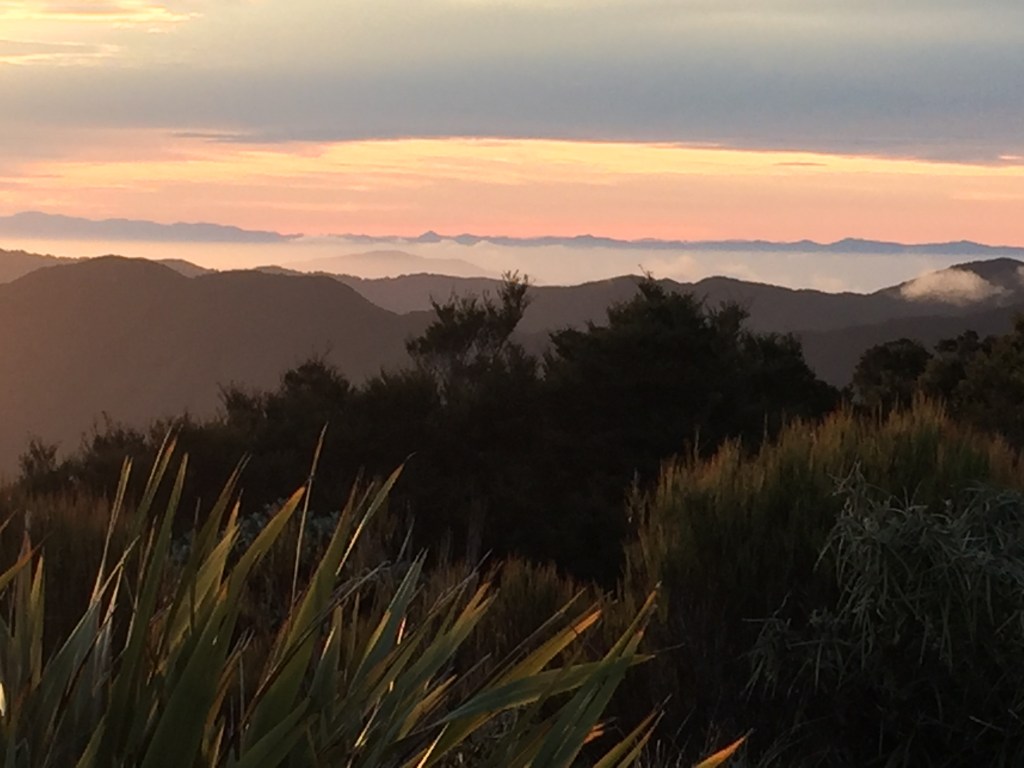
Here’s my route ahead the next day, along the main range toward Mt Crawford, which is capped in wispy cloud.

Watching rose turn gold on the last evening of what had been a heck of year, I thought about the people dear to me, and their links to places dear to me. That lead me to thinking about the original people of this special place, and their ongoing links to it as owners, guardians, users and travellers. All the sunsets and centuries they have seen go by from vantage points just like this. Who graciously allow trampers access. Who guard all this beauty and who have known it deepest and longest: Te Atiawa, Te Atiawa ki Whakarongotai, Ngāti Toa Rangatira, Muaūpoko, Ngāti Raukawa, Taranaki Whānui ki te Ūpoko o te Ika, Ngāti Rangitāne and Ngāti Kahungungu.
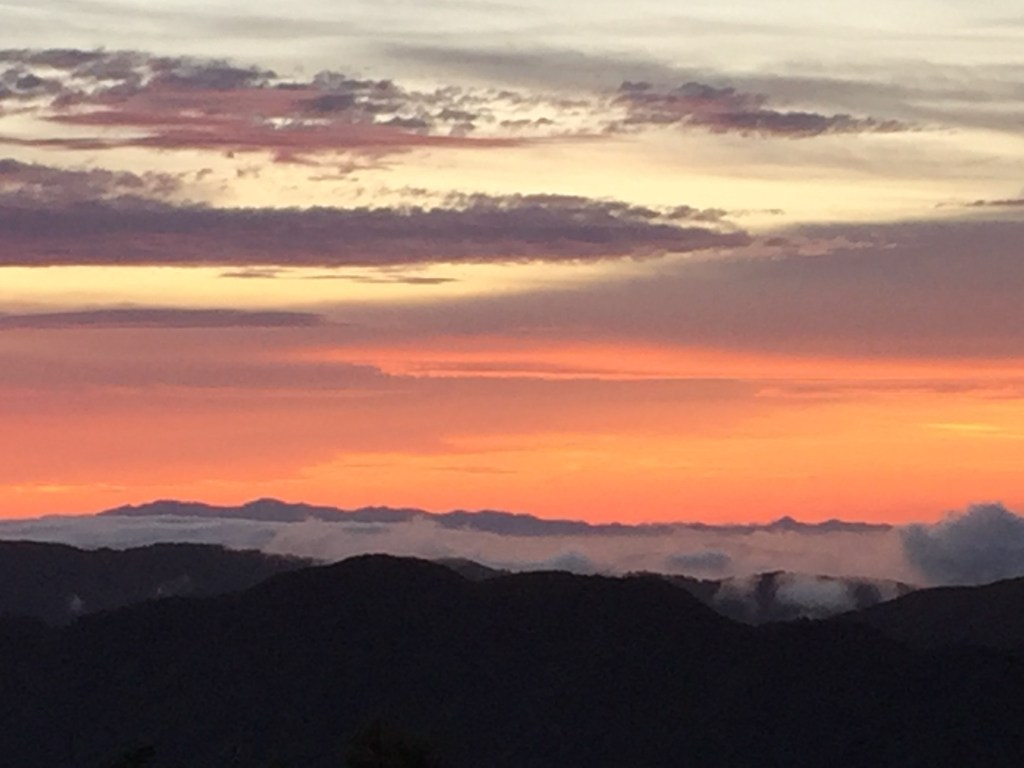
I’d lugged in a hipflask, and with a wee dram I toasted them, and the last of the sun.
Day 96: Dracophyllum Hut to Nicholls Hut, 5km

That kilometre count for the day doesn’t sound like much, but given that most of it was either steeply up or steeply down, it was a long, tough day.

The morning sky was clear and hard, promising heat. Behind me, Arete peered over Pukematawai’s shoulder, watching me go.

To the east, the Broken Axe pinnacles between Jumbo and the Three Kings, a hair-raising but exhilarating route I did by myself a few years ago:
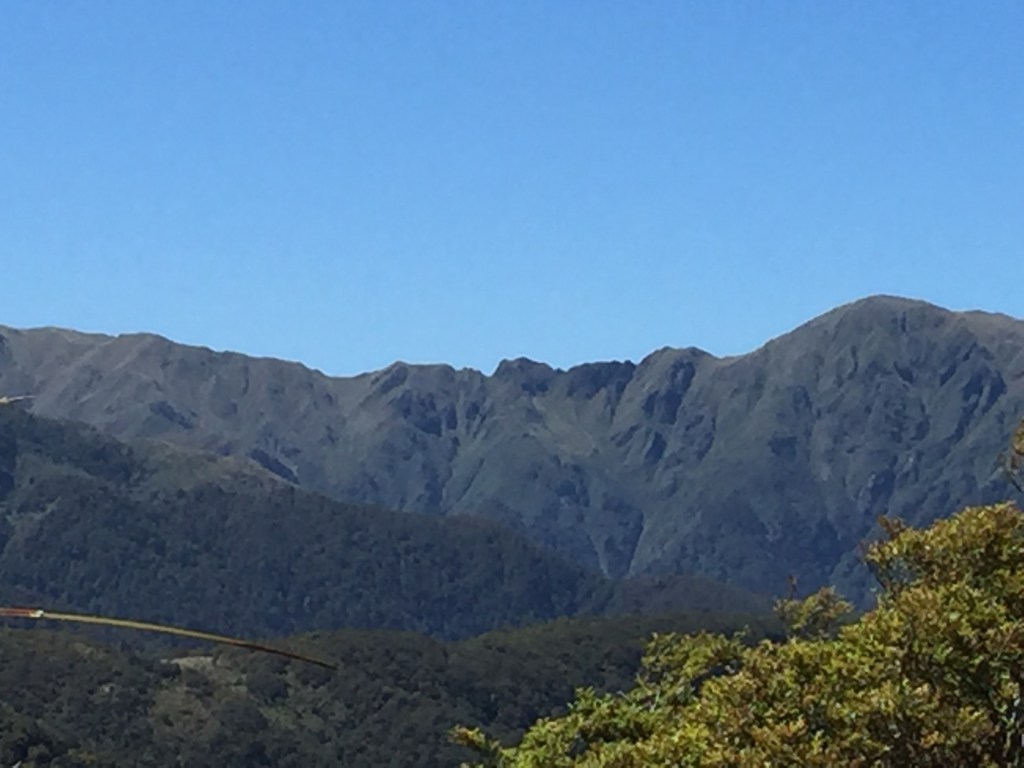
The route ahead – a long, forested ridge leading up to Nicholls and Crawford:
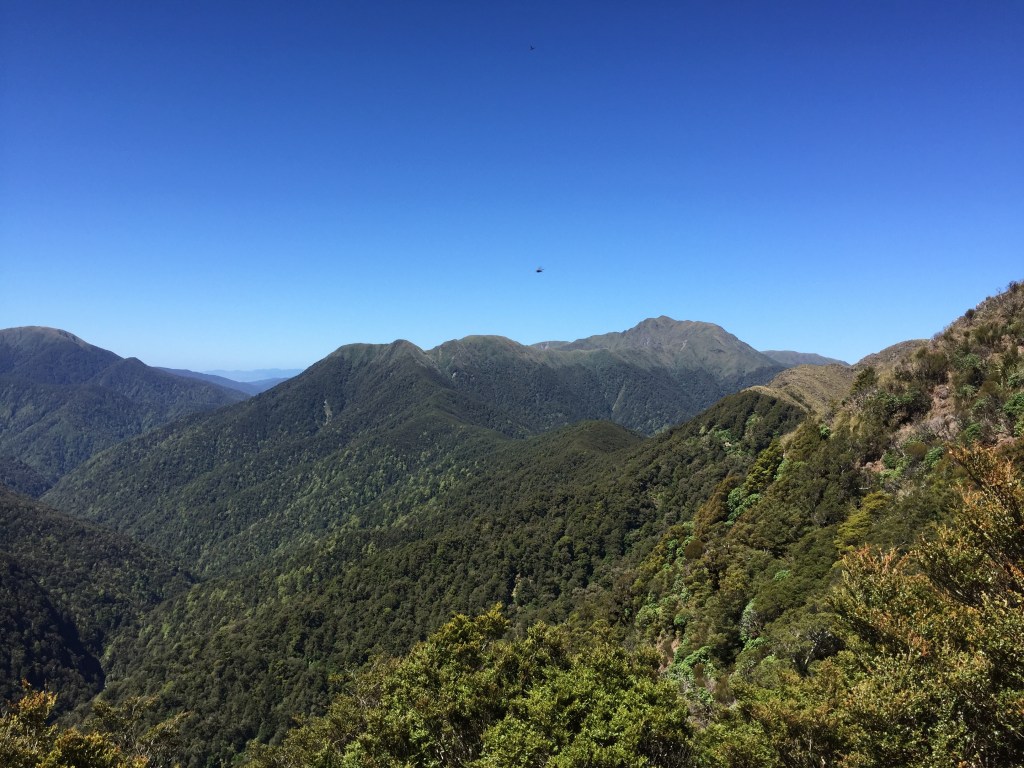
But first, I had to go over several obstinately steep and unrelenting “bumps”. This prosaic tramping term conceals a sweaty reality, involving scrambling down, and then back up, then down, ad infinitum. It’s a type of tramping that can feel very Sisyphean. Here’s the first of these awkward but spectacular bumps, Puketoro (1152m):
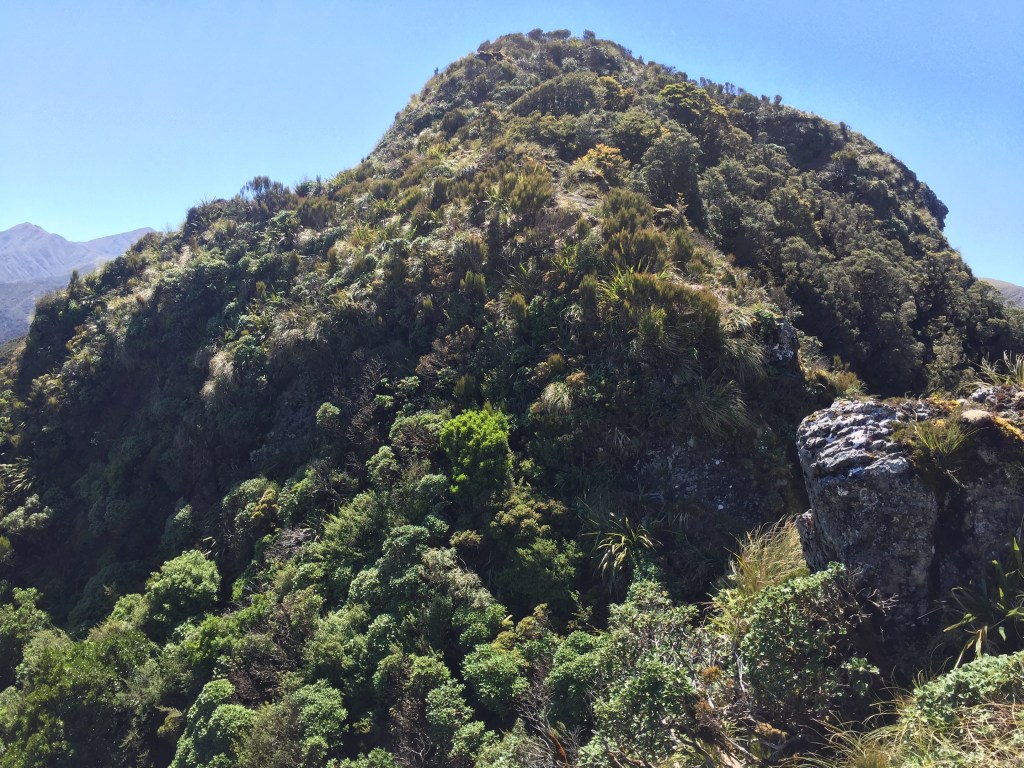
Then it was over the shoulder of another rough old bump, Kelleher (1182m), with a quick detour to its summit. Then down and along the long bushy ridge, and a long grunt up, up, up onto Nicholls. That’s where I took this next shot, looking back the way I’d come over the past two days, all the way to Pukematawai on the horizon (to the right). To the left, just beyond the bushy ridge, is Kelleher.
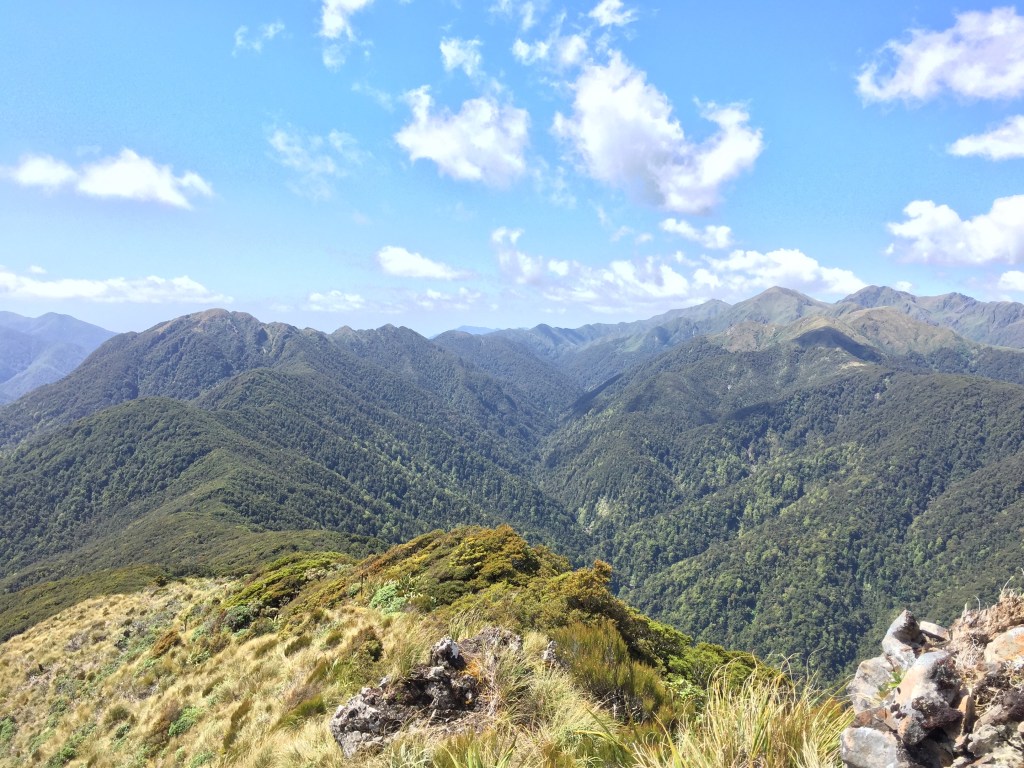
I’d got away early and felt like I’d already had been a long, hot, hard day, but it was still only mid-afternoon. Below was Nicholls Hut. I had time to carry on over Crawford, but I was out of water and there was none on this sun-baked ridge. Down to Nicholls and its rainwater tank I went.
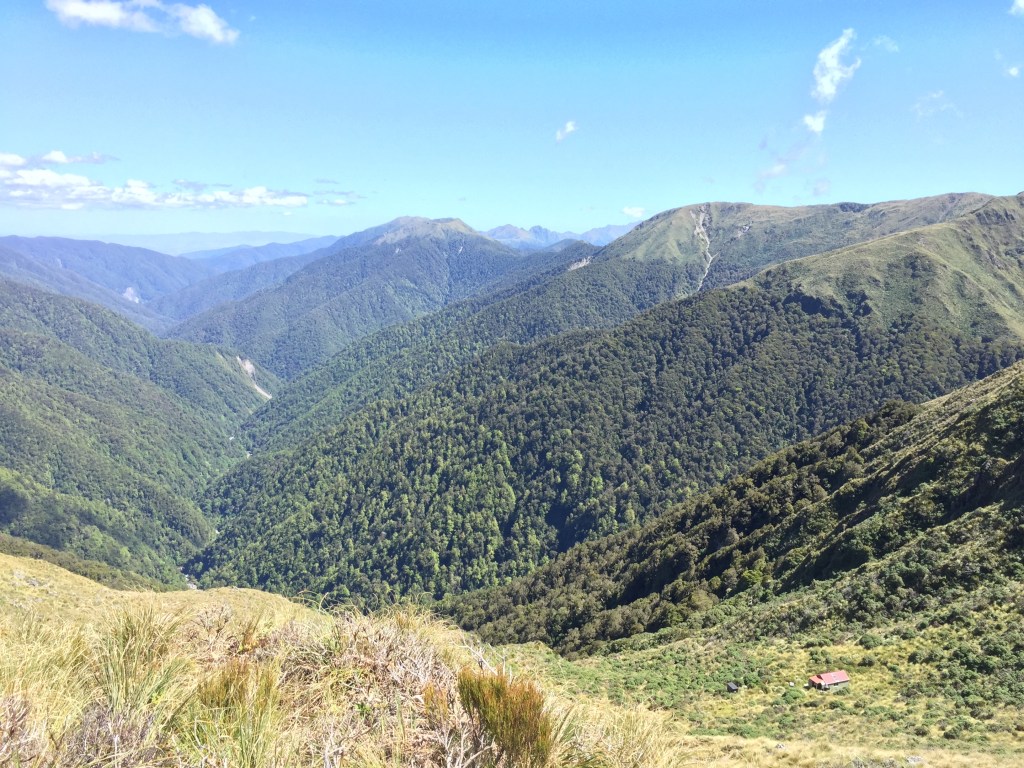
As you can see in the foreground of the pic above, Nicholls is securely tucked in a sheltered valley, with stunning views eastwards down the Waiohine River valley to the Wairarapa and the Aorangi Range. A gem of a hut.

It looks onto one particularly striking, craggy face – McGregor, I think:

Around the water tank, a stunning crowd of flies milled in their thousands. Inside, it was cooler, still and quiet. I lay on the bank and rehydrated, watching the sun slowly move down the mountains. To stay, or carry on? I was dried out, bone-weary and not very trail fit, and too tired to decide. I dozed off.

When I woke up I still had daylight left. What to do? It was a hard decision. I had to get out to the Ōtaki Gorge road-end in time to get to work, three days hence. I had a long window of perfect weather and a detour along the main range beckoned. But would I have the energy, not to mention the time? I lay there and drank water and considered.

Normally I don’t like deviating off the Te Araroa standard route, but this would be a noble exception.

The day had taken a toll. I decided to sleep on it. All evening through the hut window I could see the main range’s most famous highlight, the legendary Tararua Peaks, beckoning me. They’re the lighter coloured twin peaks on the right of the bigger, darker peak in the centre of the window – Aopkaparangi, I think.
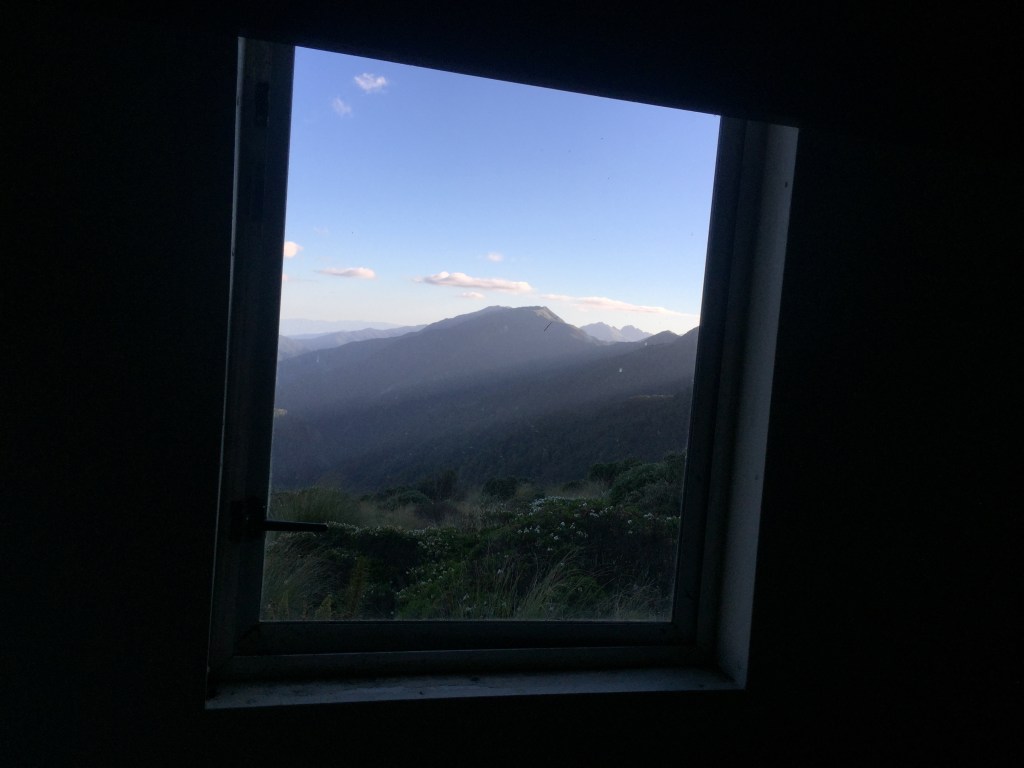
Beyond, below the setting sun, lies the Aorangi Range in southern Wairarapa.

All night as I slept, those near-vertical, legendary peaks swayed in and out of my dreams.

Day 97: Nicholls Hut to campsite on Aokaparangi, about 11 km

In the morning I still couldn’t decide. Alternate routes are a thing in the long-distance hiking community – not sticking slavishly to an established route if there’s another way that offers something special. But for me, sticking to a carefully crafted and curated trail has a certain charm. As if Te Araroa is a latter-day Camino de Santiago.

But then – even the Camino has alternates. Over the centuries different ways to reach the same objective evolve, each with their respective stories and traditions.

I’d resisted alternates for the whole journey so far, all the way from Cape Rēinga. But this main range opportunity seemed too good to pass up. You simply can’t do it in in poor weather – too dangerous – and I had a window of the most perfect weather imaginable.

However, I risked being late for work if I went the longer way. And I hate rushing in the back country. I’d decide on top of Crawford, I thought. I said goodbye to the thronging flies and to the otherwise peaceful shelter of Nicholls Hut:

Once over the shoulder of Nicholls it was an often-thrilling , steep and narrow causeway up toward the top of Crawford. It was another banger of a morning and the views were immense. Here’s Mt Ruapehu, with a white flash of snow or cloud or both, on the horizon. This is looking north, beyond Oriwa Ridge and over a slice of Tasman Sea:

And here’s the route up the side of Crawford, the summit in the centre:
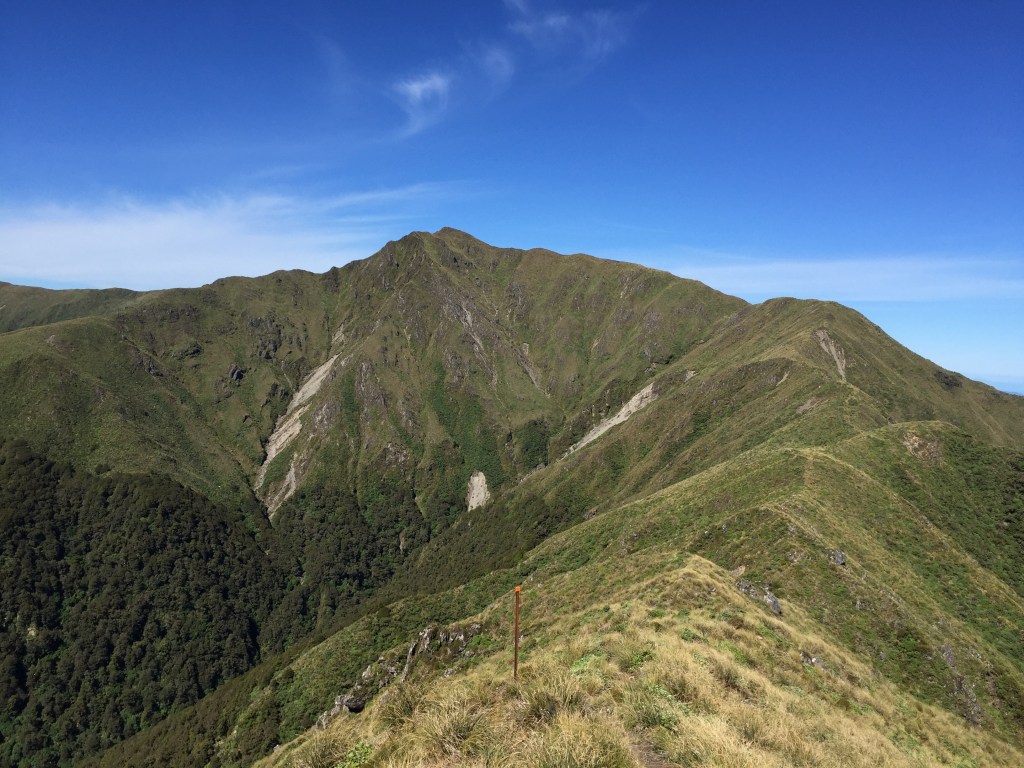
To my south-west, Kāpiti Island, with the Marlborough Sounds and Tasman Bay beyond:

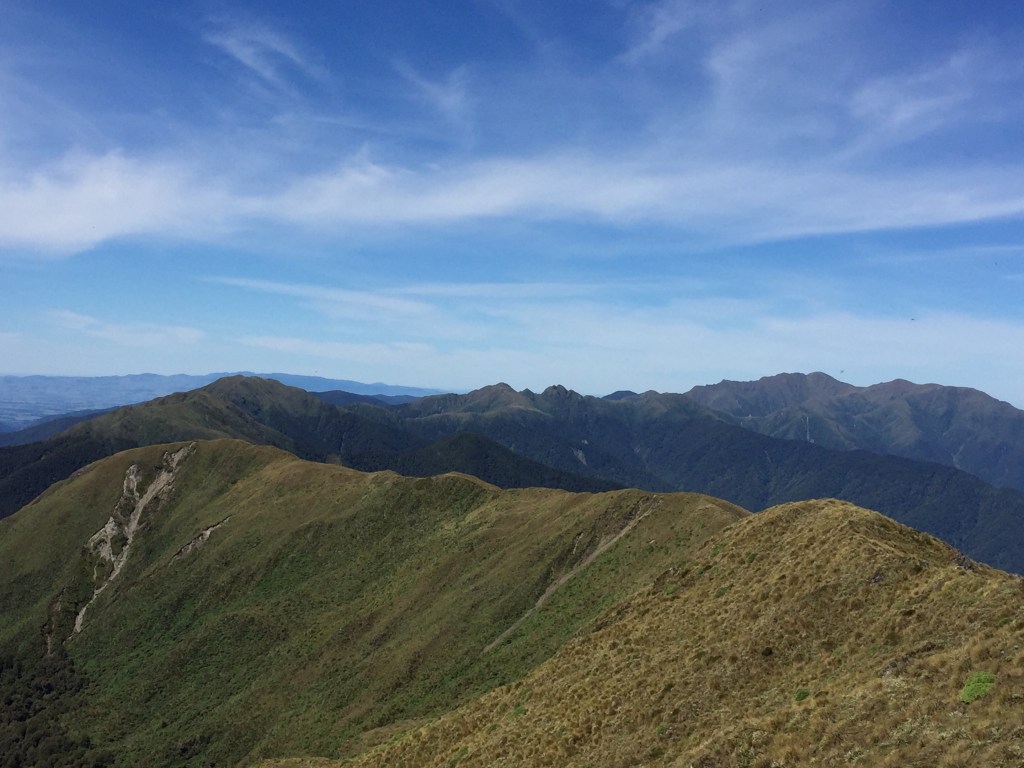
The next pic, below, is from near the summit of Crawford (1462m), looking south-east, along the main range. It shows the alternate route I was contemplating.

From here that route goes down past Junction Knob (1375m), past Anderson Memorial Hut, then along that exposed, high ridge over Kahiwiroa peak (1320m) and Aokaparangi peak (1354m) to Maungahuka Hut and peak, and on.

The standard Te Araroa route, meanwhile, heads off Crawford here via Junction Knob and Shoulder Knob, down to Waitewaewae Hut, then runs along a couple of valleys roughly parallel with the main range, out to Ōtaki Forks. Easier, quicker, but could I bear wasting such a spectacular opportunity for tops travel?

I stood at the signpost at the fork in the path on Junction Knob and thought it over one last time.

All those open, clean, tussocky tops beckoned.

It was too good a chance.

I took the path less travelled by.
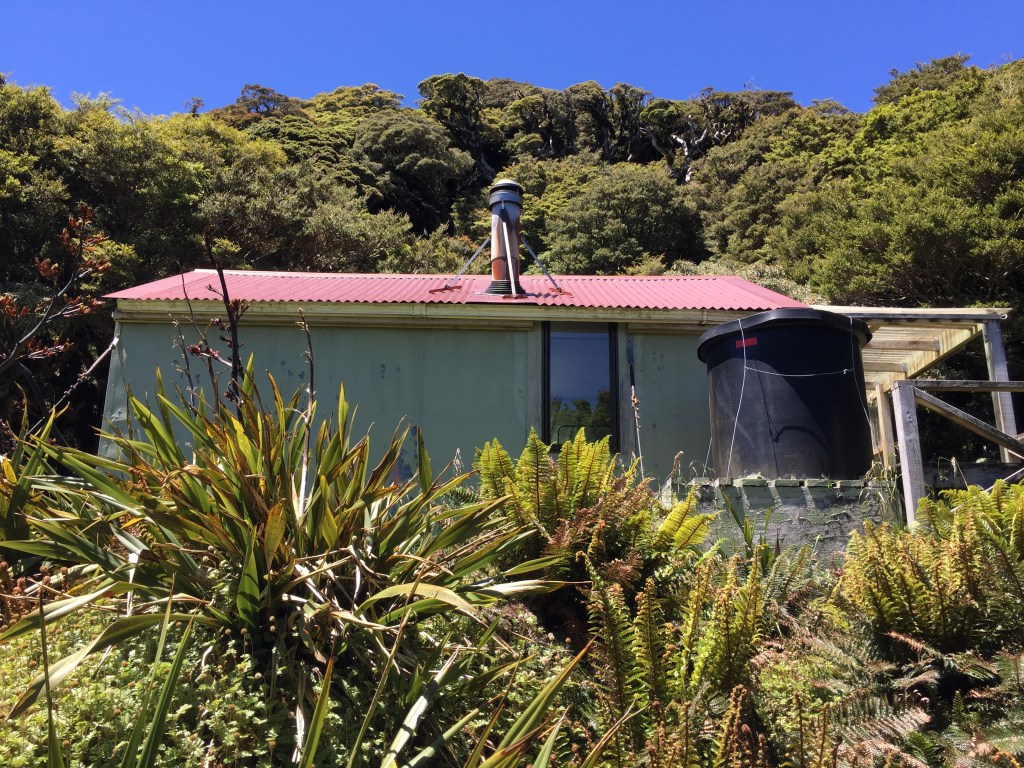
I made it to snug little Anderson Memorial Hut in time for a late lunch.
Then it was back into bush along a low ridge, before another slog, this time up onto the golden, tawny flanks of Kahiwiroa. The main range route was unspooling in all its grandeur now, like some kind of private suspended path between the sky and the earth. A long, high lane:

From a distance these rugged peaks with their savoury, mouth-filling names look soft-shouldered, easy. The ridge-line route appeals as a tussocky staircase or even escalator. But up close the reality of the likes of Kahiwiroa is gnarlier:

The long summer day was drawing in, and Aokaparangi was still a dauntingly long way off:

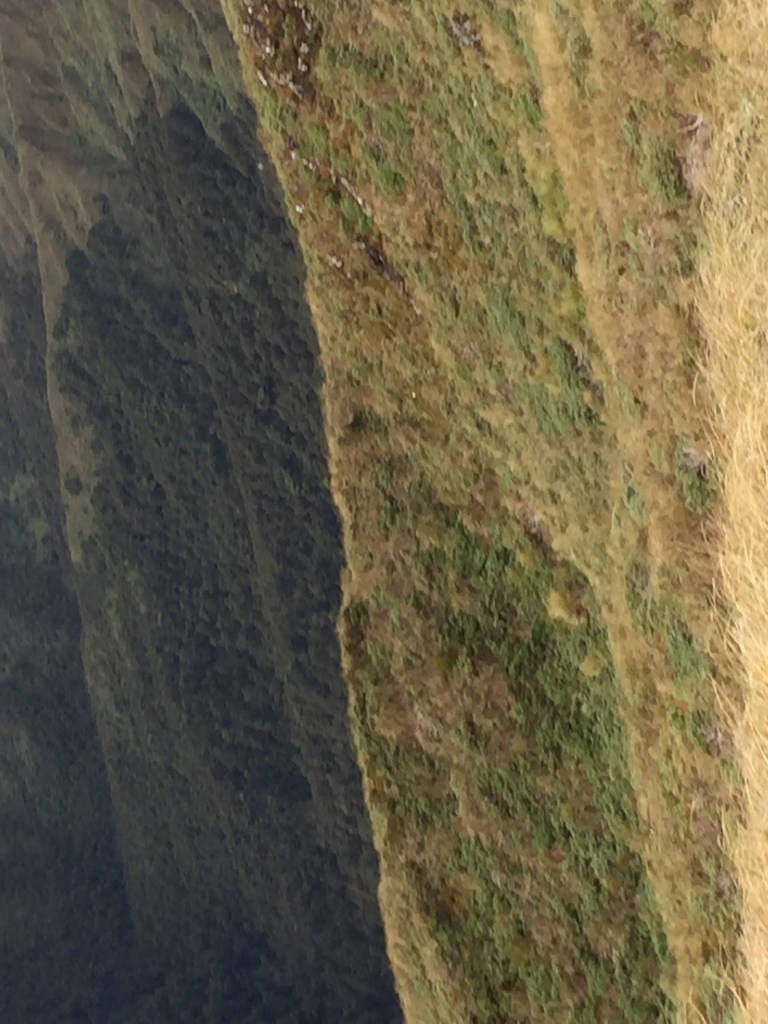
It was hairy at times. This next shot is taken looking straight down the side of a razor-back ridge:
Finally I was on the final, steep approach. There’s a hut below the summit of Aokaparangi and the long, warm twilight would get me there before dark.
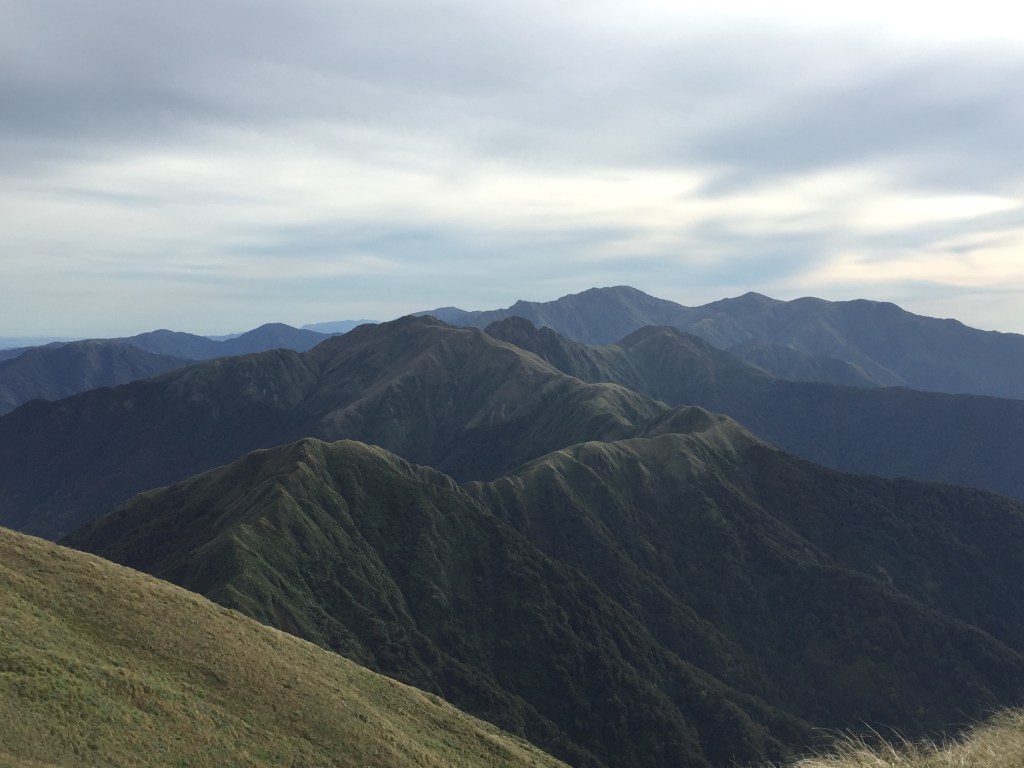
But that ridge just seemed to go on and on, refusing to submit to my stride.
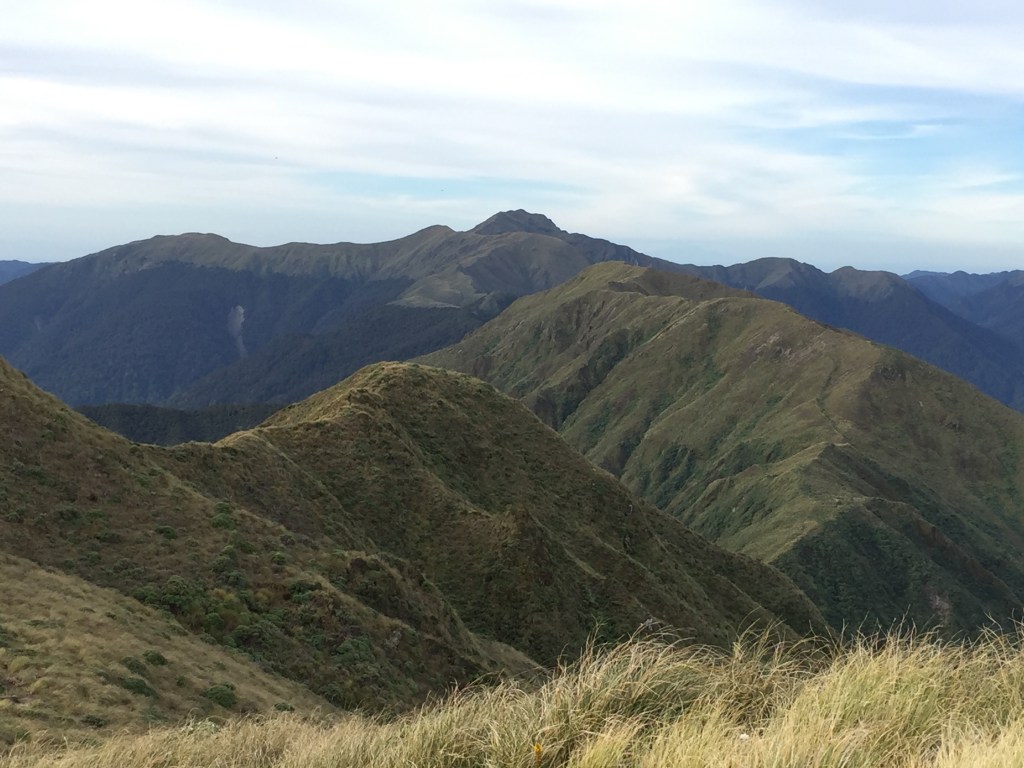
Finally I neared the junction where a spur goes down to the hut.
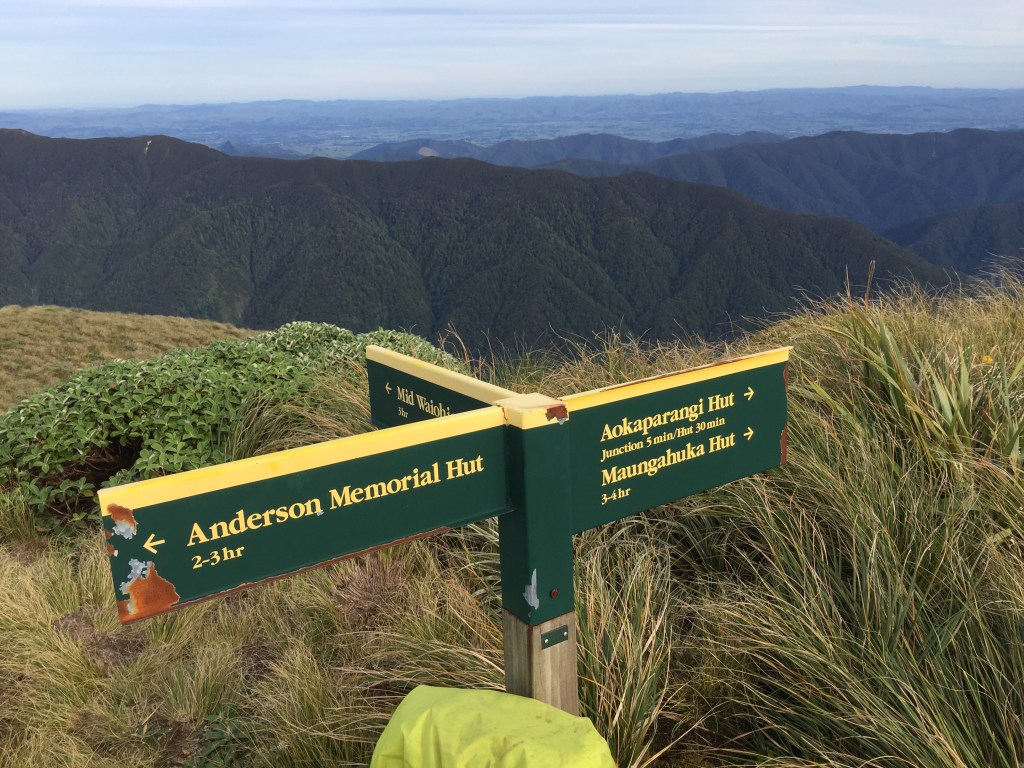
I was footsore and dehydrated but I’d made it. It’s a wonderful spot for a hut, right on the bushline in a remote, silent, magnificent place, a good two days’ walk from any road. As I drew near, though, I heard voices and my heart sank. It’s only a two-bunker and I could already tell they were both taken.
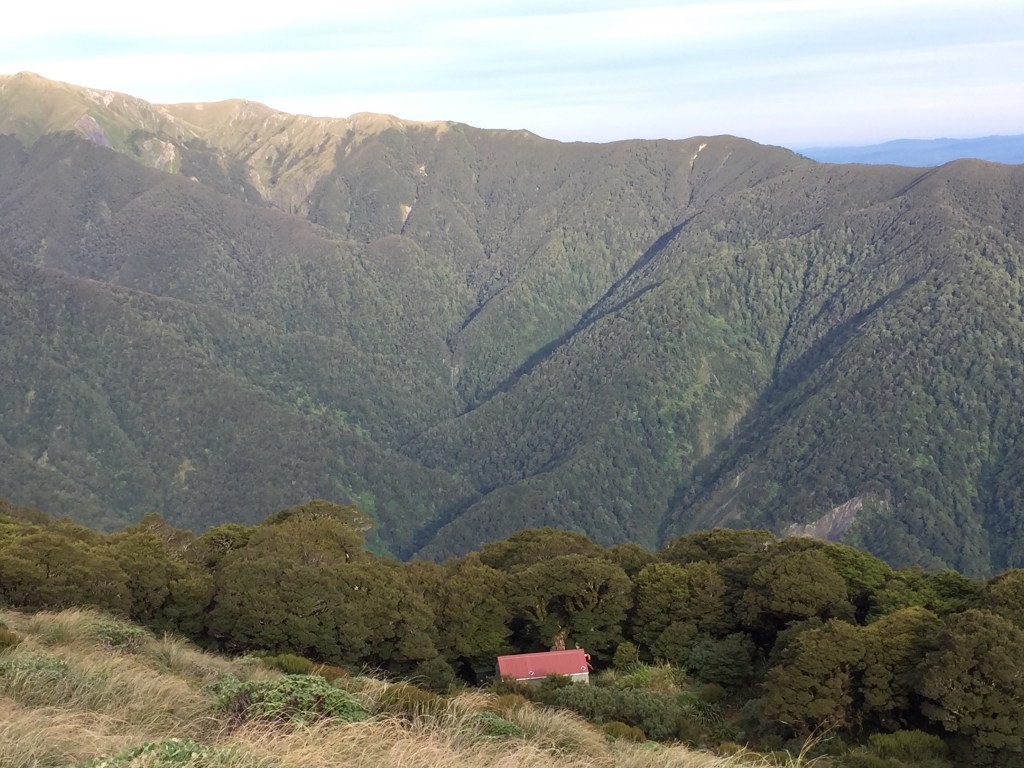
The couple with two kids in occupation were really nice though, chatting to me as I filled up with water from the hut’s tank and helping me find this nearby, pristine camping spot. Hard to complain, in the end:

I ate my noodles and drank my liquorice tea and watched this glorious carry-on:
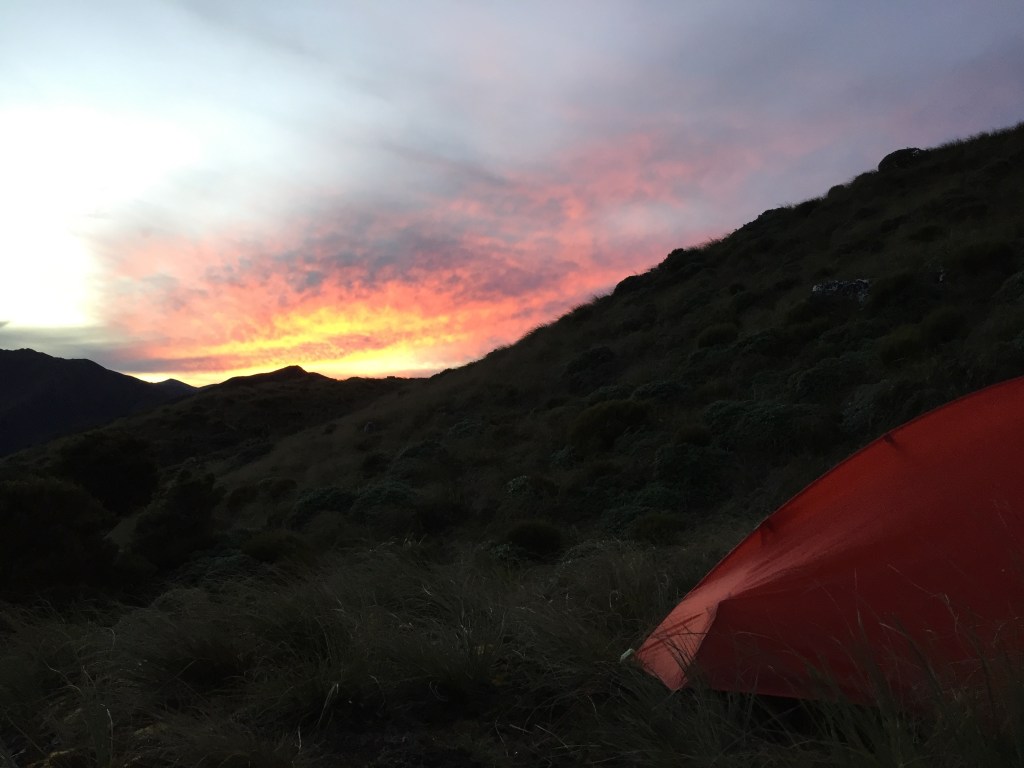
Day 98: Aokaparangi campsite to Kime Hut, about 11.5 km

Over breakfast, I watched the dawn light shine on the Pacific. It was enough to drown out all manner of aching bones.
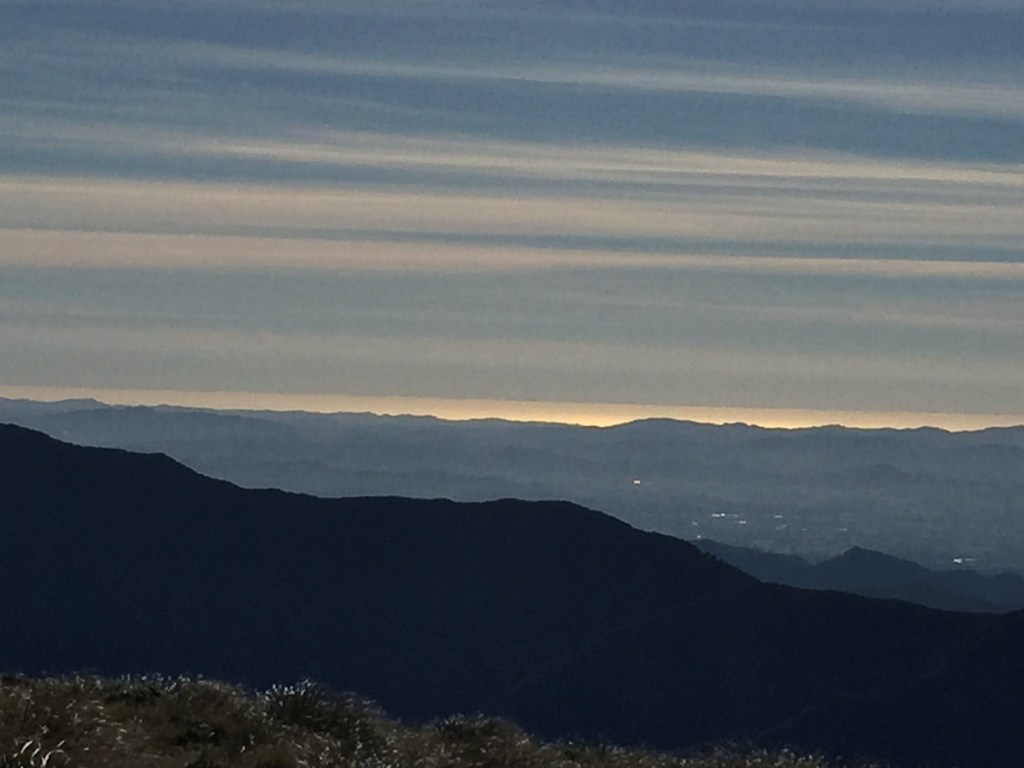
On the map, and from the peak of Aokaparangi, the route to Maungahuka looked straightforward. A nice, clear ridgeline, like a steepish hallway you’d saunter up. I’ll just bowl along to Maungahuka for morning smoko at the latest, then along to Kime for a late lunch, I thought. But the path was full of those infamous Tararua bumps, including two actual, named peaks which I’d completely overlooked – Wright (1196m) and Simpson (1174m). And in the way of these things, each of them involved a painful, slow, precarious slog up, then an equally tough slog down, then up again, and so on. Marvellous to look at and tramp among but, but saunter over them? Smash them out before morning tea? Yeah, nah:
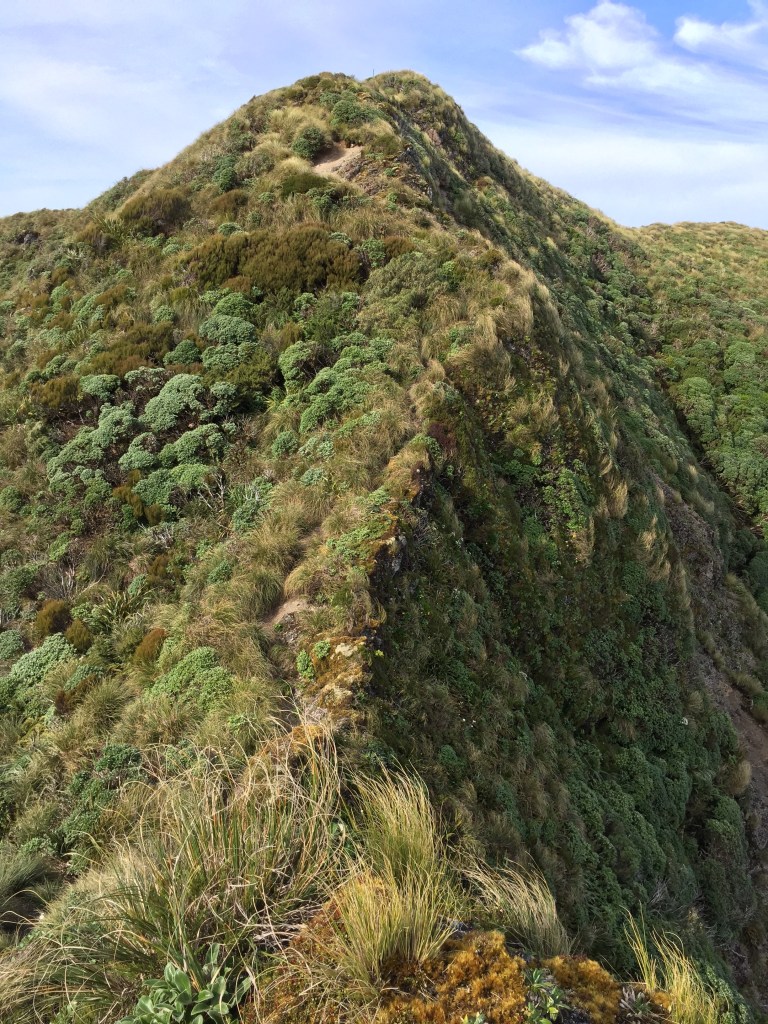
But man, was it a spectacular morning to be alive, and out in the back country, picking my way along the high spine of the land:

Finally I was on the last, tough, narrow ascent to Maungahuka. Over its right shoulder, those sheer and storied Tararua Peaks. Just looking at their near vertical sides made my heart hammer faster than it already was. I realised I’d have to reconsider my hope of getting out to Ōtaki Gorge Road by that evening. There’d be no hurrying over these puppies:

Finally, Maungahuka Hut came into view. It’s one of the most picturesque hut sites I’ve visited:
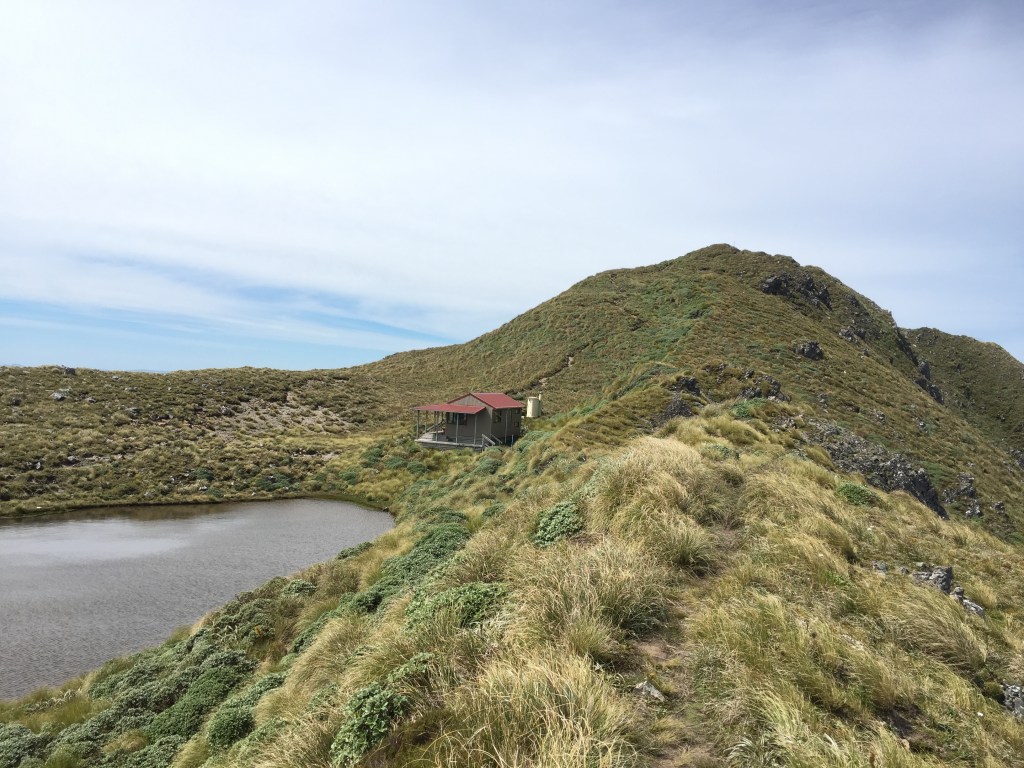
Maungahuka comes from maunga, meaning mountain, and huka meaning snow, and this whole range is often blanketed in white through the middle part of the year (and beyond). Today though it was sunlight falling hard and heavy, and it was a relief to skirt the tarn and enter the hut’s cool shadow. Even there, the view and setting were among the best you’ll see:
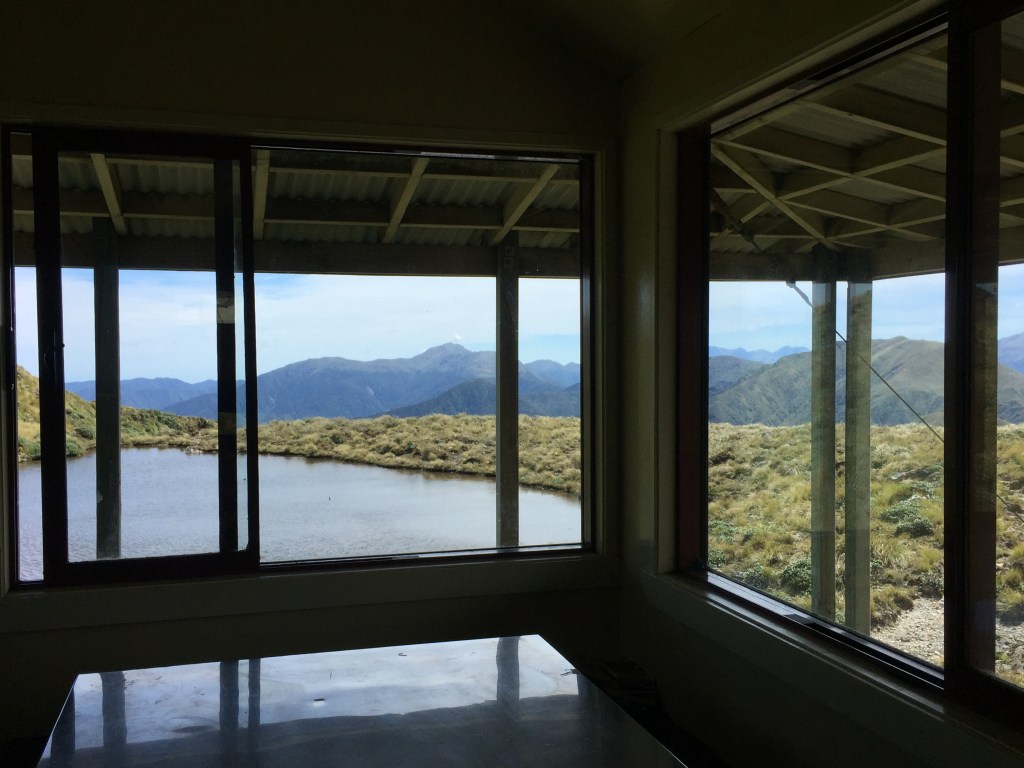
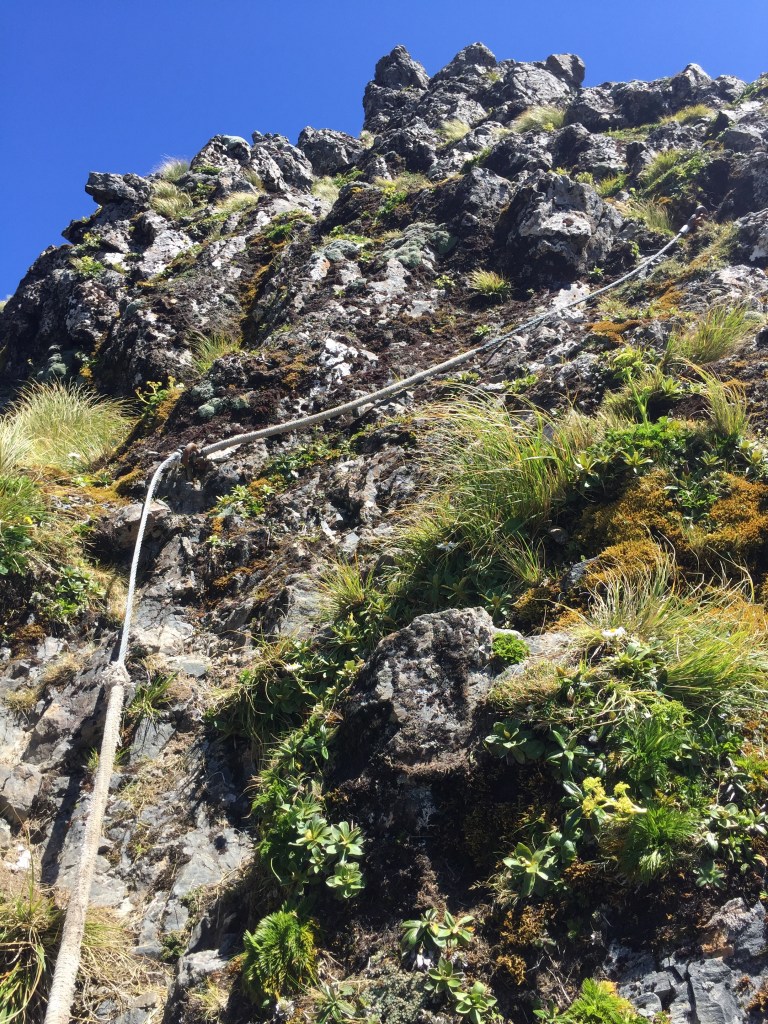
I filled up with water, food and coffee and tried to compose myself. The Tararua Peaks were just ahead, and I had just realised I was unusually nervous. I could feel my pulse beating faster than it should when you’re at rest, sipping coffee before a majestic, silent, sun-soaked panorama. I reflected on why. Sure, the near-vertical rock columns are famous for being a bit scary: they used to be only passable by those with high levels of daring and mountaineering skills, as well as ropes. Then the Forest Service put in a chain ladder, later upgraded by DOC to the current heavy-duty, 70-rung, seismic-tested steel ladder bolted to rock. But it’s still much respected as a particularly hairy little section. Which, normally, would have exhilarated rather than bothered me. So what was different?

Something I haven’t mentioned until now is that at that point, my partner and I were expecting our first child. Since then my son has been born, and he’s an utter delight. But at that moment, I was suddenly conscious of what it would be like for him to lose his dad before even drawing breath. It put risk-taking and danger into an entirely new light.

There was nothing for it though, except to calm down, put one foot after the other, and make my way carefully toward my future son. Step by step, through the narrow little notch between Tunui (1325m) and it’s slightly smaller partner, Tuiti.

First though there was a last look back at the rugged, lofty lane I’d been following those last few days. That’s Simpson in the foreground, then Aokaparangi, then Kahiwiroa, then Crawford poking up near the centre, and Pukematawai on the horizon.

Here’s my first close-up view of Tunui:

Already the footing was getting a little precarious as the spine of the land narrowed. It’s not only the difficult terrain that gives this place an aura. To the iwi of the area, this is a crux of many ancestral stories and territories. Te Ara notes, for example, the Ngāti Toa people named this whole range Te Tuarātapu-o-Te Rangihaeata (the sacred back of Te Rangihaeata, a Ngāti Toa leader) to seal a peace deal between Ngāti Toa and neighbouring Ngāti Kahungunu. Here, at this knotty, rocky junction, it felt as if I was right between those gigantic shoulder blades.

The going here is tough, and you have to reflect minutely and humbly on the land as you traverse it, often on all fours – every foot-fall or knee-press counts, every hand hold.
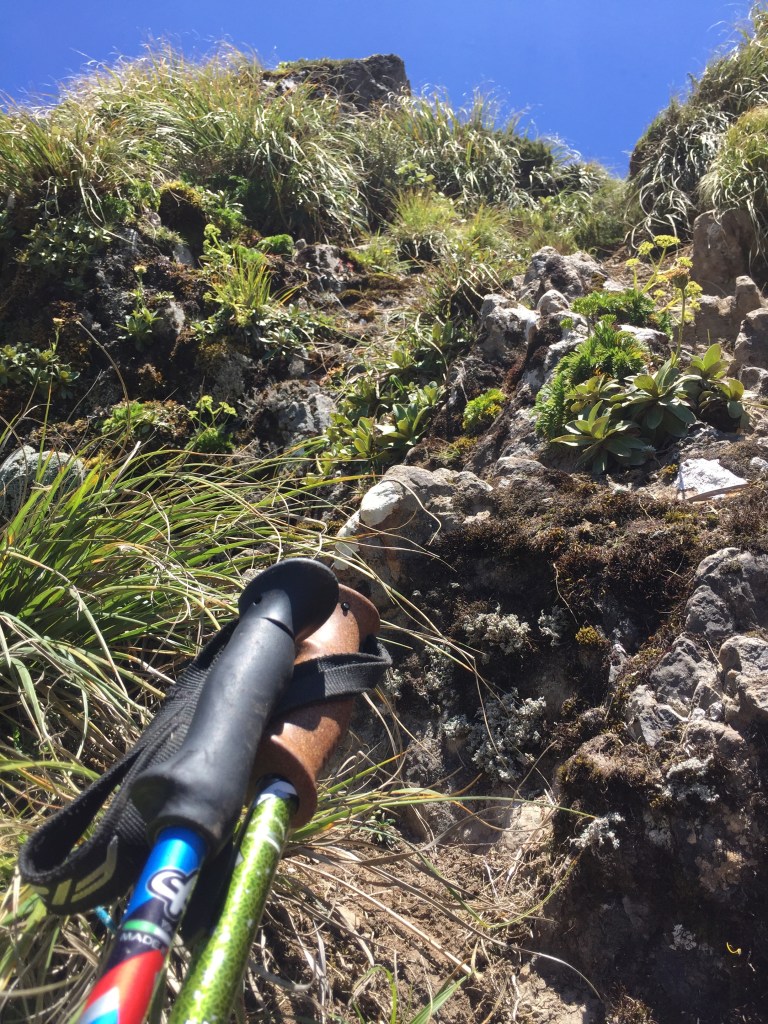
Close to the steepest part, chains are bolted into the rock. They were mostly unnecessary for me that day (except for psychological comfort), but in ice, snow, rain and fog they would be a godsend.

Finally it came into view, the fabled ladder.
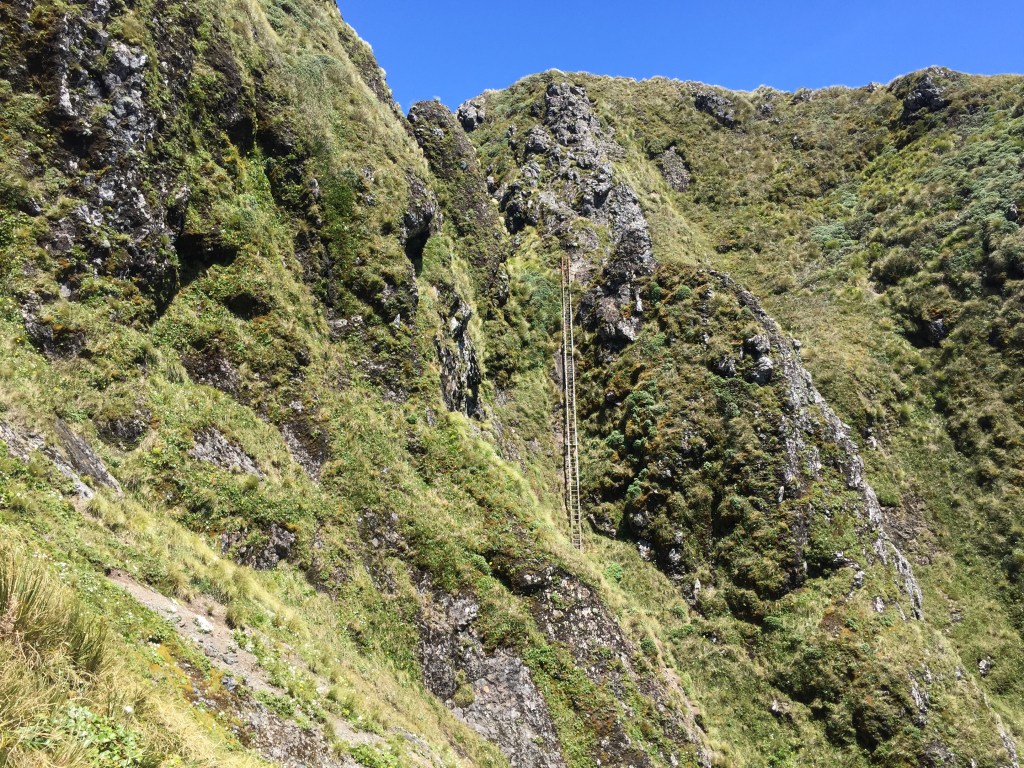
I used to live in Wairarapa and from certain points there you can see these distinctive twin peaks jutting up, like remote rock chimneys. I’d been watching them for years. Reading and hearing about their history, about others’ adventures on them. Now I was sidling right up to them.

At the ladder’s foot I laid down my pack to have a breather. It was a moment to savour.

At the top of the ladder, framed by the two outcrops I stood between, the views were a marvel. I was in the heart of the Tararua Range, just as about as far from a road-end as you can get in this park. The bush far below was silent, serene. The tussock rippled, languid, lapped by the breeze.
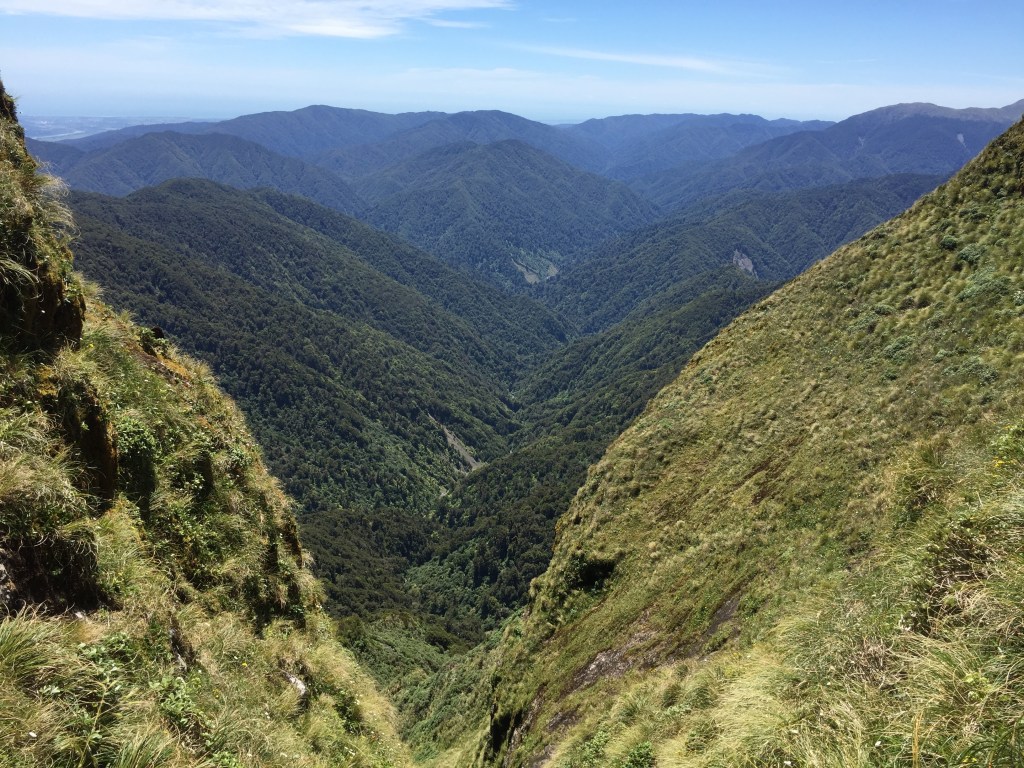
It wasn’t over, though. More scrambling and dangling and scrabbling lay in wait.
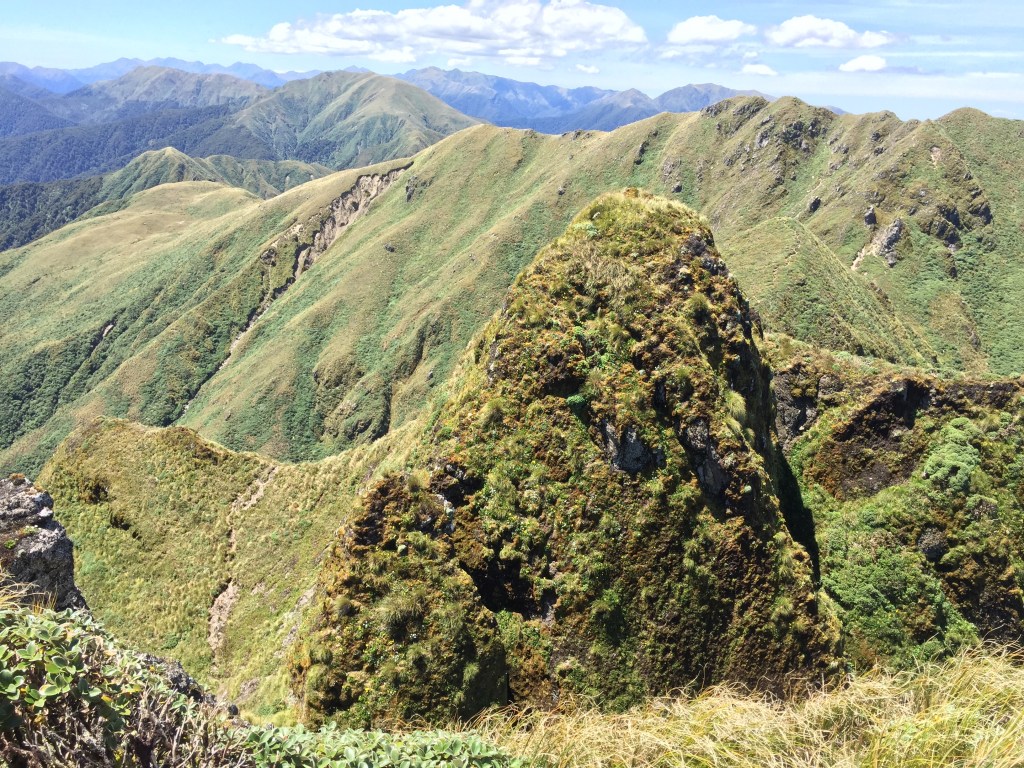
The next pic shows, from the top of Tuiti, the route ahead. That moment, again, when you crest a hill and a new swathe of tramping unfurls before you. The peak in the foreground is McIntosh (1286m). On the horizon, two peaks of the famous Southern Crossing, from west to east, Ōtaki to Upper Hutt: Bridge Peak (1421m) and Mt Hector (1529m). The destination I needed to reach by nightfall, Kime Hut, was between those two peaks. Till then, I’d have no opportunity to get more water and no respite from hard, undulating tramping, mostly upward. It seemed very far away.

Looking in the other direction, Tunui in the foreground, and the way I’d come spreading out behind.
In huge landscapes like this it’s easy to overlook the tinier delights:

You can’t look at them too closely though, because you have to keep your eye on the often-dicey footing:

Somewhere up around the top of McIntosh I was really struggling. My feet were in a bad way, blistered, swollen and sore. It’s a given when you haven’t done a lot of training, and then head out into the back country and walk all day for nearly five days straight. Sooner or later your feet will say: we need a day off.

But that wasn’t an option so I just had to nurse those battered little hobbit hooves along. That meant stopping every hour or so, shedding boots and socks, attending to blisters and crushed toes, and putting my feet up on my pack for fifteen minutes. It made for a long, hot afternoon, especially as there are no trees on the high tops, and therefore no shade. It was midsummer, roasting hot, and I was sunburned, dehydrated and running out of water. But there’d be no more till I got to Kime, still a good four km and 300m climb away.

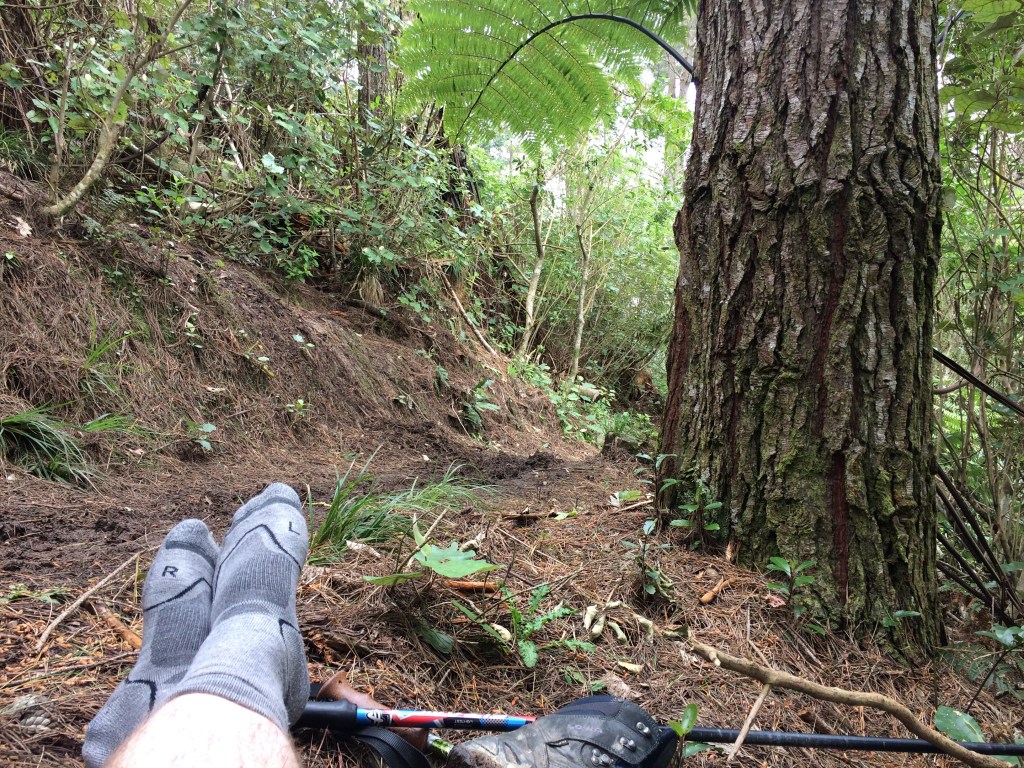
At one point I curled up under a gnarled and woody shrub, blasted bone-white and low to the ground by the prevailing northerly, nearly bare of leaves. It was the only meagre shade I could find. Despite the pressure to keep going before the light faded, I couldn’t keep from snoozing a little.

Finally, the sun began to fall, the sizzle to go out of the air and the shadows to lengthen. A deceptively tough scramble got me up and over McIntosh and then Yeates (1205m). Then I was looking back toward the twin peaks, and beyond them Maungahuka and Aokaparangi:

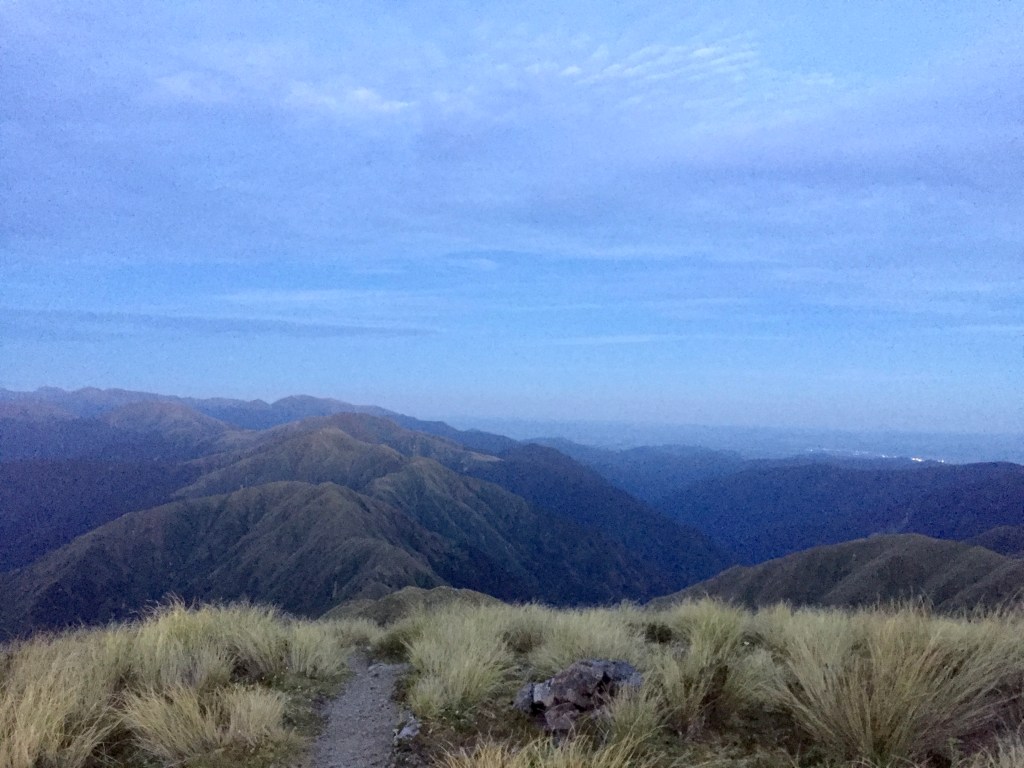
With much swearing, sweat and foot-soreness I continued then over Vosseler (1108m) and Boyd-Wilson Knob (1138m). To give myself some attacking energy I began personifying the last one as a kind of mean, posh bully: “that Boyd-Wilson knob”. Finally I was on the last, long, tough ascent, up a steep spur onto the east-west range that forms the T-junction terminus of the main range. Here’s the view back the way I’d come from that point, from near Bridge Peak. You can see lights coming on down on the Wairarapa plain:
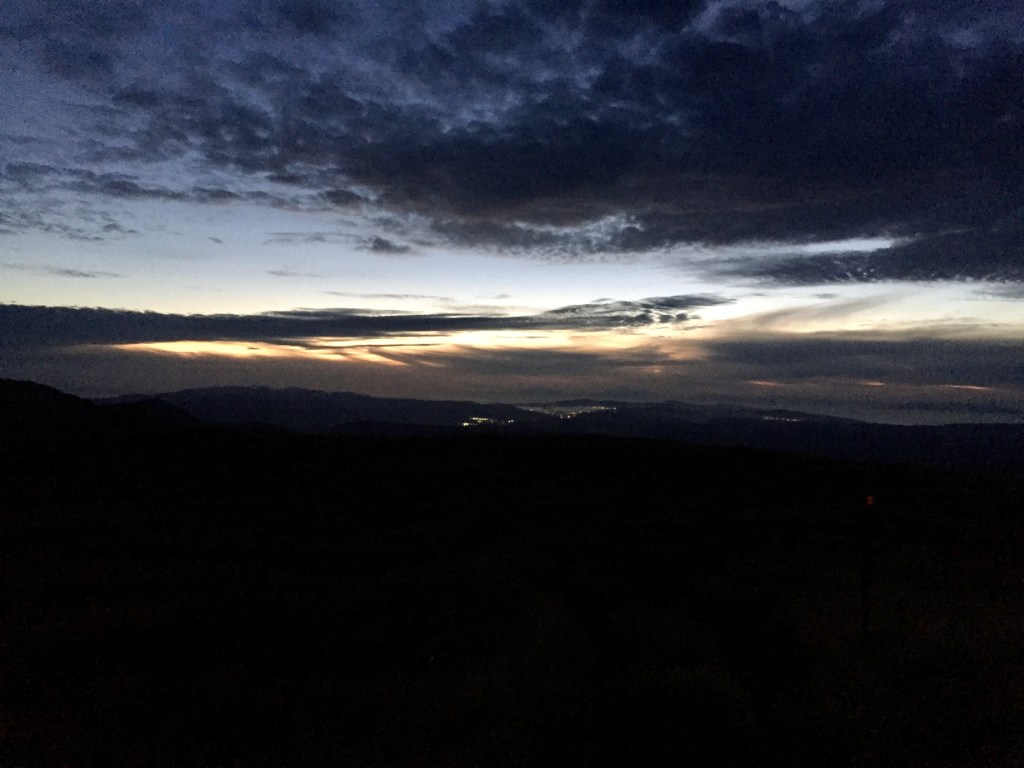
Then it was a slog in the gathering gloom over Hut Mound (1440m) to Kime Hut. On the way, the lights of Wellington winked around the harbour in the distance:
After what seemed an unfeasibly long time I was stumbling wearily onto Kime’s ample verandah and slipping into the shadowy interior. On several bunks were the still forms of other trampers, already asleep. I got carefully into my sleeping bag in the dark, every fibre aching. I munched biltong, sculled water and sipped whiskey. It had been a mammoth day but I’d made it.

Day 99: Kime Hut to Ōtaki Gorge carpark, about 12 km

In the morning I had a good and much-needed sleep in, ear plugs and eye-mask keeping me drowsing through the other trampers’ morning clatter. When I finally got up I felt like I’d been hit by a truck. I’d reached my physical limit, the most hard tramping I can really do at this stage of my life without a day off: five days’ hard, continuous walking. I really needed a break but there was no way – I had to get back to Wellington for work. Slowly I put myself back together, breakfasted and set off. Below is the view looking back at Kime Hut, out toward Hutt Valley and the Remutaka Range. Looks like I was too tired to focus properly:

To the north, Mt Ruapehu trailed a plume of cloud, beyond Bridge Peak and the Oriwa Ridge:

From Dennan (1214m) the ground dropped away like a rough staircase down toward Field Hut. In the distance, the Ōtaki River ran down to the Tasman Sea:

The next pic is looking back up toward Dennan, from around Table Top (1047m). It looks benign in this kind of weather, but if you’re heading the opposite way to what I was, i.e. up onto the exposed tops, this is a possible point of no return. More than one tramper has decided to push on from here despite a bad forecast, and never made it home. The Southern Crossing is notorious for offering few escape routes when the weather turns savage, which it can do in a blink. Table Top is a good place to take stock.

For me though, it was down into the cool relief of the bushline. It was the first time I’d been under a canopy for days.

Around the point I heard a hectic crashing near the track which made me stop, heart pounding. But only for a moment – in Aotearoa that sort of sound can only be something much more keen to get away from you than harm you, like deer, pigs or stock.

I pushed on and soon reached the quirky, old-school charms of Field Hut.

It’s a comfy, historic hut full of character, and at only a few hours from the road-end, an easy overnight destination. Someone had left a partly complete jiogsaw puzzle on the table.
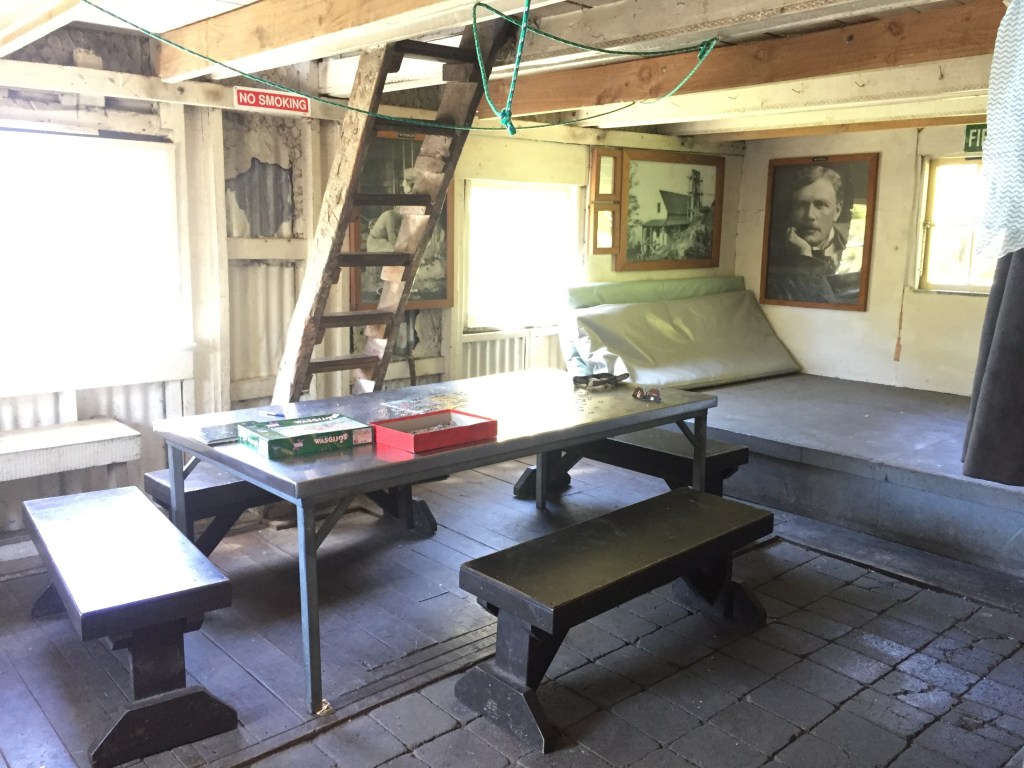
There’s a sleeping platform downstairs, near the log burner, and upstairs there’s a neat loft with plenty more room:
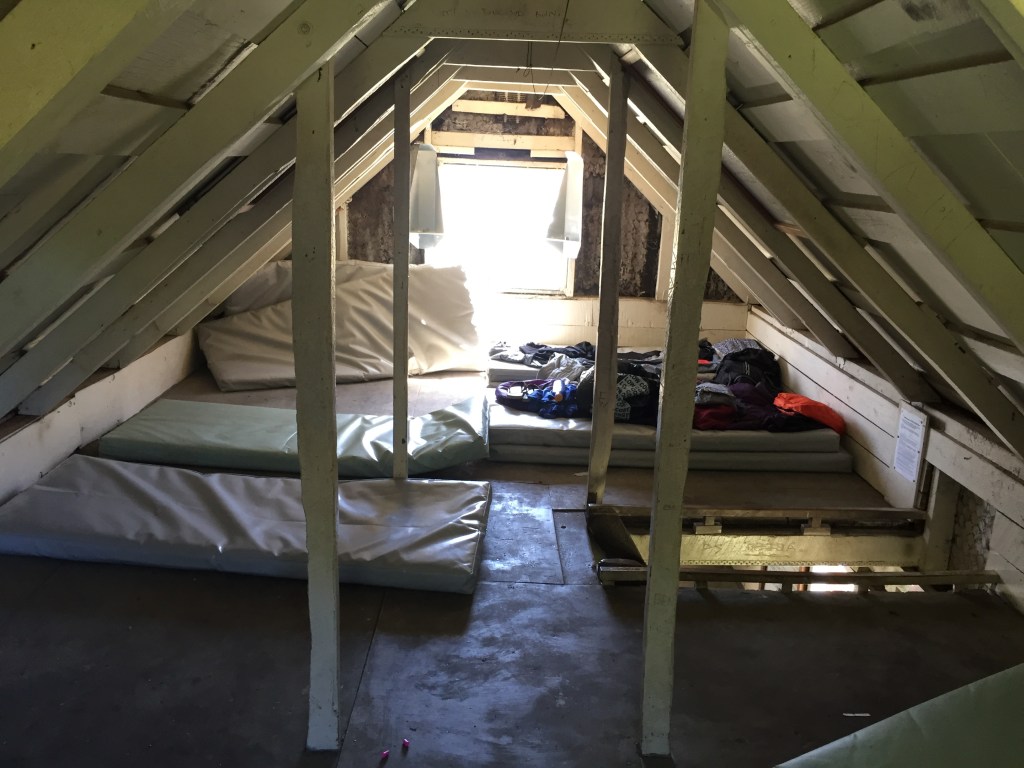
Historic photos show the hard work needed to build and maintain this old beauty:

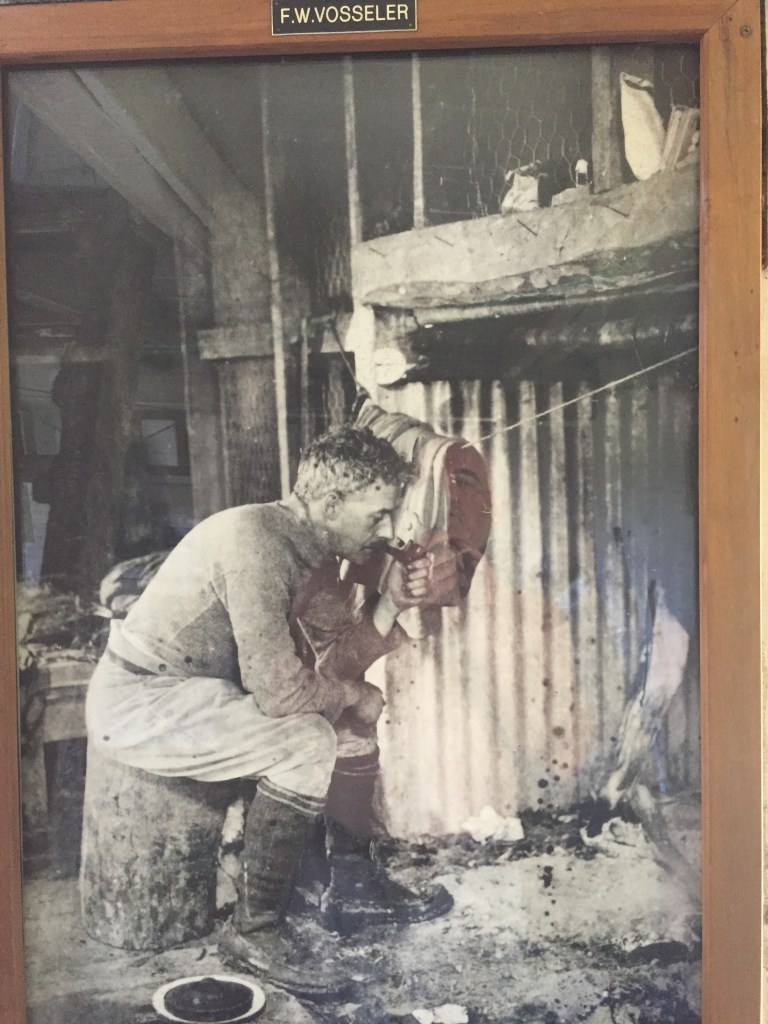
It’s a special place: one of the first purpose-built tramping huts in Aotearoa, and the oldest surviving recreational hut in the Tararua Ranges. The foundations and framing were built with pit-sawn timber from trees felled nearby, and the rest of the materials were hauled in by packhorse. It was built in 1924 by members of the country’s first tramping club, and arguably the people who invented the term tramping: the Tararaua Tramping Club. Here’s one of its founders, Fred Vosseler, in the hut named after his friend and co-founder, Willie Fields:
Someone’s note in the hut book confirmed what I’d thought about the heavy crashing through the scrub up near the bushline: wild goats are known to roam there.

Then it was on and down the long and snaking path, with the obligatory hourly stops to let the tears drain out of my crying feet:

Finally the tranquil river flats at Ōtaki Forks opened up through the thinning bush.

The path wends down through abandoned paddocks of long grass. In one, under a canopy of mānuka, I found this amazingly filigreed creature:
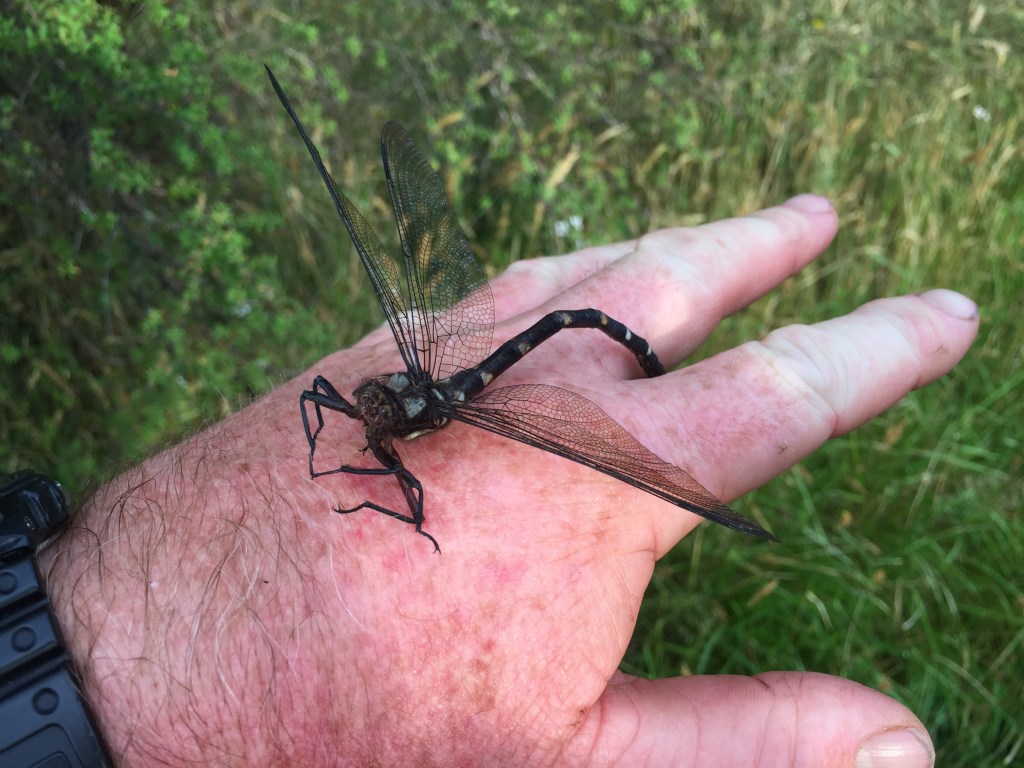
It was dead, the enormous frame a near weightless husk. Wikipedia tells me it was probably Uropetala carovei (New Zealand bush giant dragonfly). Their Māori name, kapokapowai, means “water snatcher”, for the extendable jaw that shoots out to snatch prey.

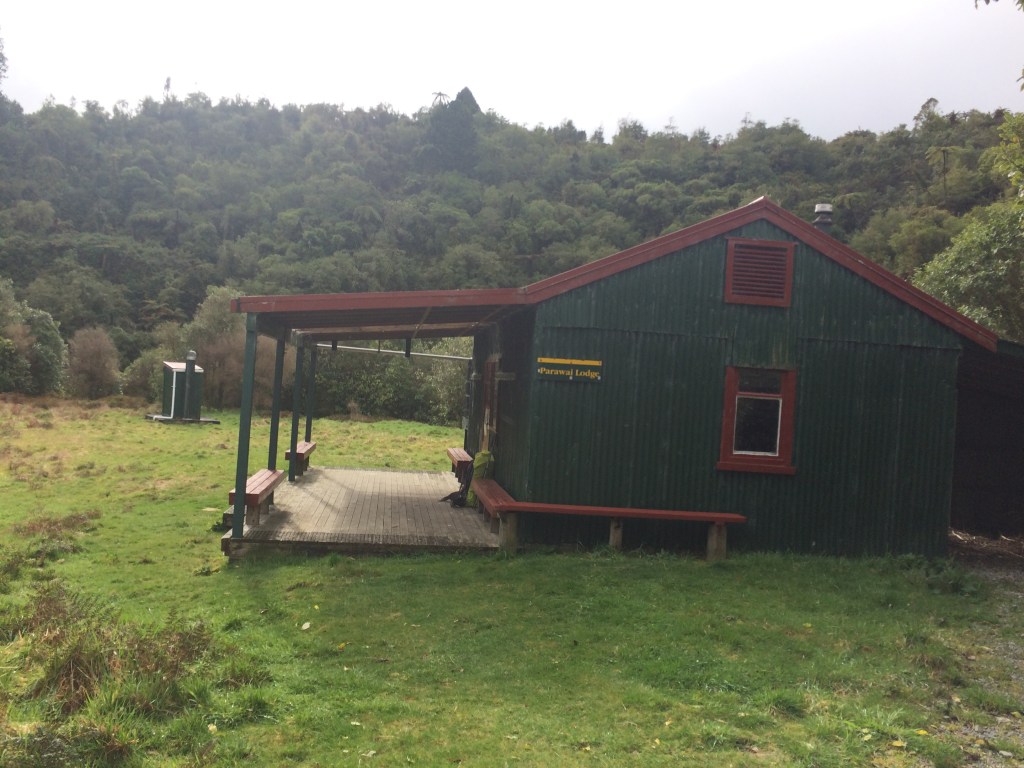
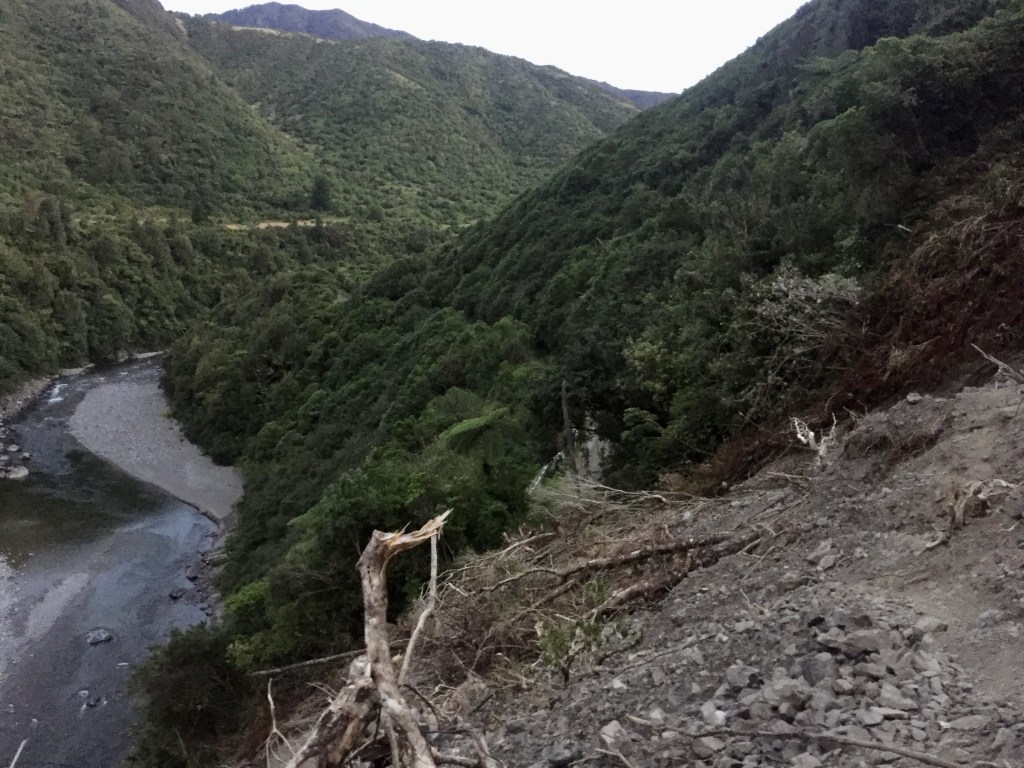
I pushed on, past the turnoff to Pārāwai Lodge (where I’d spent a night on an earlier Te Araroa expedition) and across the swing bridge to the gravelled Ōtaki Gorge Road. There’s a turn-off a few kms along it to a lengthy bypass around a big slip. Several locals and other trampers had told me the slip is safe to cross on foot, if you’re careful. I was pressed for time and didn’t fancy a two- or three-hour, steep and slippery bypass, so I nipped across. It’s an impressive slump of mountainside, and you are perched at times a little precariously above the river. But there’s a well-trodden path across, someone’s rigged up a helpful hand-line, and it was much quicker and easier than going around.

Note: The Te Araroa website’s “trail status” page is currently showing that a safe path across the slip has has constructed. I’d recommend taking it, in preference to the steep, much longer by-pass, which is still in place.
Finally I was at the Shields Flat Carpark, where I’d left my wheels. This is looking back at the gate I’d just scrambled over, as the long summer dusk closed in.

That was it – I’d done it. The whole North Island between Waikato and Wellington, all-but complete. (I’d completed Ōtaki Forks to Wellington earlier, when bad weather forced me to skip ahead, against my normal policy of completing each section consecutively. My account of that section follows this). Most of Auckland and all of Northland are done, too.

Still to walk: A three-day section of the Hunua Range, south of Auckland (closed due to kauri dieback – if they don’t reopen it by the time I’m ready to tick it off, I’ll walk the road by-pass); one kilometre of Te Kūiti main street (skipped because the person I was staying with insisted on dropping me off further down the road than I wanted); and the last day of the North Island, between the Wellington suburbs of Ngaio and Island Bay. Which I’m saving up for when everything else is done, so that when I walk down and touch the water of Island Bay, I’ll know that I’ve walked every last bit of land between it and Cape Rēinga.

But apart from that, I’ve walked every metre. It’s a very good feeling.

Now that my son Maian has arrived, those final North Island Te Araroa tramps – and the whole of Te Waipounamu/ the South Island – will have to wait. Possibly until he’s old enough to join me.

On that note, here’s a picture painted to welcome Maian into the world, by my friend Chris Murray’s daughter Olivia:

By Olivia Murray

When that time comes, I’ll put an account of it on here.

Thanks for reading my Te Araroa journey so far. Previous legs of it are posted above this one, and as mentioned another few posts follow, covering the path to Wellington.

I’ll conclude this long chapter of tramping and blogging with a whakataukī (Māori proverb) that’s stood me in good stead these 99 days (spread over five years between January 2017 and January 2022) and 1500-odd kilometres, from Cape Rēinga to Pōneke:

Whāia te iti kahurangi, ki te tuohu koe, me he maunga teitei.

Seek the treasure that you value most dearly, and if you bow your head, let it be to a lofty mountain.

Following the silvery line: Ōtaki to Wellington – Te Araroa Trail days 82-87, kms 1578-1672; PART 1 (to Paekākāriki)

I rode an Intercity bus an hour and twenty minutes north, got out and walked home.

As stints on the Te Araroa trail go, it had an enjoyable simplicity.

Since January, 2017 I’ve been slowly working my way down the North Island via the length-of-NZ trail, which runs from Cape Rēinga to Bluff. Initially I’d drive north to wherever I reached the last time – Mangamuka, Mangawhai, Huntly, Tongariro – park up and start walking. After a couple of hundred kilometres or so, I’d hitchhike or bus back to the car.

But as I’ve drawn closer to Wellington, where I live, the logistics have gotten easier. For this stint, in September 2021, they were the simplest yet.

The plan had originally been to follow the Te Araroa route from Ōtaki Forks in the Tararua Range to Wellington, via the trail’s network of national parks, local reserves and other pathways. But bad weather had nixed the previous three-day, very exposed section through the Tararuas (to be completed later).

So I had a problem: getting from Ōtaki town, to which I could get public transport, to Ōtaki Forks, to which I couldn’t (it being in the ranges). Hitchhiking in a pandemic didn’t appeal, and adding to the difficulty was that the road to Ōtaki Forks is closed due to an active slip, 11 kms from Ōtaki town.

From the closure, pedestrians can do the remaining six or seven kilometres via a temporary, hilly detour. There would have been ways to get a ride to that point, but I decided to walk the whole way – it just felt right.

Day 82: Ōtaki to Ōtaki Forks (18km, to get back on trail)

So I clip-clopped my way south out of town, with a familiar out-of-place feeling – all got up in outdoors gear, complete with walking poles, but tramping along a street instead of a bush track. Over the bridge across the big, blue-and-silver Ōtaki River at the town’s southern entrance, where State Highway 1 traffic piles up and groans, yearning to get through the bottleneck and roar on and on.

A death-dash across the nation’s clogged main artery got me onto the Old Gorge Road, which turns off east, at a right angle to the main road. It would take me all the way, basically, to my bed that night, in a hut called Pārāwai Lodge.

I was soon glad I’d walked. The Horowhenua plain spread out like a great, green lake around me, and the ranges were straight ahead, beckoning, coming closer step by step. I’d been feeling frustrated about having to skip ahead on the trail because of the weather – I’m trying to do my trail sections as contiguously as possible, to preserve the sensation of walking the whole trail in one hit. But if long-distance tramping teaches you anything, it’s to be adaptable, and the frustration evaporated as I got into another familiar, favourite feeling: eating miles. That old exposed ridge would keep.

“You will be mine,” I told it, swinging towards it along the Old Gorge Road and quoting the old movie, “oh yes, you will be.”

I came to a long corridor of native bush that lined the road and reached over it in places, making a peaceful green tunnel.

Just as I was entering it a pilot ute with a “wide load follows” sign came zooming out of the emerald shadows and paused beside me.

“Two trucks coming,” said the driver through the open window. “Wait for the second.”

Another small truck, loaded with landscaping supplies, came up behind us and its driver got the same message; he pulled off onto the verge just in front of me and got out. We both watched, he leaning on his cab and me on my poles, as a flatbed truck carrying an enormous forestry digger swallowed the road. It loomed closer and closer, the edges nearly touching the overhanging trees, then rumbled by.

While we waited for the second one, the driver of the landscaping truck strolled over to me.

“Where you off to?”

“Wellington.”

“Oh, doing the ‘TA’ are you?”

“Yep. Ōtaki Forks tonight, over Pukeatua tomorrow, out to Waikanae, then down the coast.”

“Oh yip. You know the road’s closed at Blue Bluff?”

I nodded. He and gave me some useful advice about the route ahead, and we chatted a bit about Te Araroa – he’d done some of the North Island, in sections, and knew the Tararuas well. He reckoned I’d made a good choice postponing the section prior to Ōtaki Forks, given the forecast: gales and snow to 800 metres. I told him I was hoping to get it done the following week and he eyed the waterlogged sky.

“Don’t like your chances for next week, either. But you might get a window.”

He looked down at my boots. “Those are Lowe Renegades, aren’t they? Great boots, I’ve had three or four pairs. Fit like slippers.”

He wished me well and zipped off up the tree-lined corridor, and I was alone again in the long green light. I smiled, grateful for his advice, and feeling vindicated after spending many hours over the previous few weeks, in several outdoors stores, choosing my new boots. A couple of pushy counter staffers tried to up-sell me more expensive boots, but the landscaper was right – these were like slippers. And I’ve had enough blisters and cramped feet on the ‘TA’.

I plinked along contentedly and didn’t pause again until I saw these brand-new rural residents:

Tramping in spring is a bit dodgy weather-wise, but it has many compensations. Like magnolia blossoms:

That was one of many logging juggernauts to come clanking and roaring by. But before long I was getting sumptuous views of my preferred kind of juggernaut, the Ōtaki River, which was giving off a steely blue glow in the cloudy light:

The banks of the river were getting more wild, less farmed and steeper. It was a real pleasure to walk all the way into the ranges from the coastal plains, feeling the hills draw in, the valley steepen, the wild wrapping me up and welcoming me back.

Rivers acquire more wild force, too, the deeper you go into the hills:

The human stuff was changing too – fewer industrial-sized farms, and more baches, hunting huts, alternative lifestyle-looking places.

I passed a hectic logging operation – diggers lifting freshly harvested logs onto a queue of waiting trucks. Then I crossed a shallow ford and, seeing the bush was right down to the road’s edge at last, I ducked a few metres up the stream to a very quiet, lucent lunch spot. The morning’s road walk had been fine, but it was, as always, such a joy to sit back against a tree in the actual, untracked, unspoiled bush.

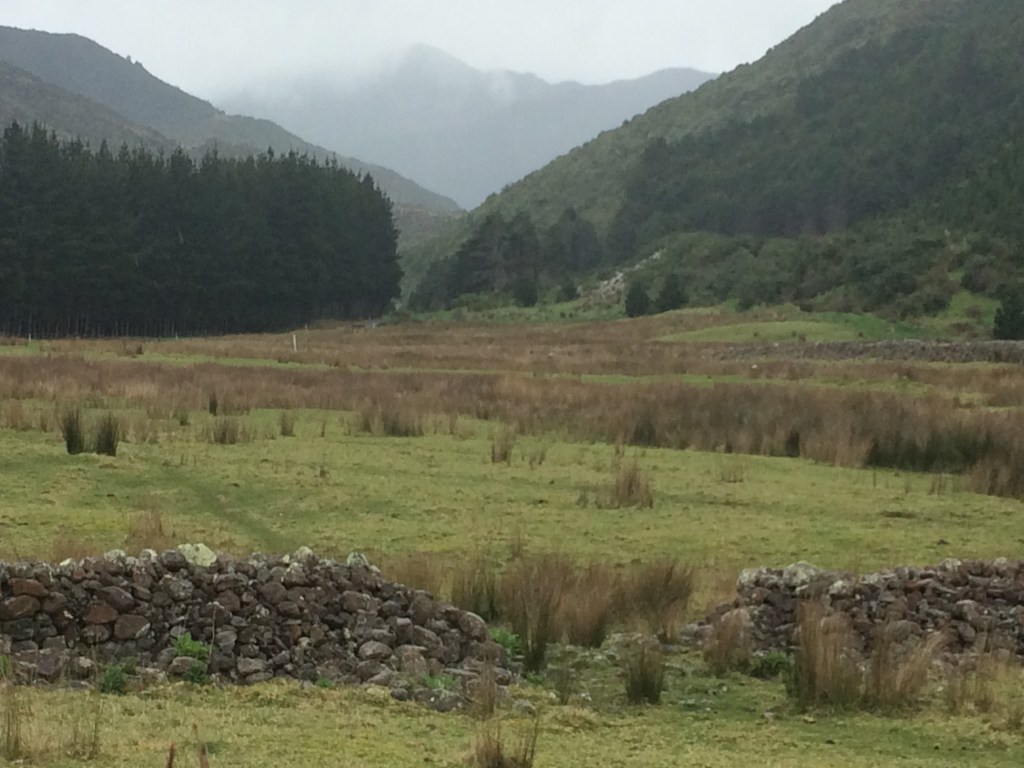
Not long after I came to Shield’s Flat, in the Hautere district, where during the Great Depression work-gangs of unemployed stacked river rocks into miles of dry-stone walls. The walls are there still, but there appears to be nothing, now, in the small paddocks they created, except rabbits, bullrushes and thistles. The part-tumbled walls emphasise the emptiness – they contain nothing, and keep nothing out. But they gave a basic income and dignity for the workers employed here to pull up and stack the stones, which they called “Hautere Turnips”. And land development for the farmer, and some extra life in what would then have been a pretty remote district.

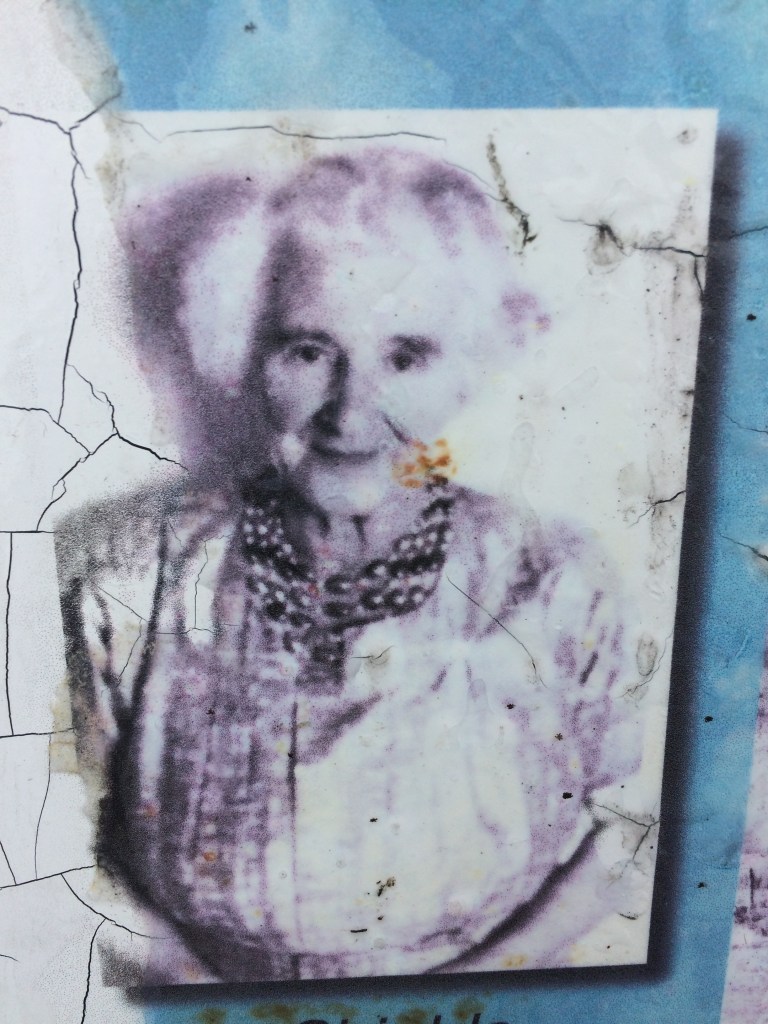
The farmers in this particular spot were Jean Shields and her husband Patrick, who came here with and their 10 children in the 1930s to farm potatoes. I imagined the crews of unemployed, mostly single men living way out here, bunked in little huts, learning the subtle, ancient art of drystone wall-building. Then moving over these flats, backs bent, stacking stone after stone into carefully balanced walls, wondering if all their effort would make any difference to anything.

It must have caused quite a stir in the pioneering district, though, with its fresh-felled virgin forest, miles of muddy cart-tracks to the outside world, and stoic, self-sufficient families. Jane Shields looks like the kind of warm, optimistic person who would have made that harsh world a bit easier to live in:

Further on I came to the locked gate that keeps cars out; walkers can climb over and carry on a little further to a sign pointing to a detour around the nearby slip. It goes up a hill, along through private land then back down onto the gorge road, adding a good two hours to the trip.

From the gorge road, the countryside was getting more and more wild. Before the road was built, the Ōtaki River must have seemed, to early European pioneers, to traverse quite the jungle.

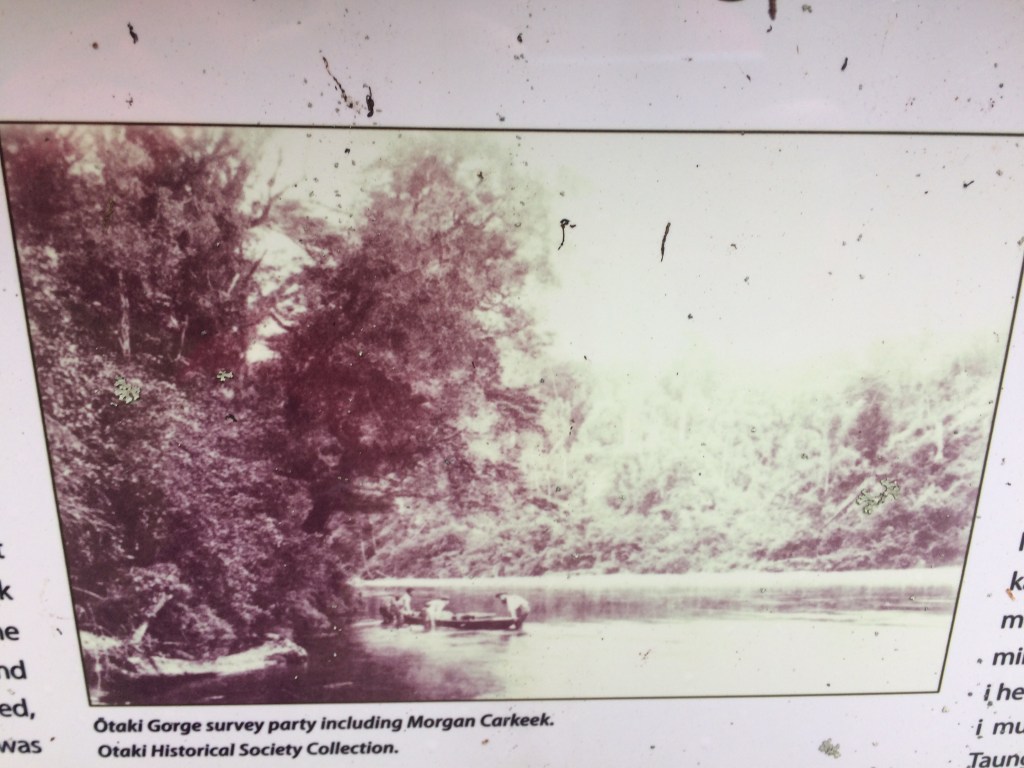
An info sign nearing Ōtaki Forks has the evocative photo below, showing some of the early Pākehā explorers surveying this very gorge, well over a century ago. Carkeek, mentioned below, has a ridge named after him in the Tararuas. Of course, Māori explorers began criss-crossing the whole range, and all its river systems, close to a thousand years before that. The whole system of ranges is named after one of them: Tara.

Tara was the son of Whatonga, one of the first navigators to arrive in Aotearoa; among his descendants (along with his brother Tautoki) are the tribes of Ngai Tara, Rangitāne, Muaupoko, Ngāti Apa, and Ngāti Ira, who still populate this area, and beyond. It’s their ancestral lands I would be walking over on this trip. As the link above details, they named these mountains after a saying honouring their famous ancestor: “Ngā waewae e rua a Tara” or “the spanned legs of Tara” – because his people had a place to stand on either side of the ranges.

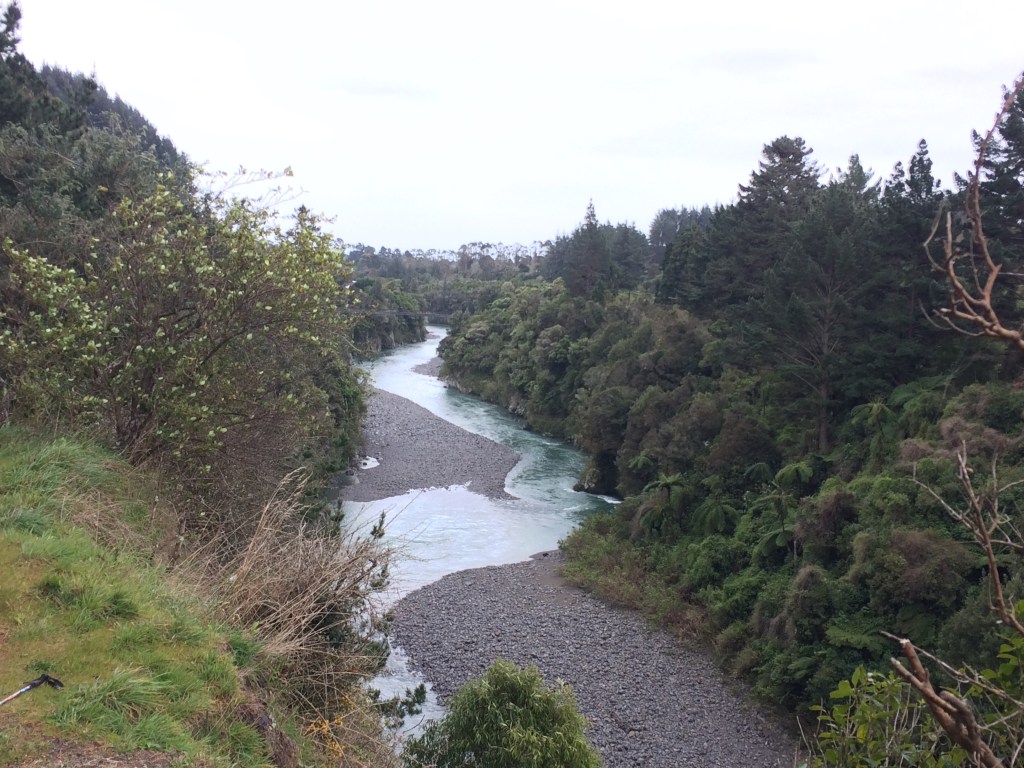
Here’s a view upriver into the heart of Tara’s territory.

A few more kilometres of gravel road took me to the main Ōtaki Forks overnight carpark and a foot-track down past the cartaker’s house to a picnic area above the river. The path goes over a footbridge and a few hundred metres more to Pārāwai Lodge, built and maintained by a local club. It was a welcome sight after a good first day back on the trail. That was even allowing for a fair amount of rodent poo on the steel bench. Oh well: for five bucks a night you can’t really mind the odd incontinent, squeaky hut-mate. After noodles and biltong I turned in early, and slept like I’d stacked a thousand Hautere turnips.

Day 83: Ōtaki Forks to South Mangone Road end carpark (16km)

Here’s the hut in the morning, with its ring of thick bush that crowds, a little darkly, around the clearing, as if resentful of the intrusion of humans (and rats).

From there it’s a couple of kilometres back across the footbridge and upriver to the start of the Pukeatua Track, which heads off roughly south toward Wellington.

As it climbed, intitially via the Fenceline Track, I got a glimpse back to the north of what I would have been hiking through had I not skipped the previous section (Makahika Outdoor Pursuits Centre to Pārāwai Hut, via Pukematawai peak and Mt Crawford):

As you can see there would have been very limited visibility up there. And with gales and snow, it would have been pretty dangerous on top of Pukematawai (1432 metres) and Crawford (1462m). They’ll keep.

A bit further on I got my first proper glimpse, on this leg, of snow. This is looking east toward Mt Hector, on the famous Southern Crossing route:

As usual when I’ve been off the trail for a while, it was a special moment to find myself, once again, fully immersed in the forest. There’d been smatterings of bush the day before, but it was around mid-morning that I looked up and saw the sky was full of branches. The canopy had closed over me and the light had turned green; I felt my heart-rate drop an extra beat. In Europe, I think it is, they call it “forest bathing”. It’s pure medicine.

The canopy cleared a moment and I got a better view of the fresh snow on the peaks around Mt Hector.

I think this is probably part of the long ridge that heads roughly northward from Renata (924m) to Elder (1110m) and Aston (1376m), then the “Dress Circle” through to Atkinson (1472m) and Hector (1529m).

Down here at around 500 metres it was cold, all right, but there was no snow yet and it was fine as long as you kept moving. Despite that, every so often it’s good to take a break, put on a warm jacket, and drink it all in.

Recharged, I charged on. It was a fairly obvious track but not all that often travelled by. I really like the way this kind of trail seems barely there, always hovering on the edge of being swallowed by the quietly ravenous bush.

Should you doubt, though, an orange triangle will appear, tacked to a trunk by your trail forebears, to guide you and draw you on, further and further into the wild, but also closer and closer to Bluff.

It was a steady, three-hour uphill hike. Finally I reached some grassy clearings, remnants, I suppose, of failed farming attempts. There were a few glimpses of the plains I’d schlepped the day before, in from the coast:

And my first glimpse, on this leg, of Kāpiti Island, a place full of history, familiar but shadowy, like a half-remembered family story.

Finally I was on the tops proper, with tussock and sunshine, and the Tasman Sea gleaming beyond Ōtaki Beach:

Kāpiti’s jagged spine sharpened:

The peak I was on, Pukeatua, is only 812 metres, but I’d climbed there from nearly sea level so it was satisfying enough. And it has a good name: as far as I know, Pukeatua means something like “hill of god”. In any case, it was good to stand on an open, breezy mountain top, sun and cold and wind on my face:

To the east, Judd Ridge led up to Table Top, Bridge Peak, Hut Mound, Field Peak and the tops around Kime Hut, where the conditions looked considerably less idyllic:

Here’s a shot of the Ōtaki Gorge area, where I’d walked the day before, along the gorge road and into the ranges:

As I was watching, the sky darkened and the promised snow came. Just a flurry, but it was still a thrill watching the flakes dance in the strong south-easterly and settle on my gloved palms.

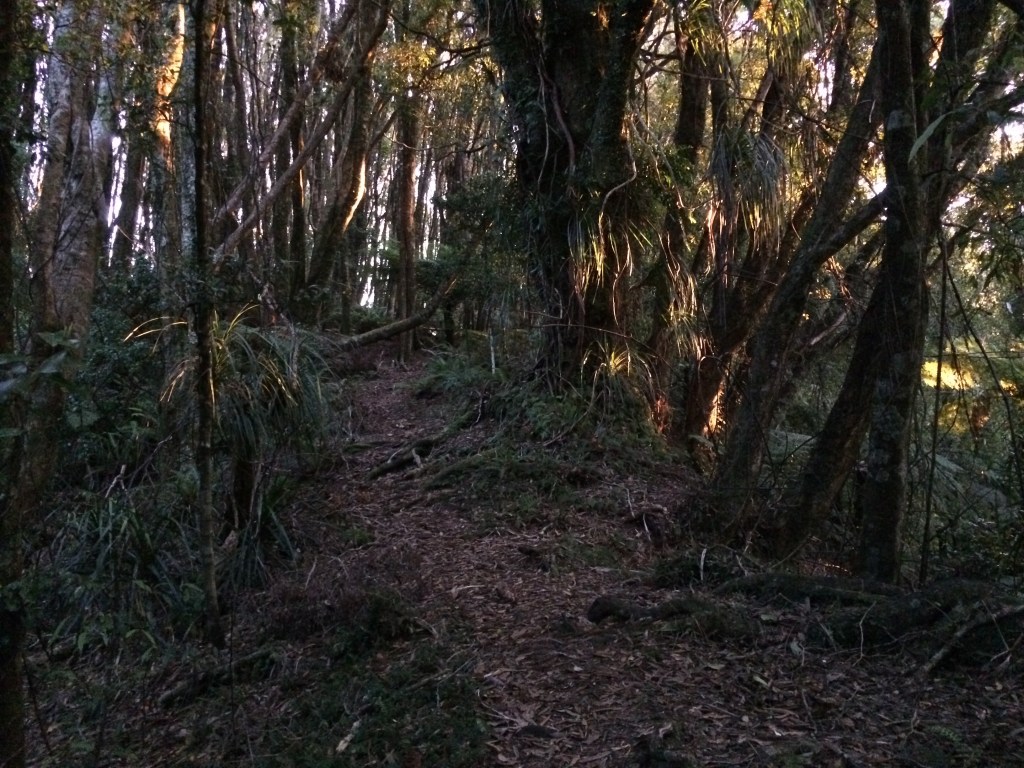
Time to head down. The trail flowed down long switchbacks and the forest thickened. I stopped to rest as the sun began to gild the moss:

The floor was thick with roots and there was a bit of wind-fall – sometimes even the hallowed orange triangle is not protection against getting toppled:

As the afternoon deepened the gold on the floor and leaves grew warmer.

I was so engrossed in the wintry luminescence I got slightly lost, and ended up walking up this little rise twice:

What happened was I got distracted by this kind of thing:

And this: a tree, cleanly split by recent wind, the wood still silky and fresh, coloured a warm coral in the evening light.

I walked up the rise, noticing the sun setting on my left. I mislaid the track at the top of that rise, thought I’d found it again and carried on down a short descent. That’s funny, I thought, the track must have done some weird curve, because now the sunset’s on my right. Then I saw a fresh-split tree, the wood still smooth and warm, coral-coloured in the evening… hang on a sec, I thought.

Once I was sure of my way again it wasn’t long before I came out into the felled remnants of a large pine plantation. The sky, open to the west, carried the last traces of the sun.

Red eyes glowed in my torch light; it was this guy, invasive and unwelcome visitor from Australia, destroyer of native trees, eater of native birds and their eggs, general hoon and persona non grata. I counted seven of them over the next kilometre or so:

Finally the track dropped into a creek then along a four-wheel-drive track, thick with storm-felled timber, massive pine stumps that were tricky to scramble over by torchlight. Finally a footbridge took me over the Waikanae River, just a bush-lined stream this high in the hills, and to my campsite. It’s a brand new one, put in by the Te Araroa Trust, and it’s a beauty. I ate my noodles under the starlight, listening to the river and the silence.

Day 84: South Mangone Road end campsite to Waikanae river mouth (17km)

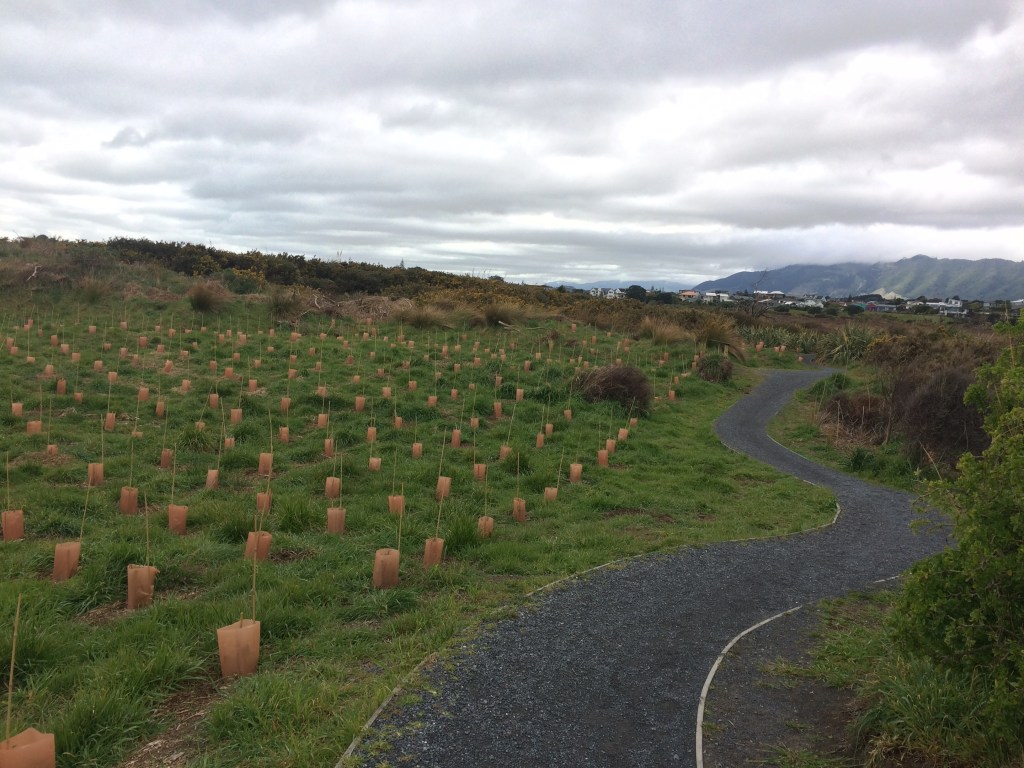
This was the lovely spot I woke up to – complete with freshly planted native seedlings and a new track down to the river for drinking water. I was tempted to stay the day, enjoying the solitude, but the trail beckoned so after porridge with goji berries I set off for Waikanae.

It’s five kilometres of easy gravel alongside the upper reaches of the Waikanae River until you get to the tarsealed Ngātiawa Road. I paused at the intersection to boil the billy in a bus shelter – there was a chilly northerly whistling down the valley off those snowy tops. Just as I stopped a mob of at least a dozen kererū came bursting out of the pine forest by the crossroads. The combined noise of all those wing-beats was like a helicopter; their pāua-shell shoulders caught the sun.

After a kilometre along Ngātiawa Road the trail turns into Reikōrangi Road, and follows it (and the Waikanae River) five kilometres into Waikanae township.

The route is flat and easy and I made pretty good progress, despite the distractions of the spring:

After lunch and a re-supply in Waikanae I was off down the riverside path, an easy ramble in the golden afternoon.

Looking back upstream I could see the first row of hills you look up on as you drive along State Highway 1 through Waikanae. So many times I’ve seen these hills, driving to and from Wellington. It was satisfying, now, to know exactly what the country was like behind them, having walked through it all the way from the ranges.

I carried on west, straight toward the sea. The sun lead me on, dropping lower, silvering the trunks of the still-bare trees.

Looking east again, back the way I’d come, a stand of kōwhai blazed in the last of the sun:

The fading light went rose-coloured on the bulldozed slopes, newly cleared of pine.

A low booming hum began to come over the water; I was nearing the new motorway. It felt good to stand below it with my feet on the ground, reading stories of the people who lived here, making lives, cultivating, fishing, fighting, making peace, walking and canoeing up and down this very river, long before this concrete behemoth got rammed through.

A wider view of the behemoth:

Following a recommendation in the Te Araroa trail notes, I’d been planning to camp at El Rancho, a holiday park right on the trail, not far from the rivermouth. But In Waikanae I’d rung to confirm an earlier attempt at booking online, and been told they were not accepting casual campers in Covid times, only school groups.

“There’s a freedom camping spot at the end of the river track, on the same side as us,” she said. “But if you get stuck let me know.”

So I pushed on past El Rancho, looking for the campsite. I was getting very close to the sea now, so close I could hear it, and Kāpiti island beckoned me on:

It was nearly dark though and I was wondering if I’d missed the camping area somehow when a woman came walking towards me with a small dog on a lead. She had an unfussy, cheery way about her, with her close-cropped blonde hair and brisk walk.

“Excuse me,” I said, “is there a freedom camping area up ahead?”

“There is!” She sounded delighted. “Why? Are you going to set up?”

I nodded.

“Oh, bless you,” she smiled. “Yeah, follow your nose another five minutes, you can’t miss it. There’s a whole bunch of campervans parked up.”

I got a little nudge of doubt – usually tents aren’t welcome at campervan freedom sites. “Can you put up a tent there as well?” I asked.

“Oh yeah!” she said, emphatic. Doubt flickered across her face, but she chased it away with another “yeah”, with even more conviction, as if delivering a generous and obvious ruling.

“Course you can, it’s Kāpiti!”

She wished me luck, adding: “Have fun! It’s just gonna be you and a bunch of old people in motorhomes!” I laughed, thanked her and we parted.

She’d gone about thirty metres when she stopped and called after me: “If you have any problems, you can come and camp in our back yard.” I yelled my thanks and she yelled her address, gesturing: “Just over there.”

It would have been a pretty good welcome to the famously hospitable Kāpiti coast, but I decided to stick to the plan.

The motor-homers seemed to have all turned in for the night and nobody seemed to know or care that I put up my one-person tent under these trees (this photo was taken in the morning):

I got the impression the place wasn’t really for tents, but supposed I was just as self-contained as a motorhome, given the reserve had a public toilet (the hand-basin tap was fine for drinking and cooking water). So I was pretty sure I wasn’t doing anything too terrible.

I drifted off to the sound of the waves, after watching the All Blacks play South Africa, live, on my phone.

Day 85: Waikanae river mouth to Paekākāriki (17km)

It was still dark when I was woken by what sounded like a four-wheel-drive reversing onto my tent. My heart thudding, I slowly realised it had backed right into the other side of the same bushes I was camping under. Its bumper was probably no more than two metres from my head, luckily protected by some solid shrub trunks. Then came a complicated series of clacks and rattles, as if someone were assembling a green-house using those long plastic sticks you get from garden centres, alongside an endless amount of door-opening and slamming. More cars arrived, mostly grunty utes and SUVs by the sound of it, developing a sympony of revving, slamming and rattling.

In my sleep- and ache-addled state it took me a while, but I worked it out: it was white-bait season, and this carpark was a a prime base for bagging a perfect possie by the rivermouth.

Mystery solved, and reasonably sure no one would actually run me over, I put in my ear plugs back in and got another hour’s sleep.

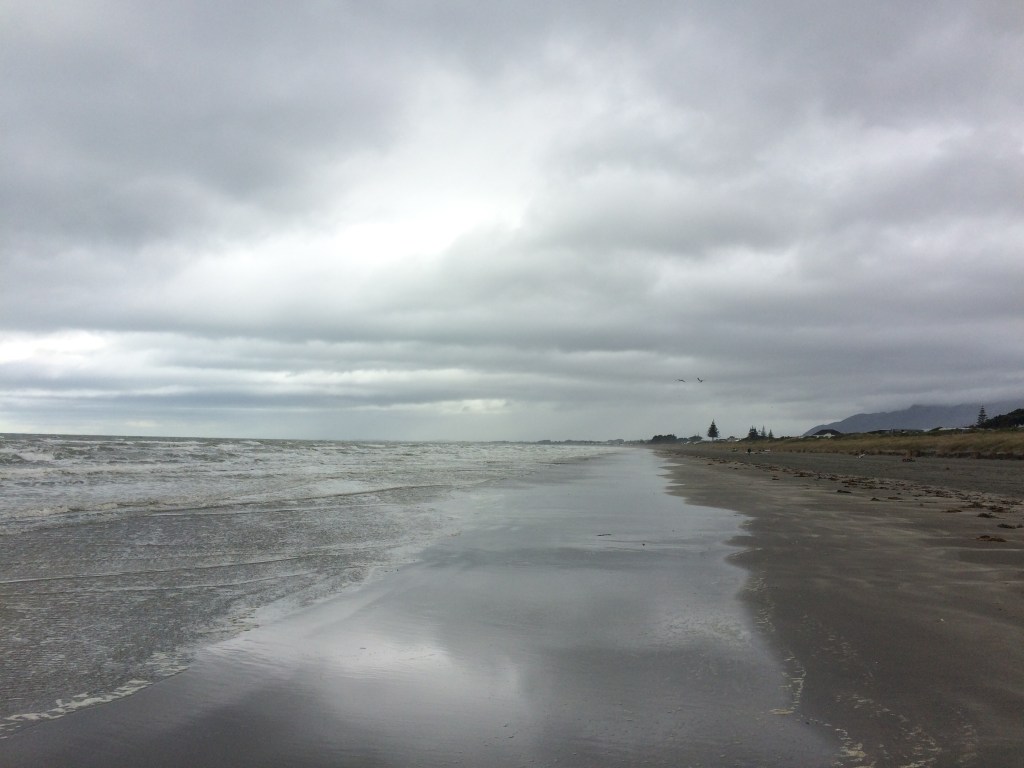
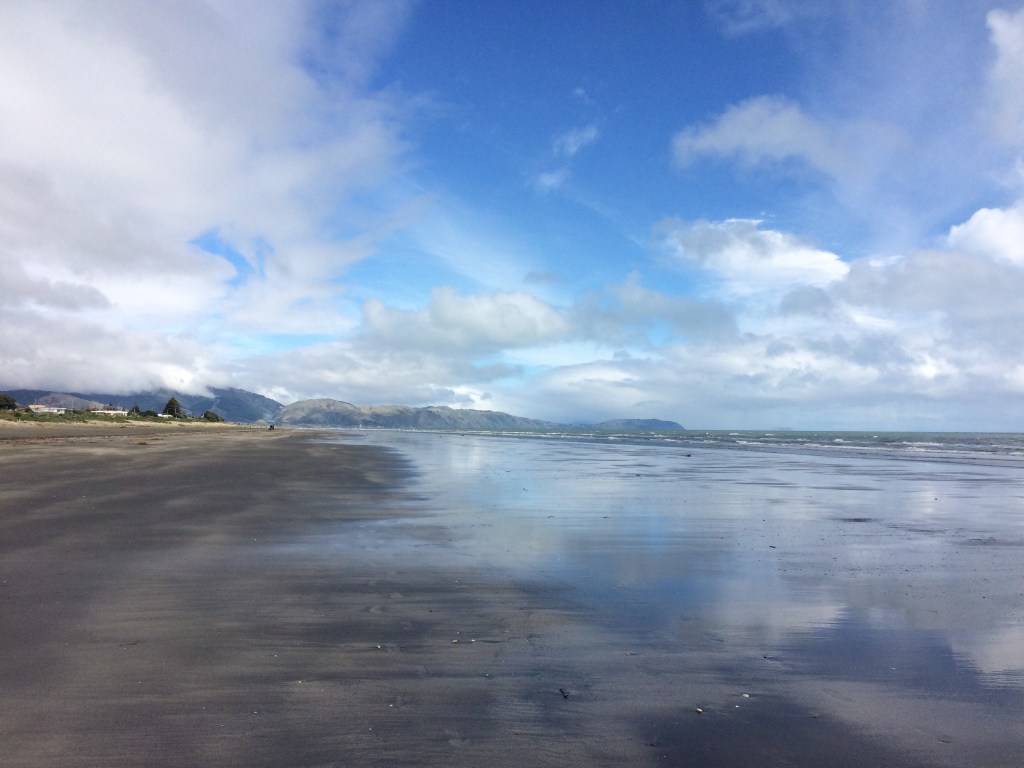
After breakfast I packed up and went down for a look at Waikanae Beach, it being only a hundred metres or so from where I’d slept. Here’s the view north:

And here it is to the south, including a bit of Kāpiti, the legendary and ripple-spined island I was to spend the day walking beside.

I walked down and let the Tasman Sea touch my boots. It the first time they’d tasted saltwater on the trail since it turned inland from the Santoft coast, south of Whanganui, 207 kilometres back.

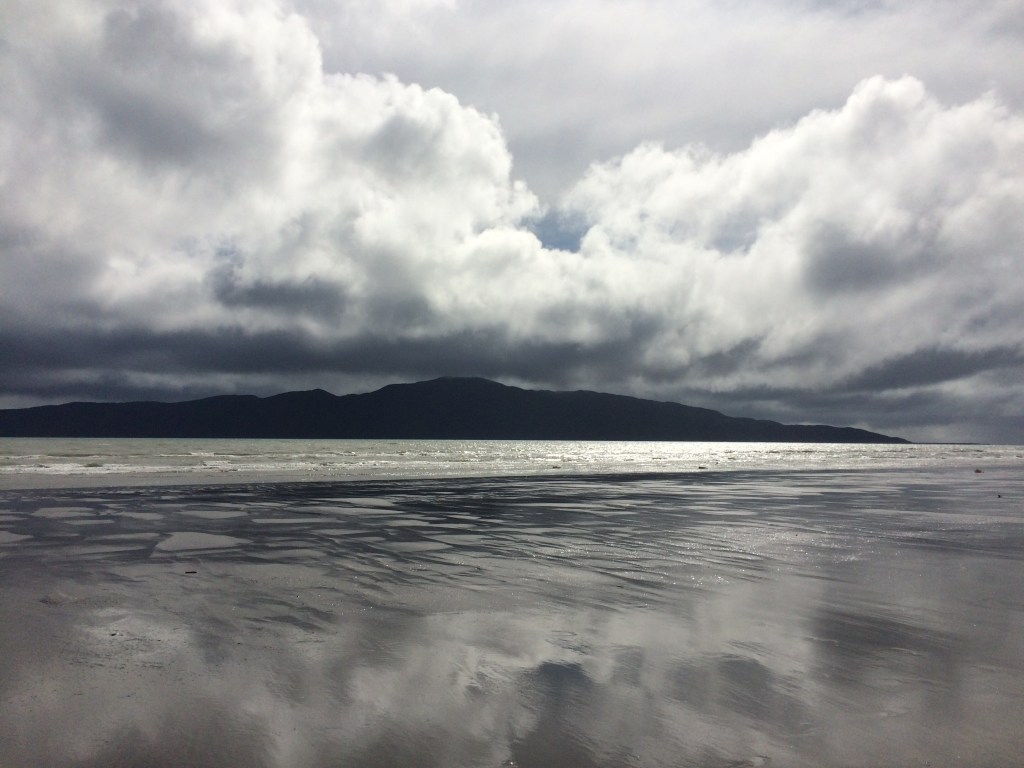
And there it was, the full length of Kāpiti; I don’t think I’d ever really looked at it from this beach, more to the north than where I usually see it from, and it looked different. I liked how you could see layers to it, peaks further back than the main one, new lights and shades to the bush.

I also liked the storm-coloured sea; normally it’s a brilliant, sunny blue, but not that rainy old week in spring.

I backtracked a kilometre or so, crossed the Otaihanga Domain footbridge and I was back on the trail. It goes back down the river again, but on the south side now.

There was a tino rangatiratanga (Māori sovereignty) flag right beside the path. With Kāpiti as a backdrop, it reminds walkers that this land – and all of Te Araroa, all of Aotearoa-NZ – has an ancient and continuing connection with mana whenua: those whose relationship with the land goes far deeper than capital gains. Even if they have often been alienated from it by the complex forms of violence that are intrinsic to colonization.

The tracks flows into boardwalks, part of a fantastic wetlands restoration scheme, run largely by volunteers. This is the Waikanae Estuary Scientific Reserve, a nationally significant and unusual coastal environment which is a real treat to walk through.

They Waikanae Estuary Care Group have planted hundreds of thousands of native trees and rooted out as many noxious, exotic weeds – reversing some of that colonial damage.

The Department of Conservation is the group’s main partner. I liked how government and citizen, each in their own language, communicates just how high the stakes are:

I liked the blunt warmth of the Care Group’s signage, and their obvious deep love for this special, vulnerable ecosystem.

I came across a peaceful-looking woman standing beside the track, her face full of dreamy repose, two dog leads dangling loosely from one hand. She was watching indulgently over two German shepherds nosing around in the long grass nearby. I saw her eye my backpack, then the lowering clouds, and smile.

“You picked a funny time of year to go camping.”

“Well, I’m walking the length of the country, so I have to take what I get.”

She nodded and asked where I’d come from, where I was going. She liked the idea.

“Oh, it would be great, you’d see all sorts of things you wouldn’t see from the road or the train. Are you doing it for anything in particular?”

“Nah. Just for the hell of it.”

She laughed. “Good on you.”

I asked if I could pat Jonty, the young male shepherd, and when she said yes he came straight over and leaned his big, warm body against me. Jonty knew when a pat was in the offing. I gave him a good old ruffle while the woman watched. An idea came to her.

“Imagine if you had a dog! To come with you, as a companion on your journey.”

“That’d be great, but there are long bits of trail where you can’t have dogs – they can damage kiwi, and that.”

She nodded, casting a protective look at her dogs.

“Mine aren’t bird dogs, so they’d be no problem. Although,” she thought it over, “I suppose they’d give a kiwi a fright.” She mused on it a bit more while I stroked Jonty’s ears. She perked up.

“You could get a little dog. Then you could just pop it in your back pack.”

It was a good image to part on.

The boardwalks curve past swamps and lagoons, then across some dunes.

I knew the main beach was coming but after chugging through the closed, intimate environment of the wetlands, it was still a thrill to round a dune’s steep corner and find myself out on the wide-open, salt-rinsed expanse of Paraparaumu Beach:

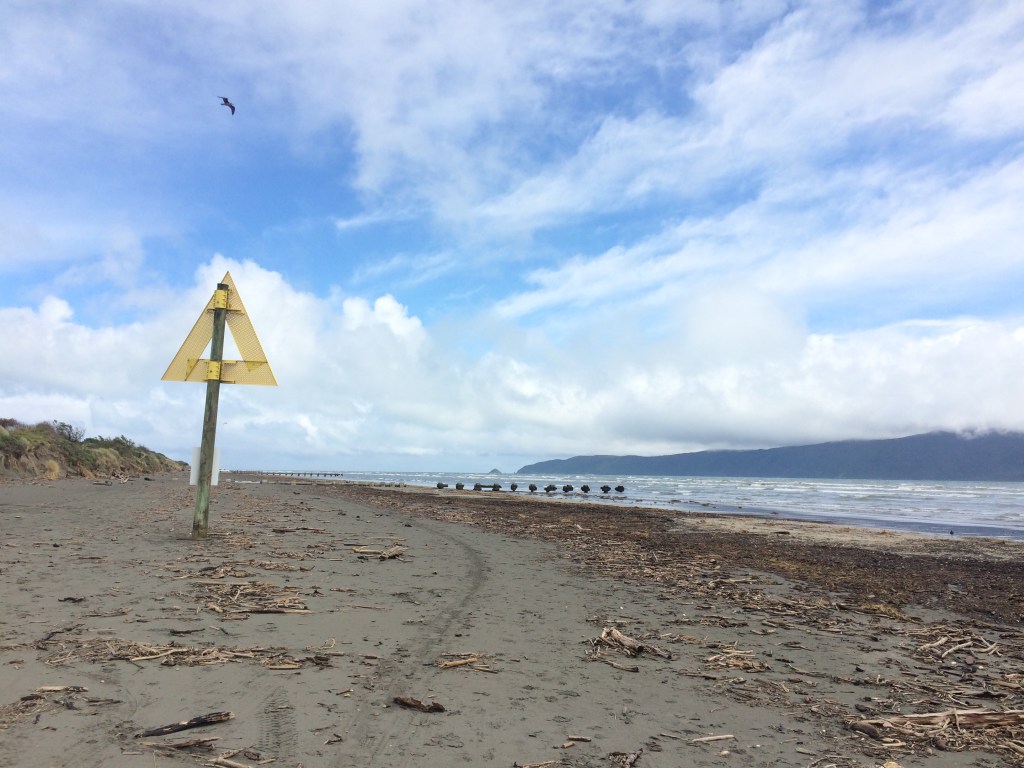
The wildness of it was somehow enhanced, not diminished, by the beach furniture: the big yellow marine reserve sign, a white cross on the dune, and some sort of decomissioned pipes mouldering into the sea on crumbling cradles.

Slowly, surely, after a bit of eddying around the river mouth, I was moving south again. The island was fully present again, along with the open sea, the windy wastes of sky, and a long spray of bladder-wrack and driftwood, the latter carved into weird shapes by the waves.

I spied a man roughly my age walking toward me, following the same line where the dunes met the flat sand, picking his way, like me, through the driftwood. He wore jandals, rugby shorts, a hoodie and a wool beanie that looked home-knitted. His long, white legs had a springy stride and he gazed around himself constantly. He had a pleased, but guarded expression, as if the whole world was very interesting to him, but that he wasn’t going to rave about it.

We caught sight of each other at the same time, then quickly looked away, nonchalance being important. When we got close, our eyes met again, and he spoke first.

“GiddayHowAreYa.” He said it flat and fast, without breaking stride, but I knew there was no lack of courtesy; just a discomfort with banality.

“Good thanks,” I said. “You?”

“YES.”

Communication achieved, conversation over. And he was gone.

Further on, I looked back north and watched a guy using a kind of parachute, attached with lines, to sail a go-kart up the beach:

It was such a delight to be back in the groove of swallowing miles, just putting yourself in gear and feeling the cadence of your breath, heartbeat and stride merge. Much like the merging of sea, sky and land, as the tide lowered:

Kāpiti was a constant companion, along with the gulls:

I liked how travelling a long way down on the beach, on foot, revealed new things about this coast I’d never noticed. Like the small islands in the channel between the main island and the beach. This is probably Tokomapuna / Aeroplane Island, and there are two others: Motungarara / Fisherman’s Island, and Tahoramaurea / Browns Island. I hadn’t even known they were there.

There are cafes near the beach where a couple of high rises poke their heads above the dunes, near a boat ramp. But I had no desire to leave this magnificent beach. Instead I sat down with my back against a sea-whittled log to have a cup of tea and a peanut butter wrap. I watched sheets of rain blow across the big island’s face, blotting out the small islands.

On I went, and as Paraparaumu blended into Raumati, then Raumati South the view began to change. Mana Island, off Porirua began to emerge. I’d be parallel with it the next evening; it’s one of the pleasures of this type of walking, to see the topography unfurl.

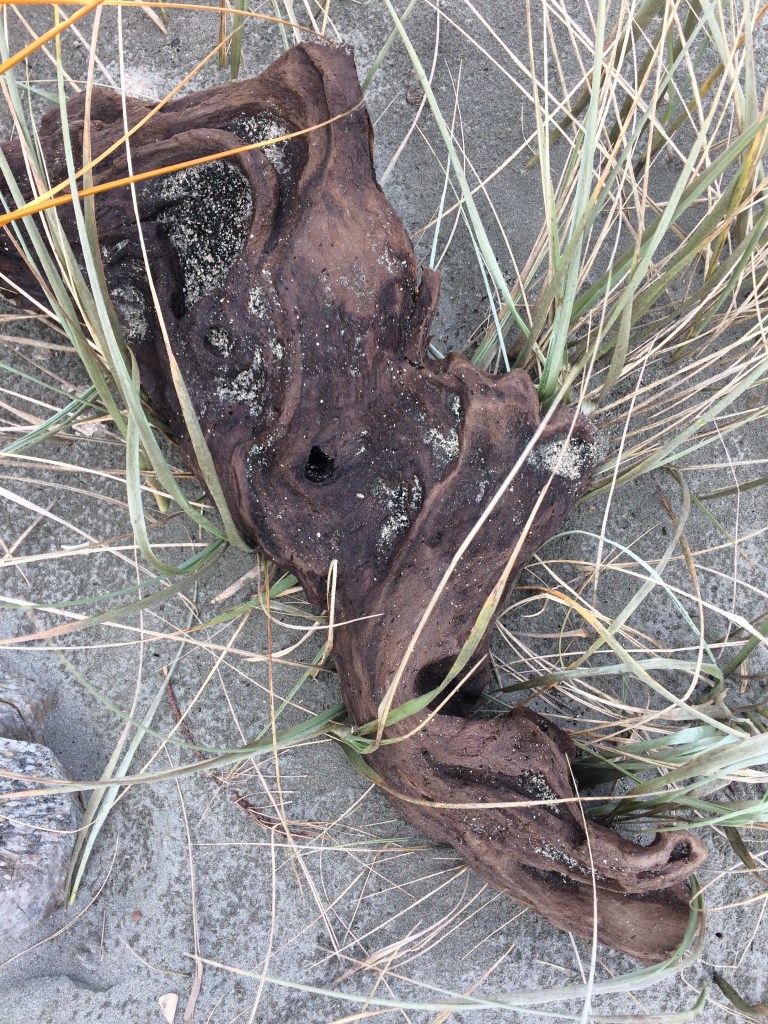
Wind- and wave-sculpted driftwood was still a big feature. Some intricate pieces looked like hey’d been carved by a skilful hand. I had to stop myself wanting to handle every little wooden jewell. A photo was a good substitute, especially for the bigger ones.

The sun came out, and to the south the day’s destination, the seaside village of Paekākāriki, began to appear.

Still the rain-clouds threatened, back-lighting the island and silvering the sand.

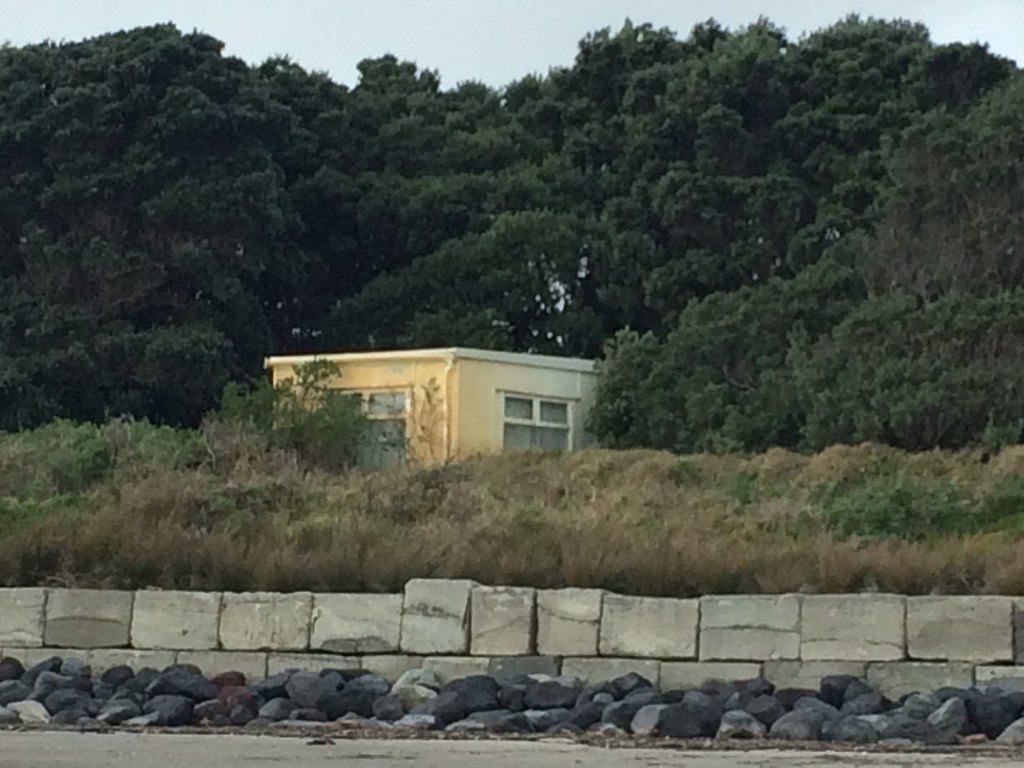
I kept an eye on the baches and homes along the waterfront, many of them palatial new-builds or builds in progress. I liked the humbler ones, reminders from childhood when stays at our “shed” at the beach made me feel like an explorer, sleeping rough in an untamed world:

Paekākāriki grew more distinct, and at its back the new highway going up through Transmission Gully, then still unopened.

I came across the two characters below, a father and son by the looks, in identical black hoodies, gumboots and black tracky daks. I think this was near the footbridge at the mouth of the Wharemauku Stream. The dad was teaching the son to surf-cast along the sand. They stood side-by-side, whipped their lead sinkers up and out of their long, supple rods, then paced out the silvery nylon lines to see who’d gone the furthest. The dad’s arm resting on his son’s shoulders.

It was interesting, in this age of climate crisis, seeing all the multitude of ways bach-owners had fortified their palaces and shacks against the sea. Logs, boards, boulders, stone-filled mesh, earth walls, native planting, reinforced fencing: people here obviously think a lot about the immense destructive power sloshing up against their sand-castles. Some of the barriers were simple and seemed homemade, some had the more elaborate look of a few neighbours clubbing together, and some were imposing, industrial-grade. There was something Quixotic about it all, or Canutian, perhaps. Good on them though – if I had a beach house I’d try to stop the sea eating it too, I suppose.

Here’s a bit of a shot of some of those beach defences, and the gathering storm they stand against:

That long-distance tramping thing of seeing your future rise above the horizon is evident in the next shot: pretty sure the hazy peak in the background, to the right, is Colonial Knob, above Porirua. I’d be going over it two days later. In the foreground is the steep face above the famous stretch of the Centennial Highway that hugs the rocky coast between Paekākāriki and Pukerua Bay. Along the ridge above them goes the new Escarpment Track, built especially for Te Araroa, and also known as the Stairway to Heaven. And those few white specks on the hillside to the right are Pukerua Bay.

Another look toward my destination for this day: Paekākāriki, just beyond Queen Elizabeth park.

I leaned back against one of those Quixotic retaining walls and had a snack, watching the endless emptiness of the horizon just south of Kāpiti Island. That was satisfying: that morning, I’d been looking at it’s northern end. Now I’d walked the length of it.

I especially liked the way this view organised itself into a rich variation on the theme of horizontal lines: beach, sea, sky. Kāpiti’s curves as a counterpoint.

There wasn’t all that much time to linger though, because the light was fading and the rain was brewing. It was tempting to watch the Apocalypse break, but it was time to go.

At the southern end of Raumati South beach you turn inland slightly through piles of driftwood and get onto the Coastal Track, part of Queen Elizabeth Park. You could keep going on the beach, if the tide’s right, but I reckon plump for this track. You get new perspectives on the land and sea, on the ways they’ve acted on each other, and on the community.

This is looking over the Whareroa Stream mouth toward Paekākāriki.

I still had a couple of kilometres to go before dark but it was hard to tear myself away from the intensifying sunset.

Just after the Whareroa there was a picnic area with a tap for drinking water and I stopped for a refuel. There was an info board with photos of the wildlife in the park and stream. My favourite was this truly terrifying photo of a giant kōkupu, rearing up to devour a moth.

Looks like something out of Creature From the Black Lagoon. It reminded me there are tiny, intricate multitudes in these parks and wetlands, more fierce and vivid than most of us probably realise.

The info and photos were courtesy of the Kāpiti Coast Biodiversity Project, another harakeke-roots environmental protection and restoration group. Kudos to them and to all their kind.

Another panel honoured the original and ongoing kaitiaki (guardians) of this moody, mighty place:

The undulating Coastal Path reached a highpoint, and a good view of the new Transmission Gully highway. A topographical illusion made the two paths blend: the gentle footpath and the multi-lane monster. The giant kōkopu and the moth?

On the other hand, that spectacularly perishing sun.

I came across a cool old touring bike, in great nick, lovely leather pannier, flung down casually. Stolen? A missing person? Melancholy was in the air and I felt a chill.

I went up the nearby knoll and was startled to find a youngish, quiet-looking guy sitting there, legs dangling over the sandhill’s lip, gazing out to sea.

“Checking traps?” he asked gently, seemingly unfazed by anything.

“What? No… just saw the bike and I wondered, um.”

“Oh yip,” he said. “It’s mine. I just like coming up here to…” – he gestured to the pyrotechnic grandeur unfolding in front of us – “you know.”

I did know. I left him to it and carried on. The path, the coast, Mana Island beckoning:

Have you ever gone down to the shops on a bike, then realised you’d forgotten to bring a bag? Like me, you might have solved the problem by tucking your coat into your belt, putting bags and bottles inside, then zipping up for the ride home. It works OK. (Though a Massey student I knew did it once with half a dozen lock-neck bottles of Tūī, and he fell off and ended up with quite a lot of stitches.) Anyway that’s how the sky burst just then: like a coatful of bags and bottles, suddenly unzipped.

It crashed down on me from the north-west, freezing and near-horizontal, a furious force at my back. I didn’t mind; it was the first real test of the new, storm-proof raingear I had – coat, mittens, leggings. It was great, actually. I felt like Scott of the Antarctic, “base camp too far away”.

Only it wasn’t. In minutes I was crossing a footbridge over the Wainui Stream, passing the surf club, turning onto Queen Elizabeth Road and reaching the Paekākāriki Holiday park.

The unflappable owners sorted me out a good campsite close to the ablution block and kitchen and soon I was cooking my noodles at the good old formica table under the good old flourescent lights.

You can meet some interesting characters in these places. That evening over my noodles I met a couple of mates who are pretty much living in the campground, each in a three-man tent, using the communal ablutions and kitchens. For entertainment they read, go for walks and watch DVDs together on a laptop.

One was slightly built, quiet and thoughtful, silver-blonde hair tied back. The other was tall and forceful, blonde locks also long but flowing freely, Norse warrior style.

They told me they’d got kicked out of their rental of many years some months before. Now they were living at the campground while putting together a legal case to get their old home back.

“We could have put our name on a register, got into a tiny cold pokey council flat or something,” the quieter one said. “But we want to go back to where we were. And meanwhile we prefer this lifestyle. More freedom, fewer hassles, and you’re by the sea, trees all around…”

They were biding their time until a Covid alert level announcement came out the next day, hoping it would allow them to travel to their home city, to work on their legal situation in a warmer climate.

We talked about tramping and books. They prefered true stories of pioneering courage, solo adventurers overcoming incredible odds, unbound by society’s conventions. Their favourite bookstore was Bob’s Books in Brown’s Bay, Auckland – now closed.

“He would write a note inside the front cover if he thought a book was truly outstanding. He was a legend.”

The awning of his shop was full of holes. The campground comrades didn’t have much funds, but they admired his bookselling ethos so much wanted to do something for him. They offered to buy him a new awning.

“I believe every creative person needs help. And if we can help them, we must,” the warrior explained. But Bob refused to be helped.

“He was too proud. But man, he had good books. The kind of books you’d only find once a year. Maybe twice. It’s hard to get books that good anymore.”

I could’ve yarned with those two for hours but I was done in. Drifting off to the rain pattering on my little tent, I reflected, not for the first time, what a luxury it is to be a voluntary nomad. To live precariously under nylon, to choose to walk all day and sleep on the ground at night. That there are many in our society who are more or less forced into it.

It was a good end to the first part of my 100km stint from Ōtaki to Wellington. Parts 2 and 3 follow in subsequent posts. You can read the whole journey from Cape Rēinga south by hitting the “home” button at the top of the page.

Thanks for reading! Mauri ora.

Following the silvery line, PART 2 OF 3: Ōtaki Forks to Wellington – Te Araroa Trail days 82-87, kms 1578-1672 (Day 86: Paekākāriki to Porirua)

Day 86: Paekākāriki to Porirua (27km)

I got up with the sun, breakfasted and broke camp. The path along the Paekākāriki waterfront was drying quickly, after the storm the night before.

Across the breakers, I could see the hills around the sounds at the top of the South Island. That’s where the trail heads after Wellington. If I can swing it when the time comes, I’d love to make the crossing by kayak rather than ferry, to keep up my current thing of never using motorised transport on the trail. But that will be a significant mission, and is probably a long way in the future. In the meantime, it was satisfying to contemplate those tantalisingly close, misty contours.

Pukerua Bay, the next town south along the trail, was taking shape in the distance, above the elegant lines of a drawn-up dinghy.

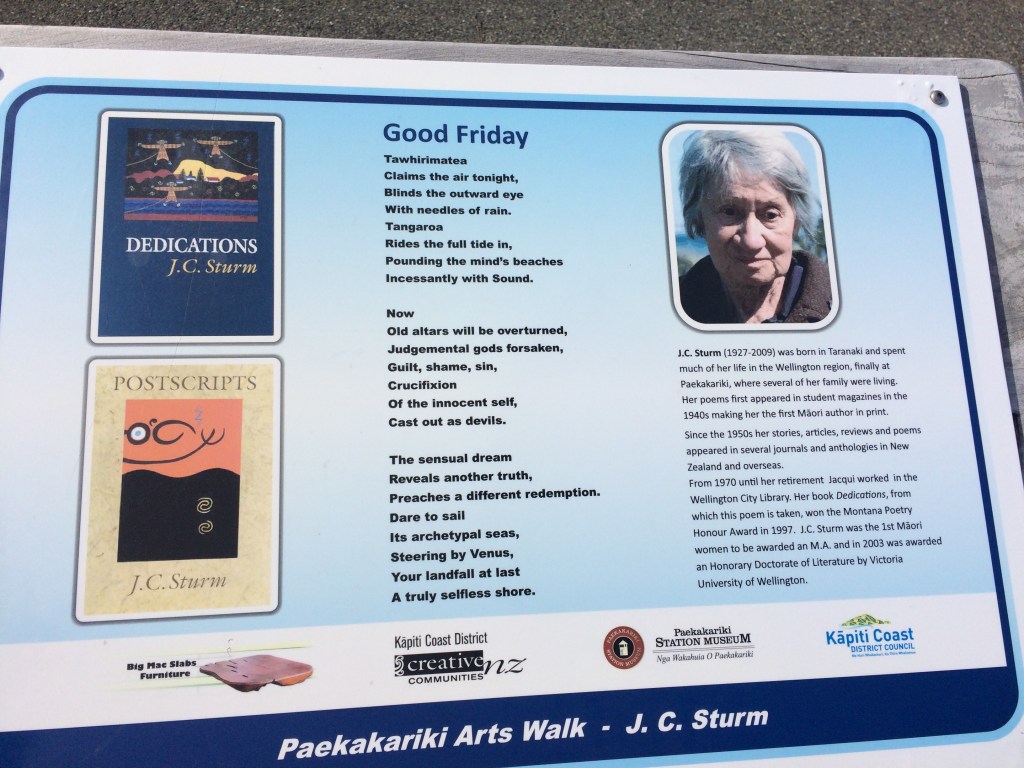
Another attraction of the waterfront path is a series of plaques honouring Paekākāriki’s creative citizens. The village has a history of homing artists, such as distinguished, brilliant poet J. C. Sturm:

I liked this pic from another of the plaques; it captures Paekākāriki’s beguiling location, nestled on a narrow strip between rugged hills and endless breakers.

The trail soon swings away from the beach and into the village proper, and I stopped for a coffee and a pie. Then the route crosses the nation’s main trunk railway line and goes briefly alongside State Highway 1. You almost wouldn’t know it though, as it winds artfully through a stand of trees, before emerging at a gate leading to a railway underpass, then up onto the famed Escarpment Track.

Sadly though, the tall gate was secured with a heavy chain and a padlock. A sign fastened to it warned the Escarpment Track was closed due to a recent slip; trampers were requested to keep out for our own safety. I looked up the “trail status” section of the Te Araroa website and a photo confirmed the wash-out was pretty bad. If you tried to scramble across, you’d be getting dangerously close to falling on the main trunk line.

It was disappointing but not too much, as I’ve walked the Escarpment a couple of times before on day trips. It really is spectacular, a roughly 10-km jaunt with stellar views up and down the coast. But as I turned away I began to actually quite look forward to the alternative route, which follows the footpath beside the Centenial Highway, right beside the sea, a fabulous piece of coast I’ve seen many times from cars, buses and trains, but never on foot.

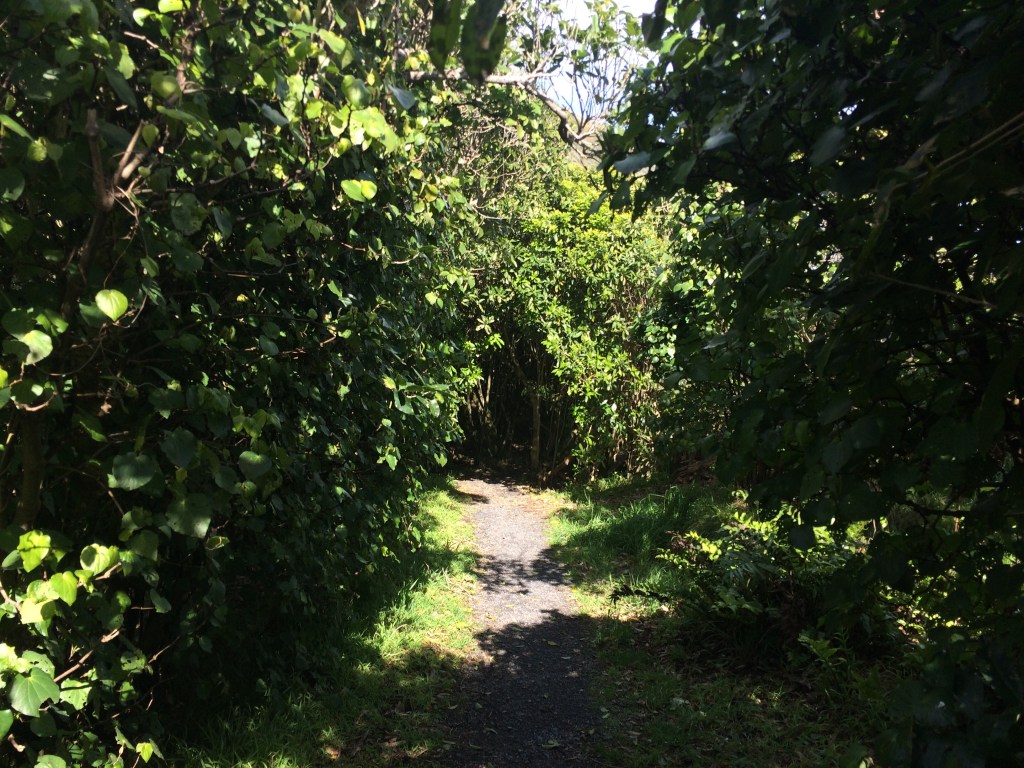
First you go through a short sandhill track through native bush, sun-dappled that morning:

It has great sea views too, right out to the Marlborough Sounds again.

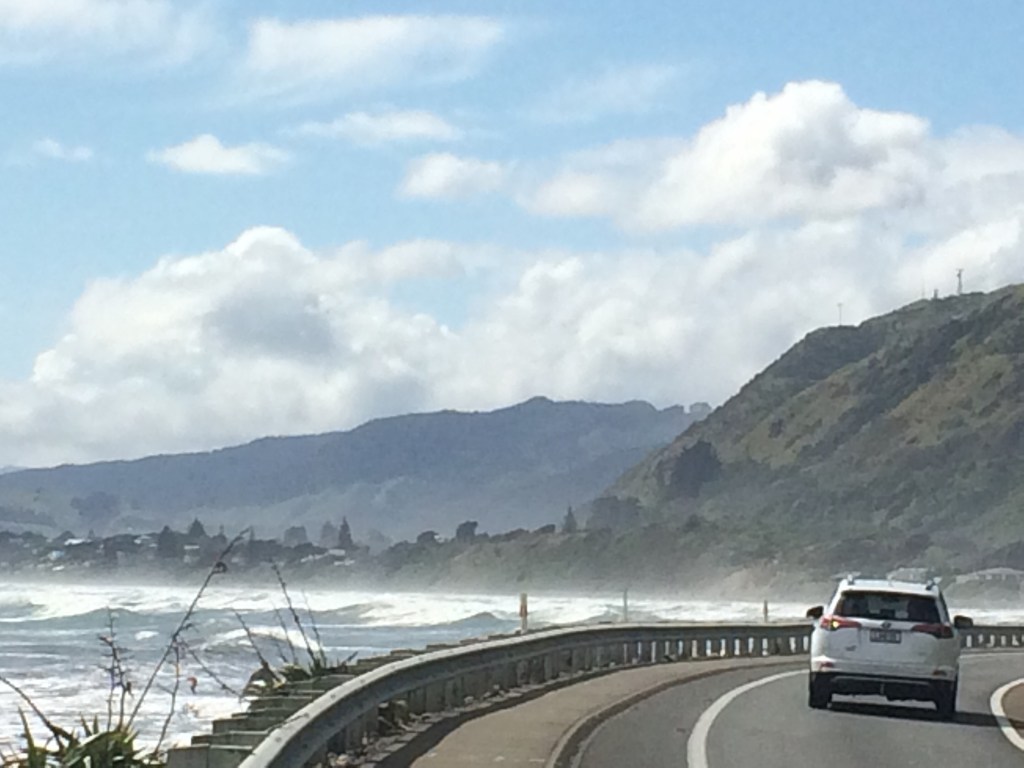
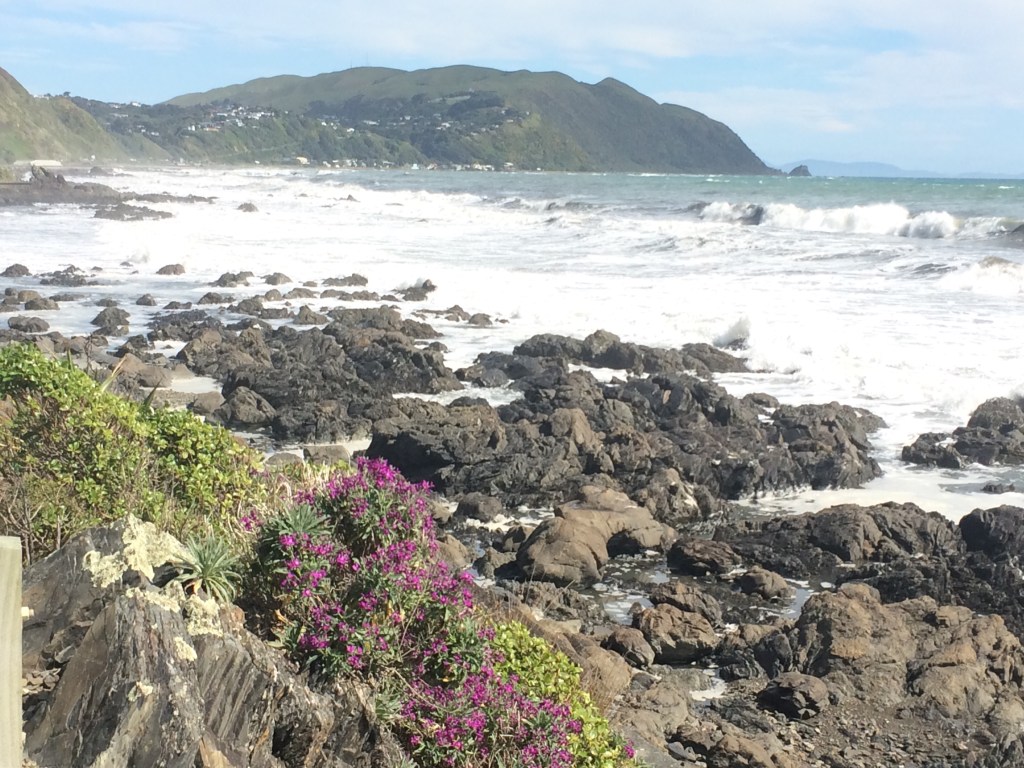
And it had my first close-up close of the route ahead. It passes along a hard-won strip between Tasman breakers shattering on a long reef, and the steep, rocky slope above them. Work gangs dug and rammed and blasted the road platform inside a hastily-built seawall 80-odd years ago, to carry the nation’s traffic to and from the capital, and in my opinion it’s one of the most dramatic bits of road in the country:

This is from a high point, looking down onto the Fisherman’s Table restaurant, a legendary spot at the end of Paekākāriki and beginning of this special bit of highway:

The footpath between the road and sea is fairly minimal, and that’s part of a unique walking experience:

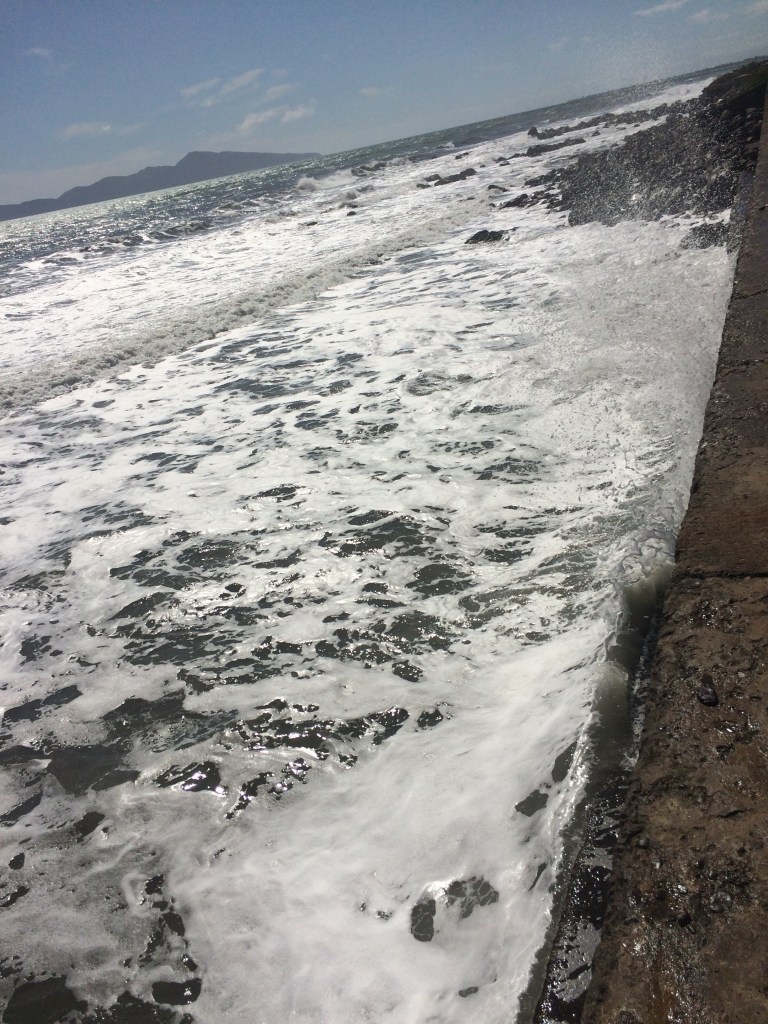
On one side of the wall, frantic-thundering industry and artifice. On the other, absolute untamed nature:

This one is looking back north, with a bit of Kāpiti Island and the Paekākāriki coast:

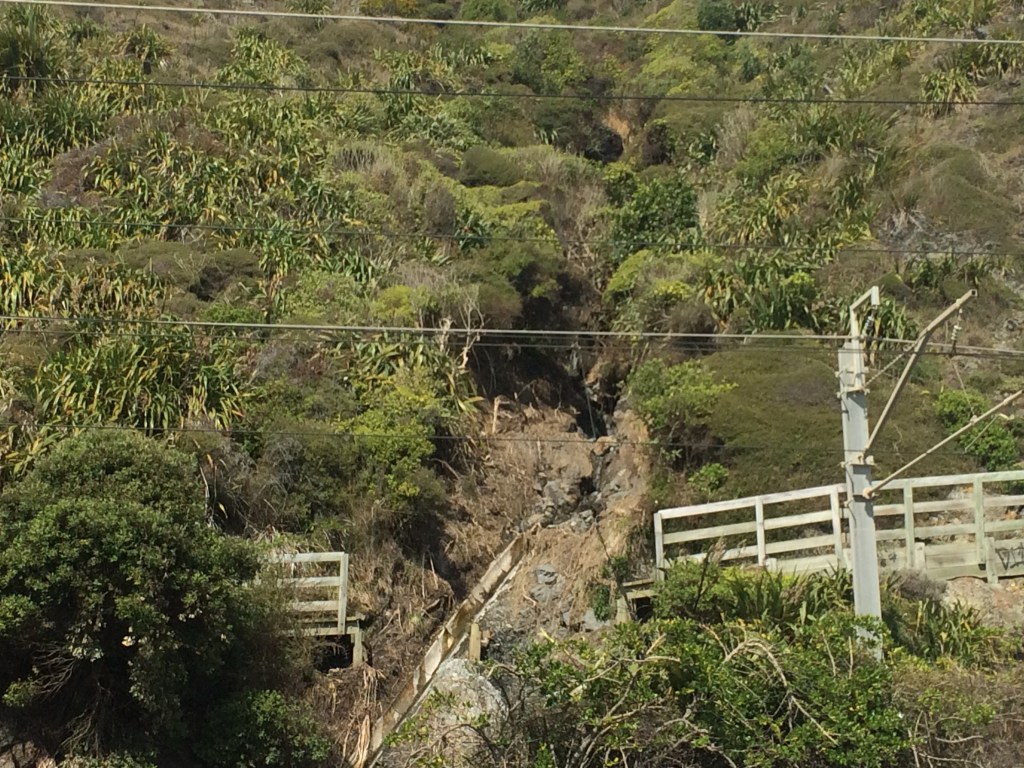
Before long I came to the washout on the Escarpment Track, just before it stops following the rail line and swoops upward toward the ridge. It might not look like much, and yes you could probably pick your way over. But the Te Araroa trail’s existence rests on goodwill from entities like KiwiRail, so respecting their space seems the right thing to do.

A movement caught my eye. Another tramper was making his way along the trail above me, heading toward the slip. I watched while he stopped, saw me, got out a camera and photographed me while I photographed him. Both of us keen to capture the alternatives we each contemplated, I guess, at the locked gate: “You take the low road, I’ll take the high road…”

What would he do at the slip? I watched as he approached. He inspected it a while and I could tell he was tempted. He glanced my way a few times, then finally turned back, his body language reluctant but resigned. This is him, in the centre just above the train line, a bit later, sitting on the edge of the trail for a rest. A sign saying, I presume, “warning: turn back” is just to his right.

Another look back north. Breakers, harakeke, curved steel, traffic, maunga:

To the south, Pukerua Bay gained in definition:

It was not long after high tide and the top of the seawall, and path, were often strewn with seaweed, wave-carved driftwood and stones. The bigger waves still splashed right up in the air, the light spray refreshing:

It would probably be a little sketchy, walking along here at the peak of a king tide.

There were a few little havens where wind-blown soil and seeds had gathered on the rocks:

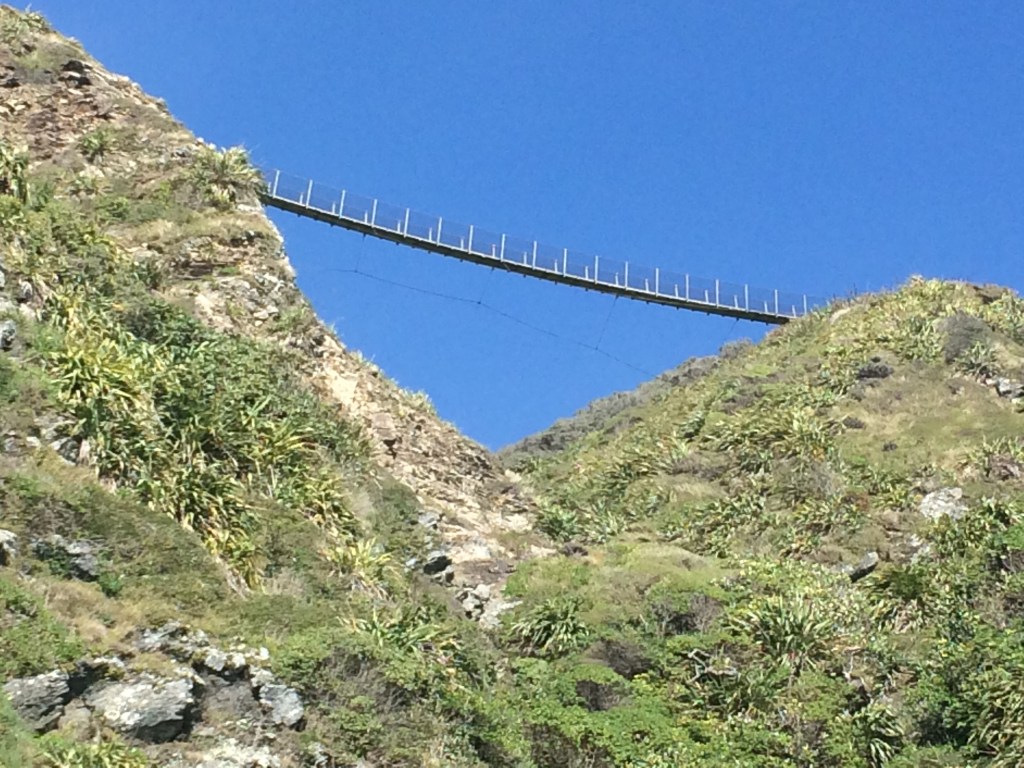
I passed under another highlight of the Escarpment Track, one of its swing bridges.

This apparently is quite a famous local landmark, one of a couple of pinnacles that locals learn to rock-climb on:

Then it was down a path from a rest area, away from the juddering yowl of the highway and toward Pukerua Bay.

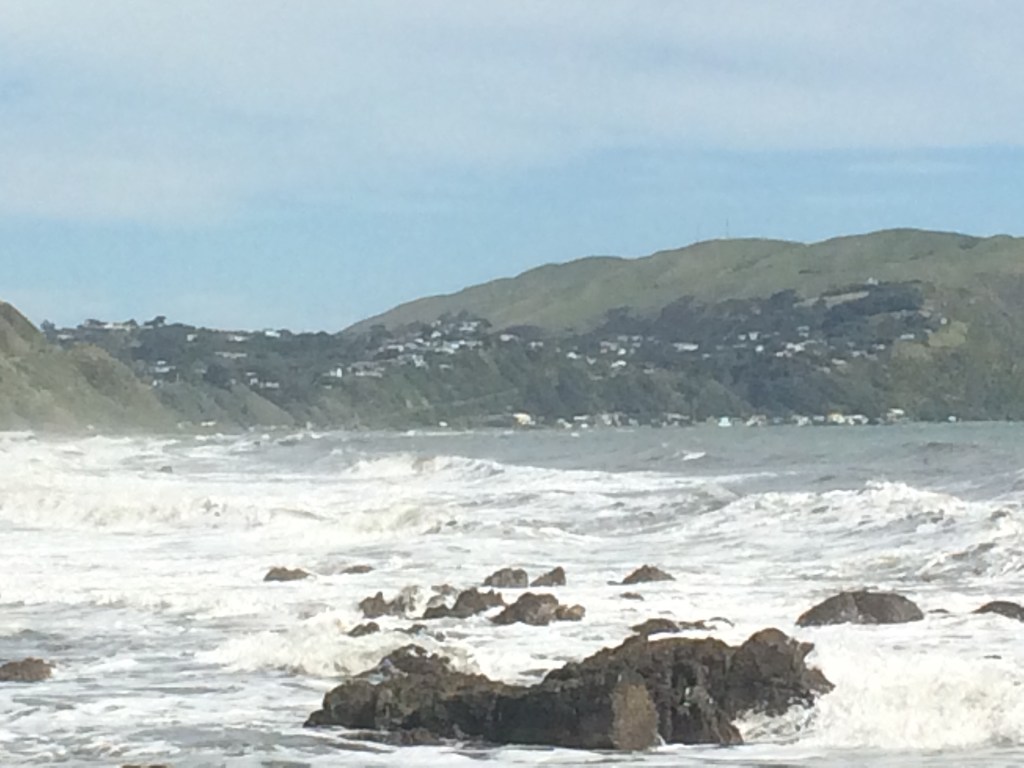
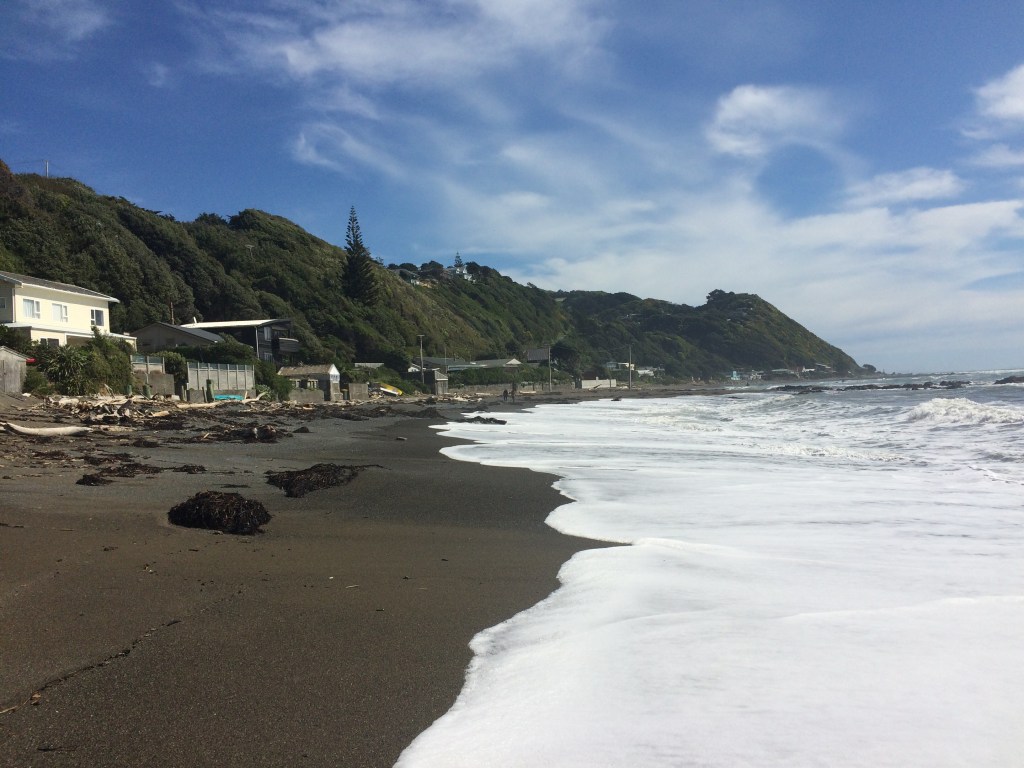
Brendan Beach, made of fine gravel and foamy waves:

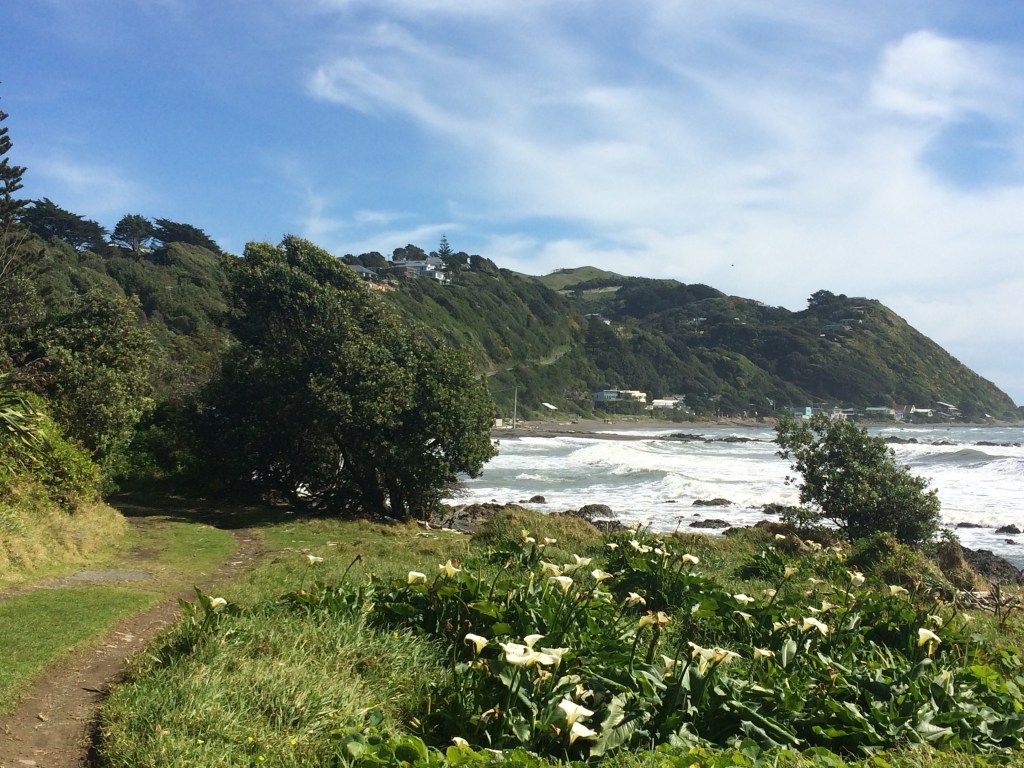
There’s a path along the beach, often completely smothered in sand and storm-tossed sea-wrack. I envied these cottage owners – no road to your door, no traffic, nothing but you, the sea, the horizon.
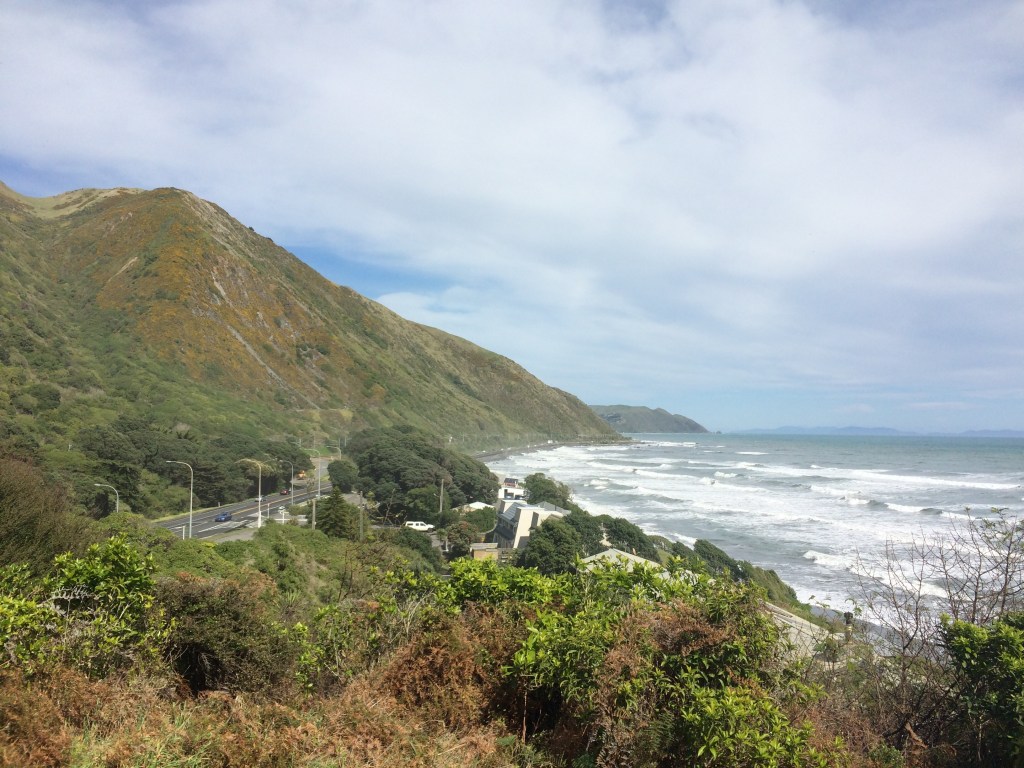
Then you follow Ocean Parade around to the main beach. It was early spring, and the snowdrops and buttercups added their gentle touch to proceedings.
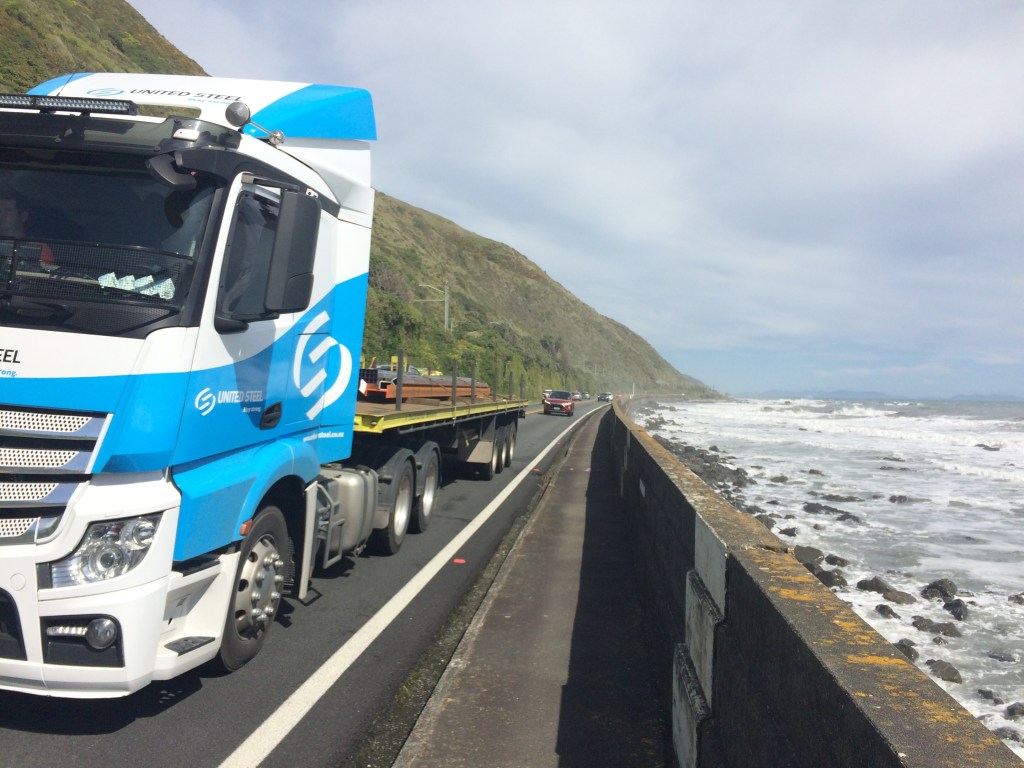
An info panel showed some of the long history of this special little place, a pocket between land and sea.

Then it was up the forbiddingly named Goat Track, past exuberant gorse up to the main part of the township.

At the top of the track this guy kept a fairly lazy watch from his prime spot in the sun on Rāwhiti Road.

I stopped at the dairy beside the highway for an icecream and a ginger beer. Then it was due south along the Ara Harakeke, the Flax Pathway, which crosses a footbridge over the rail line then follows State Highway 1. Here’s the track, and on the horizon the first glimpse of the next destination: the hills above Porirua Harbour.

The highway through here takes a big curving deviation, largely to go around this recalcitrant bit of nature that just would not accept being built on:

Here’s the mighty swamp, gleaming in the afternoon sun.

And looking north:

Te Ara Harakeke is a pleasant enough route, although asphalt is not the most enjoyable surface to tramp on, and the roar from the highway is a constant companion. In time, the native plantings between the road and the path will grow up and it will become more of a placid experience.

Before long the pathway passes through an industrial area of Plimmerton, skirts a playing field, goes through a rail underpass and comes out onto the main beach at Plimmerton. Through the mouth of Porirua Harbour, Mana Island welcomed me in the golden afternoon:

Looking south along the beach I could see I still had a long way to go that day – right past all these houses and up to the edge of Colonial Knob, out of view at this point.

A woman strolling on the beach with her partner, a toddler, a baby in a pram and a couple of dogs smiled at me.

“Doing the trail eh? Good work bro.”

From the beach you follow a gravel track between the railway line and the back of a row of buildings. You go past a marina to the mouth of the Pāuatahanui Inlet, the eastern-most arm of the Porirua Harbour, now officially known as Te Awarua-o-Porirua Harbour. It’s the largest estuary system in the North Island, a nationally significant wildlife area and is very rich in history, particularly for the tangata whenua, Ngāti Toa. In their words:

TOITŪ TE MARAE O TĀNE, TOITŪ TO MARAE O TANGAROA, TOITŪ TE IWI

If the domain of Tāne survives to give sustenance,
And the domain of Tangaroa likewise remains, so too will the people

In my rough translation, I believe that means: If we look after the land and sea, we’ll survive too.

The walkway goes under the rail line and up onto the Mana/Paremata bridge.

And there it is, the disconcertingly-named Colonial Knob:

What kind of a colonial knob would name a magnificent maunga like this “Colonial Knob”? I think it’s high time we decolonised this awful label and restored the original, much more musical one, Rangituhi. A source I found gives its meaning as “sky glow”, which seems perfect.

A pedestrian overpass takes you over the motorway and provides good views of Te Awarua-o-Porirua –

and the tidal flats, looking north –

the marina –

the golden hills –

and the moon above Papakōwhai.

Beyond the dull shine of the rail lines, Rangituhi was continuing to get its glow on.

The trail heads north along Papakōwhai Road. Tidal pools begin to appear beside it. The best one was Aotea Lagoon, silvery in the fleeing light, surrounded with inviting paths and gardens:

Porirua, it was turning out, has quite a few hidden gems like this. It’s a city that doesn’t always get good press, often because of structural racism. But the trail was showing me a Porirua with a hearty energy, striking good looks and down-to-earth charm.

It’s another joy of Te Araroa: arriving slowly and on foot reveals an area’s depths and facets, aspects you might’ve missed, despite having driven through or past a thousand times.

The trail takes you up a hill and into the grounds of one of the Wellington region’s most well-preserved postcolonial estates – the Gear Homestead. A pioneering magnate built a grand home up here on rise overlooking the harbour, as a present to his wife, and it was eventually gifted to the nation. There are ideal picnic spots, flower beds, pathways and interesting artefacts on every side:

The old villa itself, now a cafe/restaurant and bar, was once used as a set for an iconic sci-fi comedy splatter movie (Bad Taste, an eye-popping first feature for Sir Peter Jackson). It had a spooky appeal in the last of the light:

Out over the harbour, the lights showed the way out to Tītahi Bay, through the leaves of tī kouka trees, the Te Araroa trail emblem.

Below, the nation’s artery was slowly unclogging in the gathering dark.

The trail exits the Gear property via the “Adrenaline Forest”, where hair-raising ropes courses sway and loom among a huge, old stand of pines. Past that, I stopped for a break, looking straight down the Aotea subdivision bike path to the lights of the Porirua CBD.

At the end of the Aotea path you turn left for a brief bit beside the motorway, then you go up and over “The Ramp”, a local nickname for the motorway overbridge. It takes you into the heart of one of Aotearoa’s most diverse, humming and underrated cities.

You take a footpath beside an inlet of the estuary, up Bullock Lane toward the railway station. It was nearly totally dark now but the estuary looked clean and well cared-for; and impression borne out by hundreds of silver, finger-sized fish thronging shallows under street lights. When my shadow fell on them they jumped away as one, an electric wave of connected lives.

At the railway station you take the Raiha Walk through the CBD and up bushy gullies and slopes toward Rangituhi, on the other side of town. It’s yet another section of trail whose construction was led by the Te Araroa Trust, which has been quietly opening up under-appreciated bits of the nation for more than a decade now.

You see a side of Porirua you just will never know if you never go on foot. It’s brilliant the way the trail stitches together the city’s natural, wild nooks to make a new route. One of these nooks is the stately parkland where where the trail passes the grounds of Te Wānanga o Aotearoa, NZ’s prestigious, Māori-oriented university. A magnificent sculpture lets you know where you are:

As do the trail signs: only 1354km to Motupōhue!

It was peaceful and solitary on the track, which climbs steadily behind factories and between subdivisions.

At one point shouts, whistles and laughter began floating toward me through the soft-breathing bush. They grew in volume until the path popped out beside the tall mesh fence of a large football academy. Dozens of fit youngsters sprinted up and down, locked in an intense training game on the bright green artificial turf.

This isn’t much of a photo, but it just about captures the pleasure of night-time tramping through proper bush, in the heart of a thrumming city.

Finally I reached Elsdon Campground, right on the upper edge of Porirua. Below, the city’s lights shone through the camp buildings; above, Rangituhi’s cloak of bush creaked in the night wind. I pitched my tent, scoffed food and slept.

My Ōtaki to Wellington section concludes in the next post. You can read previous posts, right back to the start of my Te Araroa journey, by hitting “home” at the top of this blog.

Thanks for reading! Ka kite.

Following the silvery line, PART 3 OF 3 – Ōtaki Forks to Wellington: Te Araroa trail days 82-87, kms 1578-1672 (day 87, Porirua to Wellington)

Day 87: Porirua to Wellington (22km)

I was pretty sore and tired when I woke up on my 1cm-thick mattress in my tiny little tent. I could see my breath in the air, I had a dehydration headache, and all my joints felt rusted shut. Five days straight of walking all day, after not much training, will do that. After breakfast in the Elsdon Camp communal kitchen, I took some Ibuprofen and rubbed on a possibly dangerous amount of Tiger Balm. Then I hobbled up to the manager’s office to pay, feeling broken, and taking in the view of Porirua:

The pic below shows where I pitched my tent, on the small lawn in the middle. The best part of this campground, apart from the view from the manager’s office, is the bush and birdsong right down to its edge.

Mine was the only tent, surrounded by people sleeping in buses, vans and caravans. Many of them, I learned while chatting to a couple over breakfast, were long-term residents. They live at the camp not necessarily by choice but because of high rents and the impossibility, for many, of getting a house deposit together.

Again, that sense of my absolute privilege in being able to adopt and cast off the nomadic life as I choose.

The path up Rangituhi begins just outside the camp’s gates. I was soon immersed in cool, still bush.

This path is very popular with Porirua locals, who have made a morning or after-work constitutional up the “Knob” a part of the city’s way of life. Watching them stroll past me, gossiping and laughing as I Iaboured under my pack, reminded me of the way people in Ngāruawahia have become proud frequent flyers on their Hakarimata summit track – also part of Te Araroa.

About two-thirds of the way to the Rangituhi summit there’s a lookout with fantastic views in all directions. To the south, my day’s main objective: Mt Kaukau, Wellington’s northern gateway. That’s it with the big TV and radio aerial, right on the skyline. It seemed a bloody long way off.

To the south-west, the Rangituhi summit, also aerial-capped. Much of the actual summit has been cleared for farming, but some is gradually reverting to bush, or at least bright yellow gorse and tenacious, olive-coloured scrub.

The next pic’s to the south-east, where the new Transmission Gully route comes in to rejoin State Highway 1, down through Kenepuru, Tawa and Johnsonville toward central Wellington. On the horizon you can just make out the tops of the Remutaka Range.

This is north-east, showing the new gully road swooping in, and the foothills of the Tararua Range up beyond Pāuatahanui and the Akatarawa Road.

This one’s looking north, over the Porirua CBD and the harbour. You can make out the Paremata/Mana Bridge over the mouth of Pāuatahanui Inlet, and beyond it, the hill between the city and the Kāpiti coast. The small dark green blob near the centre of the pic, beside the motorway, is the Gear Homestead and Adrenaline Forest that I mentioned in my previous post; on its right, the Aotea subdivision.

The wind from the north howled and battered. I went for a look around. Hidden in scrub near the summit something caught my eye: a heavy log, wrapped in a white cloth. Someone had written things on it with marker pen – names of loved ones, it seemed, along with personal problems: “my anxiety”, “X’s depression”, “Y’s anger”, “Z’s negative memories”. I imagined the writer, a big-hearted parent maybe, walking up their city’s special maunga bearing this symbol of their burdens. Standing a moment at the top, breathing hard, taking in the size of the view, the size of what they’d lugged up there. Closing their eyes, maybe, then chucking that log high and out, sending it spinning into the wind and the bush. Letting it fly. Feeling the power of all this huge openness flood inside.

It was time for me to get spinning too.

The summit track gets more and more exposed. At times it was hard to stand. Off to the west, Mana Island appeared, from a new perspective for me – almost from above:

Here’s a closer look – a savoury layer-cake of land, cloud and sea:

The summit track was a wind-blasted, wild place. Cresting a small rise the wind made it hard to even take a step; it felt like my heavy pack was the only thing keeping me from blowing into Cook Strait. A mountain biker coming toward me had to dismount and struggle along crab-wise, bent double. Still, I liked the way the land lay, out toward Makara beach:

Here’s a closer shot of those turbines, possibly among the world’s most fuel-rich:

Wellington harbour briefly appeared through the mist, out beyond the hills of Granada and Newlands, but you can’t really see it in this photo:

This one maybe gives a better idea:

Meanwhile, Mt Kaukau loured closer, its massive aerial lost in the clouds:

Following the farm track down off the Rangituhi summit (that infamously and inadequately designated “knob”) I came across these hardy youngsters, following their mum, all three seeming as comfortable and agile in the pounding northerly as I wasn’t:

The trail then winds downward through the Spicer Forest, a pine plantation. It’s a quiet, moody place, with a sense of nature slowly reasserting itself.

Ponga ferns and other natives are slowly coming up among the pines.

After less than an hour you come out onto the valley floor, then Ōhariu Valley Road. Kaukau beckons above a sheepyards.

Walking Ōhariu Rd is a strange experience. Just outside the capital, it would be one of the wealthier rural areas of the country. Much of the valley’s heartbeat seems to be to do with horse-sports. The homes and farm buildings are often elaborate and imposing, the pastures groomed and the white-railed fences looking polished, and on the mailboxes and gateways British names abound: Oak This, Willow That, So-and-so Glen. British vegetation predominates, too: apart from all the heavily fertilised grass, it seems mostly willows, pines, macrocarpas, cherry trees and ivy.

But the most striking things is how the immaculate fences and house boundaries come right down to the fog line, as if the owners begrudge ceding any more land than is absolutely necessary to the public right-of-way. Often there’s nowhere to walk except a deep ditch, or right out on the narrow strip of tar itself. You have to keep alert; there are stetches with nowhere much to go, if a big shiny ute comes barrelling round a corner. Which they quite often do.

It was uncomfortable physically, but also interiorally – it felt unwelcoming, even mean-spirited. As if there is no such thing as public space in this valley, except the bit you traverse sitting in a steel box, behind an insulating pane of toughened glass. No place to wander, to take your time, and certainly not to be any kind of stray.

This pic isn’t a particularly good example, as there’s actually a bit of walking space. Also it’s actually Rifle Range Road, which the trail follows off Ōhariu Valley Rd. But it gives an idea of what I’m on about.

I was passed by a BMW, an Audi, a Range Rover and any number of flash, clean, pumped-up utes, especially those self-consciously alpha-looking Rangers. Every one of them whooshed by like a spaceship, barely slowing down.

Conscious of representing the trail, and that I was probably offending these people by being without means of motorised support on their posh road, I’d wave and smile and try for eye contact. But they would either stare straight ahead, as if I didn’t exist, or turn their heads to stare blankly at me.

As if thinking: how utterly vulgar, that man is walking. On the road.

Whew, got that off my chest. Apologies to the good folk of Ōhariu, who are probably actually fine. These mean thoughts may have mainly occurred to me because I’d been walking for nearly a week and my whole being hurt.

That said, I’ve read somewhere the Te Araroa trustees are trying to negotiate an off-road route along the ridge between Ōhariu and the Tawa area to the east. That would be fantastic.

But I do know that my snide remarks above are a crass generalisation, because the driver of one of Ōhariu’s passing cars not only did acknowledge me with a smile, but actually clapped on the brakes and waited till I came abreast.

The car was a beaten-up old hatchback. The jaunty-looking guy in his 50s who wound down the driver’s window wore a holey jersey, a three-day growth and a mishmash of hair. He grinned at me warmly, leaning through the window.

“Gidday mate, you doing that Great-New Zealand-North Island-South Island-Walk-Thing?”

“Yep.”

He laughed, shaking his shaggy head and raising his eyebrows at the pure comedy of it.

“Well… you’re over halfway!”

I smiled and he gave me a big, calloused, full-armed thumbs up. “Good on ya, mate.”

Then he wound up the window and rattled off, beaming.

All the while, beyond the immaculate pastures, Kaukau was getting closer:

Finally I was at the end of Rifle Range Road and onto the Old Coach Road, which starts as a farm track that switches its way higher and higher. The wind pummelled me, blowing my pack cover off at one point. On, on I plodded. Suddenly, around a corner, suburbia appeared. Johnsonville. After nearly five days, I’d made it to Wellington. If I’d wanted, I could have walked from this point down a path for five minutes, then got a city bus for another fifteen to my house.

But I resisted. My plan was to walk all the way to my front door in Wilton, a few suburbs past this one and just off the trail. And the light was fading. I pressed on.

It was far from the first time that, at the fag end of a long day’s tramping, I’ve had to force myself forward in the dusk, the wind and the cold. But it felt odd to be doing it with home comforts so close at hand.

The higher I got, the worse the wind. Mt Kaukau is one of the windiest places in the country, regularly recording gale-force gusts at the summit. That day, gales were forecast in exposed places, and they don’t get much more exposed than the upper north-facing slopes of Kaukau. While I pondered the wisdom of continuing, and my whole body vibrated in the wind, I tried to take a photo of the way ahead:

I slogged on – it seemed a reasonable risk, given I was only a duck downhill from safety. Meanwhile, the track passed below the canopy of a stretch of regenerating bush; instant relief from that carping, hassling wind.

My favourite harbour then came fully into view, with Somes/Matui Island at its centre. It was a great feeling, that sensation of walking all the way home, nearly, from far away and overcoming many toils and snares.

It was also satisfying to look back north, up the Ōhariu Valley and beyond, at much of the ground I’d covered that day:

I tried to savour the views while I had them, because it didn’t look like there’d be much visibility at the Kaukau Summit:

Through the mist and between folds in the hills, my home city glimmered. I could see the waterfront, the inner harbour, the lights near the airport, Mount Vic:

It was a relief but also quite intense to walk out onto the summit. The wind hammered, the rain scythed and the big old pines around the antenna roiled and moaned. Having been there before, I knew the top of Kaukau has a ghostly, charged, gothic feel. But it was extra interesting in this weather, right on dusk, with a long way to go.

Through it all, the aircraft warning beacon on the big aerial flashed out its steady, sombre beat. Here, here, here:

Walking down the sharp ridgeline of the Skyline Track on the other side, further requests for focussed photos were denied by the northerly:

I staggered over into the lee, on the south-facing slope below the ridge, and rested a while in the long, wet grass. Contemplating from above the rainswept heart of my new hometown, I felt like the narrator of Baxter’s “The Ballad of Grady’s Dream”:

And through the harbour fog
The guts of Wellington
Glowed like a great morgue
Where even the cops had gone.

I realised, then, that walking all the way to my front door was out of the question. It was only another 7km or so, but much of that would be uphill onto Te Ahumairangi Hill, and it was dark, wet, windy, and already much later than I’d wanted to be home. Plus I was shattered. I rang my partner, who graciously agreed to pick me up at the next road access.

Then I was off again, trying not to get blown over on the narrow ridge, looking out for the turn off, just before Crow’s Nest, down into the suburb of Ngaio.

Finally I found the sign for Bell’s Track. Descending the exposed slope, the wind pushed me into a half-run, dangerous on the rough ground carrying a heavy pack. But I made it into the shelter of the bush and was soon winding down to Awarua Street. This track is cared for by a local environmental group, and it was good to see all their new seedlings lining the track.

Then I was passing a gateway and back onto asphalt footpaths, back under street lights, back among mail boxes and back beside manicured berms. After the wind-scoured tops of Pukeatua, Rangituhi and Kaukau, the empty miles of the Kāpiti beaches, the rowdy ones of the Centennial Highway and the inhospitable ones of Ōhariu, I felt like an alien, or a lost explorer returning from the wastes.

I sat down on the footpath, back against a retaining wall and my pack beside me, and waited for my ride. This small metal figurine mounted on a housefront sort of summed up how I felt:

It was only a five-minute drive home, where the fire was going and dinner was waiting. I’d walked over 100km and gained a new appreciation for the corner of the world I live in, by reaching it on foot, through its hinterland. A very good and memorable feeling.

More posts will follow soon as I fill in the couple of short previous sections I had to skip, and then do my very last Te Araroa North Island day, down to the edge of Cook Strait at Island Bay.

Meanwhile you can read the rest of the journey so far, all the way from Cape Rēinga if you like, by hitting “home” at the top of this post.

Thanks for reading, hasta pronto and ngā mihi nui.